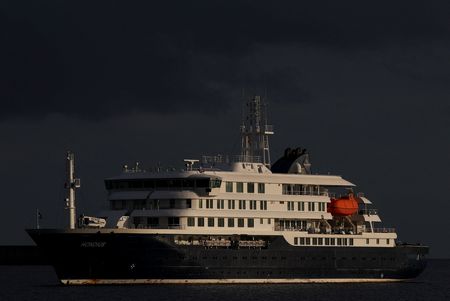

Australian officials announced Monday they will bring home citizens aboard a luxury cruise vessel where a fatal hantavirus outbreak has claimed three lives.
The MV Hondius, flying under a Dutch flag, remains anchored off Tenerife in Spain’s Canary Islands as international evacuation efforts continue. Environment Minister Murray Watt confirmed to ABC News that Australia has committed to evacuating a small group of its nationals along with one foreign resident requiring medical care, though he did not specify that person’s nationality.
“We have agreed to repatriate a small number of Australians… and also one resident of another country to Australia for medical treatment,” Watt stated.
Officials have not disclosed whether any Australians being evacuated have developed symptoms or contracted the illness. Australia’s foreign ministry has yet to provide additional evacuation details.
According to World Health Organization data from Friday, eight individuals who were previously aboard the cruise ship have become sick, with six cases confirmed as hantavirus infections. The outbreak has resulted in three fatalities: a Dutch couple and one German passenger.
Spain’s health minister indicated that the final two evacuation flights – one bound for Australia and another for the Netherlands – were scheduled to depart Monday afternoon local time. Earlier evacuations had already transported passengers to Spain, France, Canada, Turkey, the United Kingdom, Ireland, and the United States by Sunday evening.
New Zealand officials are still working with international partners to arrange evacuation for one of their citizens aboard the ship. Public Health Director Corina Grey said Monday that New Zealand’s health system is prepared to handle quarantine protocols if needed.
Health authorities are implementing a 42-day quarantine period for all passengers, following WHO recommendations. However, global health experts are urging the public to remain calm, emphasizing that this virus spreads much less easily than COVID-19 and presents minimal danger to the broader population.
The virus typically spreads through contact with infected rodents, though rare cases of human-to-human transmission can occur during close contact. Health officials in Johannesburg first identified the outbreak on May 2 while treating a British passenger who required intensive care. This occurred 21 days after another passenger had already died from the illness.
Once authorities confirmed the outbreak, the vessel departed Cape Verde waters on Wednesday and headed toward Spain. The ship had completed a journey from Argentina’s southern coast, crossing the southern Atlantic Ocean before reaching the Cape Verde islands.