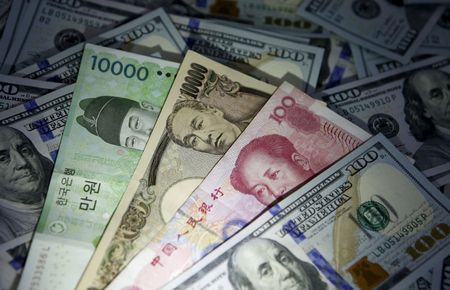

Two major Asian economies announced Saturday they’re prepared to take action as their national currencies continue sliding against the U.S. dollar amid escalating Middle East tensions.
Following their yearly conference in Tokyo on Saturday, Japanese Finance Minister Satsuki Katayama and her South Korean counterpart Koo Yun-cheol issued a joint statement declaring they “expressed serious concern over the recent sharp depreciation of the Korean won and the Japanese yen.”
Both the yen and won have weakened significantly as escalating conflict between the U.S.-Israeli coalition and Iran has pushed investors toward the dollar as a safe investment, particularly hurting nations that depend heavily on oil imports.
“Furthermore, they reaffirmed that they will closely monitor foreign exchange markets and continue to take appropriate actions against excessive volatility and disorderly movements in exchange rates,” their joint statement declared.
The Japanese yen hit its weakest point in 20 months on Friday and is approaching the 160-to-dollar threshold that market analysts believe could trigger Japanese intervention to strengthen their currency. Meanwhile, South Korea’s won crossed the significant 1,500-per-dollar mark this month for the first time since March 2009.
During a news conference following their discussions, Katayama acknowledged that both nations recognized substantial instability had developed in financial markets, particularly in currency trading.
“The Japanese government is fully prepared to respond at any time, bearing in mind the impact that currency moves may have on people’s livelihoods amid surging oil prices, and I believe both sides share that understanding,” she stated.
While Katayama frequently indicates Japan stands ready to address yen fluctuations, some officials privately acknowledge that attempting to strengthen the yen at this time might be ineffective, since dollar demand will likely continue growing if the Middle East conflict continues.