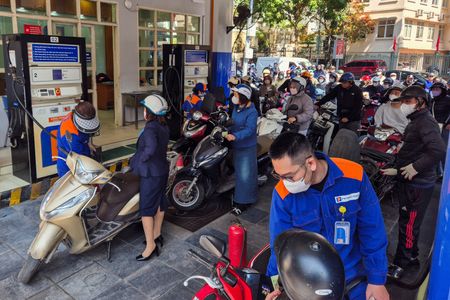

Asian countries are frantically negotiating fuel exchange agreements as ongoing Middle East conflicts severely impact energy deliveries to the region, with Indonesia’s president making a diplomatic visit to Japan this week as part of these urgent efforts.
The scramble for energy alternatives has intensified after China, the globe’s second-largest economy, banned fuel exports, while countries like South Korea and Thailand attempt to take advantage of temporarily relaxed U.S. sanctions on Russian energy as an emergency solution.
The situation has become dire for developing nations, with the Philippines becoming the first country to announce a national energy emergency, Sri Lanka reducing its work schedule to four days weekly, and Myanmar restricting vehicle use to alternating days.
Indonesia, which represents Southeast Asia’s largest economy and ranks as the world’s fourth most populated nation, has implemented comprehensive measures including fuel sales restrictions and encouraging remote work arrangements.
“To maintain rational economic relationships is of vital importance,” President Prabowo Subianto addressed Japanese business executives in Tokyo following agreements signed Monday for long-term oil, gas and geothermal energy projects.
“The geopolitical situation in the Middle East gives strategic uncertainty for the security of our energy.”
In more immediate terms, Jakarta may finalize an agreement to increase liquefied natural gas shipments to Tokyo in return for liquefied petroleum gas, a crucial cooking fuel, according to Djoko Siswanto, who heads oil and gas regulatory body SKK Migas, speaking to Reuters Monday.
Although Prabowo and Japan’s Sanae Takaichi agreed to strengthen energy security cooperation during Tuesday’s meeting, neither official verified such an exchange arrangement.
Japan’s government-supported energy company Inpex is negotiating a comparable trading agreement with India to exchange LPG for naphtha and crude oil, based on an internal Japanese government document obtained by Reuters.
Vietnam has similarly requested Japan’s assistance for energy supplies, the document revealed, while the Philippines announced Monday it had received diesel shipments from Tokyo.
Japan’s trade minister emphasized the critical nature of maintaining fuel deliveries to Southeast Asian countries where it operates supply networks, but refused to discuss specific agreements.
Energy-scarce Japan depends on Middle Eastern sources for approximately 95% of its oil and 11% of its liquefied natural gas imports, although its energy reserves rank among the world’s most substantial.
Australia’s status as a significant energy producer and exporter should provide it with negotiating power in discussions with Asian partners for jet fuel supplies that may soon become scarce, according to energy experts.
The government has been coordinating with major suppliers including China, Singapore and South Korea, Foreign Minister Penny Wong stated this month.
Nevertheless, China has prohibited refined fuel exports, including jet fuel, to protect its domestic economy from energy disruptions.
This prohibition, along with Thailand’s similar ban, has particularly affected Vietnam, as these neighboring countries supply over 60% of its jet fuel requirements.
Vietnam’s aviation regulatory body urged officials this month to pursue additional jet fuel sources from Brunei, India, Japan and South Korea.
Bilateral agreements with alternative suppliers should help alleviate shortages, but extended conflict would demand coordinated responses, according to Hiroshi Hashimoto, senior fellow at Japan’s Institute of Energy Economics.
“If the crisis continues for a prolonged period, Asian countries may need to develop multilateral frameworks to help each other and talk to alternative supply sources.”
Russia may emerge as an unexpected supplier for certain Asian nations following the United States’ temporary suspension of sanctions related to its Ukraine invasion.
South Korea imported Russian naphtha this week for the first time in years, a essential component for manufacturing plastics used in automobiles and electronics, and is also seeking crude oil access, its energy ministry reported.
India has increased oil purchases from Russia, with Bangladesh, Thailand and Sri Lanka also conducting negotiations.
Finalizing arrangements with Russian oil companies before the April 11 expiration of the U.S. sanctions waiver could prove difficult, noted Janaka Rajakaruna, chairman of Sri Lanka’s state-operated Ceylon Petroleum Corp.
Smaller nations like New Zealand recognize their vulnerability during an increasingly intense fuel competition expected to worsen in coming months.
Prime Minister Christopher Luxon has conducted phone conversations in recent weeks with leaders from Singapore, Malaysia and South Korea, New Zealand’s three primary refined product suppliers, as well as the European Commission head.
Associate Energy Minister Shane Jones told Reuters he has also reached out to major commodity trading companies, among others, in efforts to secure fuel supplies.
“Unless you build options, we’re too small to get noticed in a maddening, frenzied search for fuel in another two or three months,” Jones explained.