
HONG KONG (AP) — Financial markets across Asia displayed varied results Friday after Wall Street experienced modest declines, while crude oil prices dropped over $1 following their climb to the highest point since summer 2024.
American market futures showed slight gains as the conflict involving Iran reached its seventh day, with Israeli military strikes continuing to target Iran’s and Lebanon’s capital cities. The S&P 500 future contracts rose 0.2%, while Dow Jones Industrial Average futures climbed 0.3%.
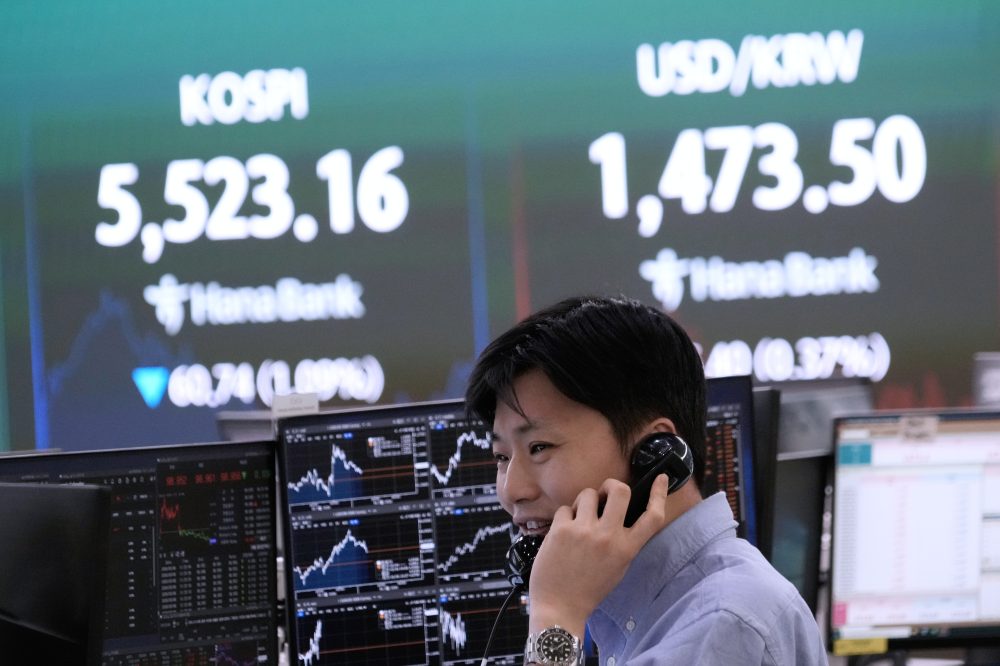
During Asian market hours, South Korea’s Kospi index dropped 0.8% to close at 5,536.40, capping off a turbulent week that saw a dramatic 12% plunge Wednesday followed by nearly 10% recovery Thursday. The benchmark had surpassed 6,000 points in recent weeks before military conflicts began disrupting market stability.
Japan’s Nikkei 225 posted gains of 0.4%, finishing at 55,518.63.
Hong Kong’s Hang Seng surged 1.6% to reach 25,713.49, while Shanghai’s Composite index posted modest growth of 0.1%, closing at 4,113.70.
Australia’s S&P/ASX 200 fell 1.1% to 8,845.30.
Taiwan’s Taiex declined 0.4%, while India’s Sensex dropped 0.6%.
Crude oil markets retreated Friday, providing relief from this week’s dramatic increases driven by production and supply concerns related to the Iran conflict. U.S. benchmark crude declined 1.2% in early trading to $80.07 per barrel, after reaching $81.01 Thursday.
International benchmark Brent crude fell 1% to $84.59 per barrel, following Thursday’s peak of $85.41.
Market experts warn that if crude prices surge to $100 per barrel and remain elevated, the global economy may struggle to absorb the impact. This uncertainty has triggered dramatic market fluctuations throughout the week, with conditions changing by the hour.
Friday’s crude price relief came after the U.S. granted a 30-day temporary exemption allowing Indian refineries to purchase Russian oil, according to ING analysts Warren Patterson and Ewa Manthey. While not a “game-changer,” they noted it demonstrates American efforts to control oil price increases.
Future oil pricing will depend on consistent restoration of petroleum shipments through the Strait of Hormuz after tanker operation disruptions, ING analysts explained. Approximately 20% of global seaborne oil travels through this critical waterway between Iran and Oman.
Thursday’s Wall Street session saw the S&P 500 decline 0.6% to 6,830.71. The Dow industrials dropped 1.6% to 47,954.74, while the Nasdaq composite fell 0.3% to 22,748.99.
Semiconductor company Broadcom’s stock surged 4.8% following better-than-anticipated quarterly earnings and revenue results, helping limit broader Wall Street losses.
Aviation sector stocks ranked among the biggest U.S. market decliners, as rising oil prices increase fuel expenses while hundreds of thousands of travelers remain stranded throughout the Middle East due to ongoing warfare.
American Airlines dropped 5.4%, United Airlines decreased 5%, and Delta Air Lines fell 3.9%.
In early Friday currency trading, the U.S. dollar strengthened to 157.80 Japanese yen from 157.56 yen. The euro remained flat at $1.1611.
Precious metals saw gains, with gold prices rising 1.1% and silver climbing 2.7%.