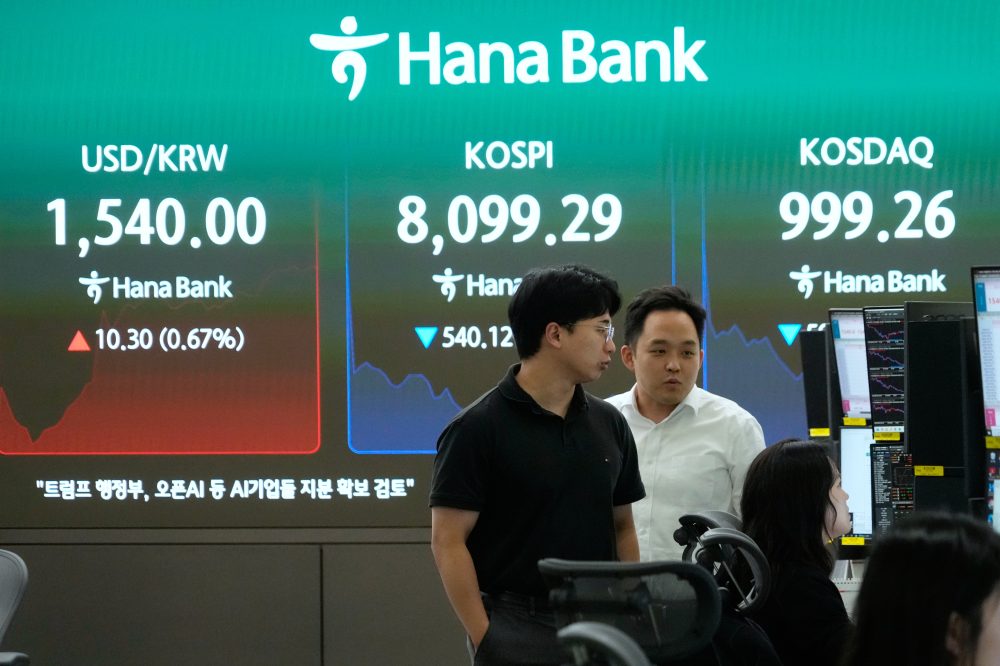

Stock markets throughout Asia experienced significant losses Friday, with South Korea’s primary index plummeting more than 5% following steep drops in major artificial intelligence companies on Wall Street.
Futures trading in the United States also showed declines.
Thursday’s trading session on Wall Street saw computer chip manufacturer Broadcom experience a 12.6% decline after the company issued forecasts that disappointed investor expectations, sparking worries about the broader artificial intelligence and technology industries.
Memory chip producer Micron Technology saw its shares fall 7.7%, while cybersecurity firm CrowdStrike Holdings declined 3.8%.
Despite these losses, the S&P 500 benchmark managed to rise 0.4% and the Dow Jones Industrial Average climbed 1.7% to reach a new record. The technology-focused Nasdaq composite slipped 0.1%.
However, Asian investors sold off major AI-related stocks, with South Korea’s SK Hynix tumbling 8.4% and Samsung Electronics losing 5.4%.
The Kospi index dropped 5.1% by midday trading to reach 8,185.62. This index has approximately doubled over the past year, boosted by gains in major technology companies.
Japan’s Nikkei 225 decreased 1.4% to 66,532.35, with technology stocks leading the downturn, despite official data revealing that Japan’s real wages increased for the fourth consecutive month. Chip equipment manufacturer Tokyo Electron saw its shares decline 7.2%.
Hong Kong’s Hang Seng fell 0.8% to 25,047.83, while the Shanghai Composite index rose 0.4% to 4,075.31.
Australia’s S&P/ASX 200 dropped 0.5% to 8,639.50.
Taiwan’s Taiex lost 1.5%, while India’s Sensex gained 0.2%.
Petroleum prices found stability after Thursday’s declines. Brent crude, the international benchmark, increased 0.4% to $95.42 per barrel. It had fallen to approximately $95.03 per barrel Thursday, compared to roughly $70 per barrel before the conflict began in late February.
U.S. crude benchmark traded 0.1% higher at $93.15 per barrel.
Robust corporate earnings and enthusiasm surrounding AI demand have helped drive some stock markets to record levels, despite ongoing disruptions from the Iran war. Oil prices remain pressured as the Strait of Hormuz, a critical waterway for global oil and natural gas shipments, stays effectively blocked, and the war-related energy crisis threatens to hamper economic growth and increase inflation across many nations.
American and Iranian negotiators achieved a preliminary agreement last week to extend their ceasefire, but the deal remains unfinished, while developments in Lebanon have raised questions about prospects for a lasting resolution to the conflict.
Thursday saw the Iran-backed Lebanese militant organization Hezbollah refuse the most recent ceasefire agreement between Lebanese and Israel governments.
“While there are few signs of progress in US-Iran talks, the oil market continues to trade on expectations of an imminent deal that would resume flows through the Strait of Hormuz,” ING commodities strategists Warren Patterson and Ewa Manthey wrote in a report.
Expectations regarding the U.S.-Iran negotiations may have been “overly optimistic,” they said.
In early Friday currency trading, the U.S. dollar declined to 159.97 Japanese yen from 160.03 yen. The euro traded at $1.1614, up from $1.1610.