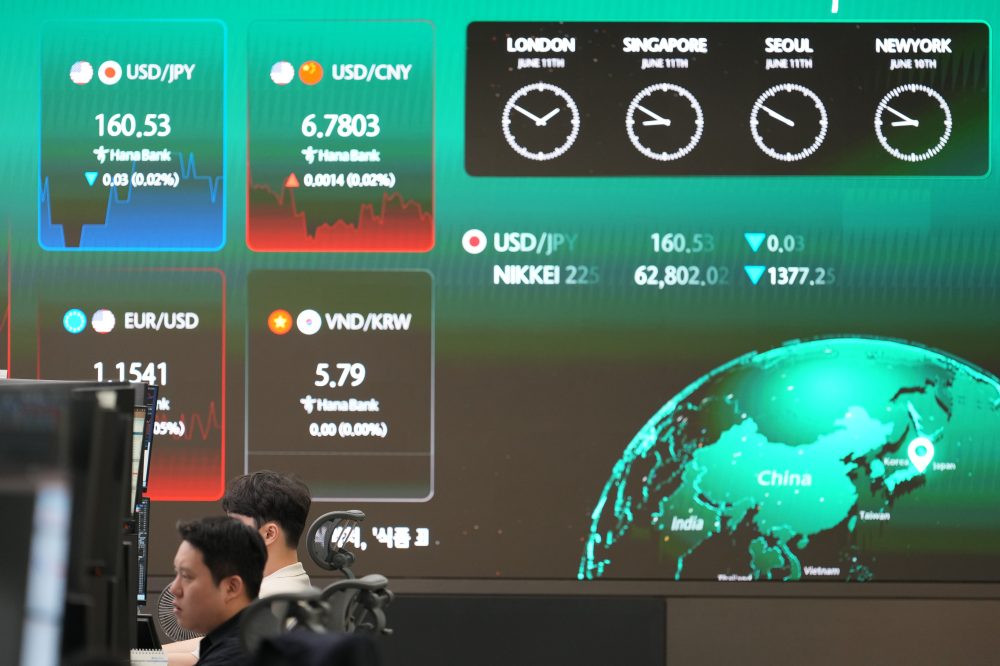

Asian stock markets experienced declines following a continued selloff in artificial intelligence companies that sent U.S. markets tumbling.
U.S. market futures showed gains while oil prices jumped more than $1 per barrel.
Japan’s Nikkei dropped 0.5% to 63,878.60, while South Korea’s Kospi declined 0.2% to 7,720.75.
Hong Kong’s Hang Seng managed a slight 0.2% increase to 24,468.82, though the Shanghai Composite index fell 0.2% to 3,983.80.
Australia’s S&P/ASX 200 also dropped 0.2% to 8,632.50.
Taiwan’s Taiex declined 0.4%.
On Wednesday, Wall Street’s previous high-performing stocks remained under intense pressure.
The S&P 500 fell 1.6% for its first consecutive decline in three weeks, closing at 7,266.99 and returning to early May levels.
The Dow Jones Industrial Average plummeted 953 points, or 1.9%, to 49,918.78. The Nasdaq composite led market losses with a 2% drop to 25,169.50.
Wall Street has experienced volatility since last week when AI stocks shifted from record-breaking gains to sudden declines. Concerns center on whether stock prices rose too rapidly due to artificial intelligence enthusiasm. The current question is whether this downturn has eliminated excessive investor optimism or signals the beginning of a prolonged decline.
Super Micro Computer, an AI server manufacturer, plunged 28% after announcing Tuesday evening plans to raise $7 billion through stock and convertible preferred stock sales. Such fundraising typically occurs when stock prices are elevated and can reduce existing shareholders’ ownership percentages.
Micron Technology experienced dramatic swings, moving from an early 4% loss to modest gains before settling at a 4.7% decline. The company has endured extreme volatility, dropping 7.7% last Thursday, falling another 13.3% Friday, then surging 9.9% Monday. Despite these fluctuations, the memory chip manufacturer’s stock remains up 212.5% year-to-date.
Nvidia, the semiconductor company that has grown to nearly $4.9 trillion in value due to the AI surge, was the S&P 500’s biggest drag after falling 3.7%. Broadcom, another AI beneficiary, was the second-largest negative influence with a 5.1% decline.
AI stock pressure may also stem from investors withdrawing funds in preparation for upcoming high-profile U.S. market debuts of several AI companies. SpaceX’s initial public offering could occur later this week, for example.
Companies with substantial fuel expenses also weighed on markets. United Airlines dropped 6.2%, while cruise operator Carnival fell 6.3% as oil prices climbed due to escalating conflict in the war with Iran.
Brent crude oil prices rose 1.8% to $93.10 on Wednesday after President Donald Trump warned Iran would “pay the price” for stalled war negotiations. The conflict has effectively closed the Strait of Hormuz to oil tankers, preventing Persian Gulf crude deliveries to global customers.
Rising oil costs have increased inflation, with Wednesday’s report showing U.S. consumer prices jumped in May at the fastest pace in three years.
Traders anticipate the Federal Reserve will need to raise its benchmark interest rate at least once this year due to pricing pressures and robust job market conditions.
Elevated yields can slow economic growth and reduce investment values across stocks and cryptocurrencies. They particularly impact investments considered overpriced, with some critics labeling AI as a bubble with excessive investment inflation.
Early Thursday, Brent crude oil gained $1.34 to $94.44 per barrel. U.S. benchmark crude oil increased $1.50 to $91.53 per barrel.
The U.S. dollar weakened to 160.44 Japanese yen from 160.56 yen late Wednesday. The euro strengthened to $1.1555 from $1.1537.