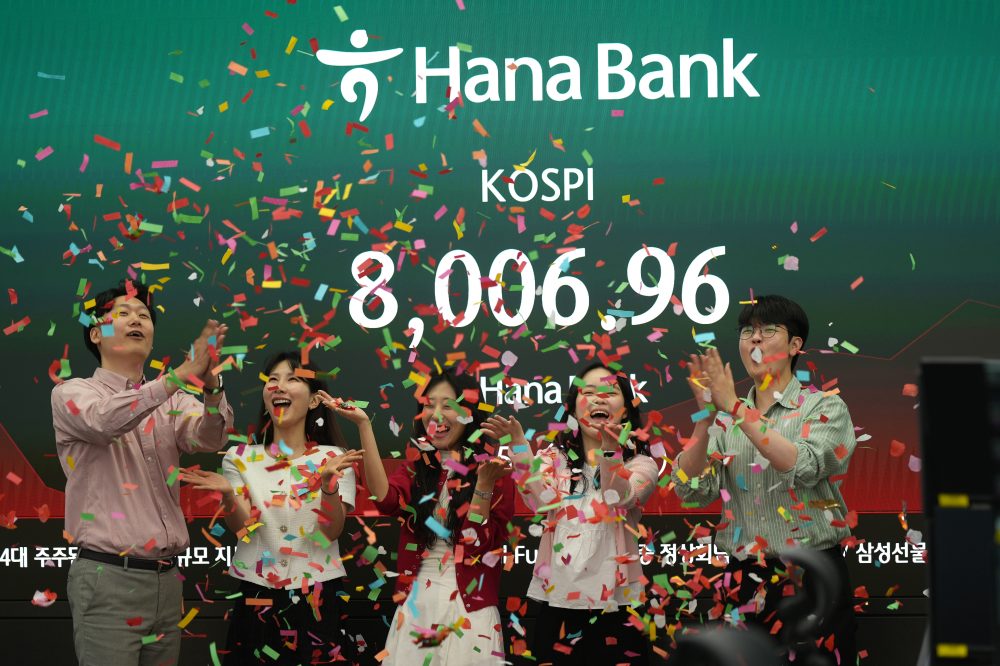

HONG KONG (AP) — Markets across Asia declined on Friday despite South Korea’s Kospi index achieving a historic peak before surrendering its advances, while investors monitored developments surrounding the Iran conflict and U.S. President Donald Trump’s Beijing summit with Chinese leader Xi Jinping.
American futures declined following Wall Street’s achievement of new record highs.
Japan’s Nikkei 225 dropped 1.2% to 61,880.04 despite earlier gains during the session. South Korea’s Kospi declined 3.2% to 7,727.34 after surpassing the 8,000 threshold for the first time and touching 8,046.78, driven partly by enthusiasm surrounding artificial intelligence developments.
The Hang Seng in Hong Kong decreased 0.9% to 26,145.66, while Shanghai’s Composite index gained 0.1% to 4,183.05.
The S&P/ASX 200 in Australia fell 0.1% to 8,629.70.
Taiwan’s Taiex declined 0.5%, while India’s Sensex rose 0.1%.
Trump is concluding his Chinese visit on Friday following multiple sessions with Xi that addressed topics including bilateral trade, expanded economic partnerships and Taiwan. Market participants are tracking updates on trade agreements covering American agricultural products like soybeans, beef and aircraft.
Despite positive sentiment regarding U.S.-China relations, some experts recommend approaching any agreements with caution. “Headline deals should be looked at with a healthy degree of scepticism,” wrote Leahy Fahy and Julian Evans-Pritchard, China economists at Capital Economics, in a Friday note.
Many of the announced projects and investments from U.S.-China agreements during Trump’s previous China visit in 2017 never came to fruition, they noted, as Washington-Beijing relations deteriorated significantly in subsequent years.
Trump also mentioned in an interview that China could purchase U.S. oil, more than a year after China essentially halted crude oil purchases from the United States following Trump’s implementation of significant trade tariffs last year.
Energy prices rose early Friday as U.S.-Iran negotiations on permanently ending the Iran war reached an impasse, and following the seizure of a vessel anchored near the United Arab Emirates and an attack on another cargo ship close to Oman.
Brent crude, the global benchmark, increased 1.3% to $107.06 per barrel. It was trading around $70 per barrel before the Iranian conflict began in late February.
U.S. benchmark crude rose 1.4% to $102.56 per barrel.
International energy transportation continues to face restrictions with the Strait of Hormuz, vital for worldwide oil and gas movement, remaining mostly blocked and as the U.S. established a naval blockade on Iranian ports since last month. The White House announced Thursday after bilateral discussions between Trump and Xi that both nations agreed the Strait of Hormuz must stay open.
On Thursday, Wall Street equities advanced with the S&P 500 benchmark climbing 0.8% to 7,501.24 and achieving a record high for the second straight day.
The Dow Jones Industrial Average increased more than 0.7% to 50,063.46, marking the first time it finished above 50,000 since the Iran war began. The tech-focused Nasdaq composite advanced 0.9% to 26,635.22.
Technology company Cisco Systems shares surged 13.4% after exceeding earnings expectations and announcing job cuts affecting fewer than 4,000 positions, while Nvidia gained 4.4% as investor optimism increased regarding updates on sales of its advanced H200 chips to Chinese companies as CEO Jensen Huang accompanied Trump to Beijing.
In currency markets, the U.S. dollar strengthened to 158.50 Japanese yen from 158.37 yen. The euro traded at $1.1651, declining from $1.1669.