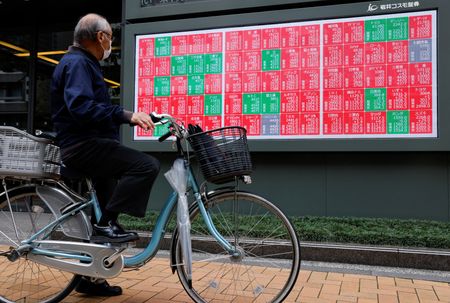

Markets across Asia experienced gains Wednesday morning, shaking off ongoing concerns about artificial intelligence investments that have been troubling global financial markets, while crude oil prices steadied following diplomatic developments between Iran and the United States.
New Zealand’s currency dropped significantly after that nation’s central bank indicated it would maintain supportive monetary policies to help their economy recover.
Japan’s primary Nikkei 225 stock index climbed 1.4%, ending a three-session decline, while Australia’s S&P/ASX200 advanced 0.5%.
Several major Asian markets including mainland China, Hong Kong, Singapore, Taiwan and South Korea remained shuttered for Lunar New Year celebrations.
European market indicators suggested modest opening gains, with Euro Stoxx 50 futures climbing 0.07%, German DAX futures adding 0.06% and FTSE futures increasing 0.14% to reach 10,529.
American stock futures also showed positive momentum, with S&P 500 e-minis gaining 0.06% to 6,864.8.
The optimistic Asian trading session came after a subdued Tuesday on Wall Street, where investors continued wrestling with questions about the artificial intelligence sector’s future.
Worries that corporations may be spending too heavily on AI technology, combined with anxiety about how the emerging technology might affect employment, have created market uncertainty in recent weeks.
Wednesday saw the benchmark U.S. 10-year Treasury note yield increase 1.7 basis points to 4.0712%. The 30-year bond yield rose 1.6 basis points to 4.7011%.
“AI uncertainty remains a source of volatility, both in terms of the difficulty in assessing which AI companies will be the winners and losers but also what sort of impact will AI have in other companies and sectors of the economy,” NAB analysts said.
Brent and West Texas Intermediate crude oil futures posted gains of 0.2% to 0.3% Wednesday, trading at $67.60 and $62.51 per barrel respectively, after both dropped to their lowest levels in over two weeks during the prior session.
After diplomatic meetings in Geneva Tuesday, Iran’s foreign minister announced that Tehran and Washington had reached agreement on key “guiding principles” toward settling their prolonged nuclear disagreement, reducing concerns about potential military action near the Strait of Hormuz that could interrupt worldwide oil distribution.
Gold recovered from early losses to trade 1% higher at approximately $4,926 per ounce, while silver jumped 2.15% to around $74.94 per ounce.
The U.S. dollar index, tracking the American currency against major trading partners, edged slightly higher during Asian trading hours to 97.22.
The traditional safe-haven currency maintained strength as global political tensions kept markets cautious and investors prepared for Federal Reserve meeting minutes from January, scheduled for release Wednesday, seeking clues about future interest rate decisions.
The euro slipped 0.1% to $1.1843, while the British pound held steady at $1.3555 after declining 0.5% in the previous trading session.
New Zealand’s dollar tumbled 0.8% to $0.5998 following the Reserve Bank of New Zealand’s decision to maintain interest rates at 2.25% during their first policy meeting of the year, with officials indicating supportive policies would likely continue indefinitely.
The Australian dollar weakened 0.2% to $0.7069, while Japan’s yen strengthened nearly 0.2% to 153.58 against the dollar.
Japan’s yearly bond sales are expected to increase 28% within three years due to growing debt-financing expenses, according to finance ministry projections reported Tuesday by Reuters.
Japanese officials estimate they will need to sell up to 38 trillion yen ($248.3 billion) in bonds during the fiscal year beginning April 2029 to cover the gap between government spending and tax collection, representing an increase from 29.6 trillion yen projected for fiscal 2026.