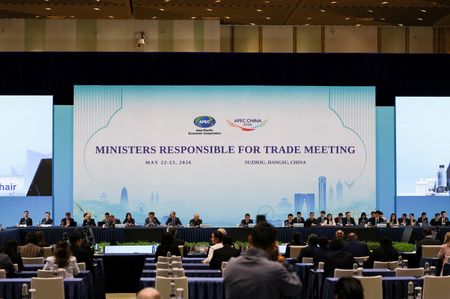

Trade officials from across the Asia-Pacific region have convened in the eastern Chinese city of Suzhou for discussions focused on strengthening economic cooperation amid mounting global tensions.
The two-day conference, which began Friday, brings together representatives from the Asia-Pacific Economic Cooperation nations – a bloc that handles nearly half of worldwide trade. Participants are addressing multilateral partnerships, trade imbalances, and how to build more resilient supply chains during times of international crisis, including the U.S.-Israeli war on Iran.
During Friday’s opening ceremony, Li Chenggang, China’s international trade representative and vice commerce minister, emphasized the importance of collaboration during uncertain times. “The more turbulent the times, the more we must adhere to seeking common ground while reserving differences, working together to overcome difficulties, striving to reach more consensus, leading the Asia-Pacific economy through the crisis and injecting confidence into the global economy,” Li stated.
The Suzhou meetings serve as preparation for this year’s annual APEC leaders summit scheduled for Shenzhen. Attendees are also examining ways to advance regional free-trade agreements, enhance digital commerce, improve artificial intelligence capabilities, and promote sustainable economic growth.
Li outlined this year’s conference priorities as “optimising institutional arrangements, cultivating momentum in emerging fields, jointly expanding the Asia-Pacific economic pie and ensuring fair distribution of that pie to achieve inclusive, mutually beneficial, and win-win outcomes.”
The gathering occurs against a backdrop of significant trade tensions. China recently reported a record trade surplus approaching $1.2 trillion for the previous year. Meanwhile, Group of Seven finance ministers recently reached consensus on addressing current trade imbalances, describing the situation as unsustainable. U.S. Treasury Secretary Scott Bessent has advocated for increased protections against an influx of low-priced Chinese goods.
The conference follows recent high-profile diplomatic visits to Beijing by U.S. President Donald Trump and Russian President Vladimir Putin. All three nations hold APEC membership.
APEC Business Advisory Council chair Li Fanrong addressed the gathering Friday, highlighting the economic pressures facing the global marketplace. Speaking for the business community, he called for a moratorium on additional trade restrictions to avoid creating more uncertainty. “The stakes could not be higher for business confidence, jobs, living standards and long-term prosperity in our region,” he declared.
Notable participants representing APEC’s 21 member economies include Rick Switzer, the deputy U.S. trade representative; Don Farrell, Australia’s trade minister; Kao Kim Hourn, ASEAN’s secretary general; and Taiwan’s top trade negotiator, Yang Jen-ni.
Japanese trade minister Ryosei Akazawa’s attendance marks the highest-ranking Japanese official visit to China since diplomatic relations deteriorated in November. A potential meeting between Akazawa and senior Chinese officials would represent the most significant diplomatic contact since Japanese Prime Minister Sanae Takaichi sparked controversy by suggesting Japan might respond militarily to a hypothetical Chinese attack on Taiwan.
Following those remarks, Beijing implemented various retaliatory actions, including discouraging Chinese citizens from traveling to Japan and restricting exports of certain rare earth materials essential for manufacturing electric vehicles, weapons, and other products.