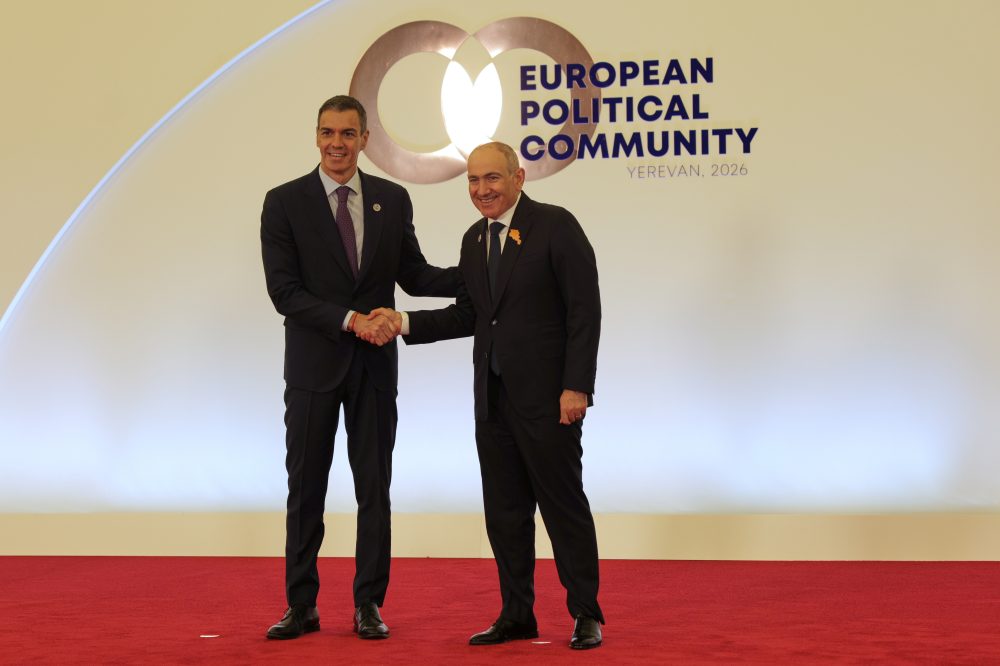

Armenia marked a significant diplomatic milestone Tuesday by hosting its inaugural bilateral summit with the European Union in Yerevan, signaling the Caucasus nation’s determined shift toward Western alliances while gradually distancing itself from Russia, its traditional partner.
The EU-Armenia summit took place following the eighth European Political Community gathering, which drew numerous European leaders to Armenia’s capital. During Monday’s discussions, officials tackled European security concerns and addressed the ongoing conflict between the U.S., Israel, and Iran.
These diplomatic gatherings highlight Armenia’s strategic pivot toward Western partnerships while reducing Russian influence. Relations between Armenia and Moscow, historically strong allies, have deteriorated significantly since 2023 when Azerbaijan successfully recaptured the Karabakh territory, ending decades of control by ethnic Armenian separatists.
Armenian officials blamed Russian peacekeeping forces stationed in the area for their inability to prevent Azerbaijan’s military campaign. Moscow, preoccupied with its Ukrainian conflict, dismissed these claims, maintaining that their forces lacked authority to intervene.
Richard Giragosian, director of the Regional Studies Center in Yerevan, told The Associated Press that the conflict served as “a belated demonstration that Russia is dangerously unreliable as a partner.”
Following these events, Prime Minister Nikol Pashinyan’s administration has actively pursued stronger Western relationships, an initiative the EU has embraced.
During Monday’s EPC conference, EU Council President Antonio Costa expressed gratitude to Pashinyan for “the courageous political decisions he has taken to bring Armenia closer to the European Union.”
“The direction of travel is unmistakable,” Costa declared, emphasizing the importance of “strengthen[ing] Armenian democracy and fight[ing] external interference and misinformation.”
EU Commission President Ursula von der Leyen highlighted Armenia’s strategic importance for European supply networks during her EPC address, noting the country’s role “specifically on the connectivity to the South Caucasus and Central Asia.”
In 2023, Armenia became a member of the International Criminal Court, prompting Moscow to denounce the decision as an “unfriendly step.” The court has issued an arrest warrant for Russian President Vladimir Putin, charging him with personal accountability for Ukrainian children’s abductions.
Armenia subsequently suspended its involvement in the Moscow-led Collective Security Treaty Organization in 2024.
The Armenian parliament later enacted legislation formally announcing the nation’s goal to pursue EU membership.
According to Giragosian, the EU has filled the role previously occupied by Russia, rather than the United States taking that position.
“EU engagement is much more prudent and much more productive than the U.S. becoming involved, simply because European engagement is less provocative to Russia over the longer term,” he explained.
Nevertheless, Armenia maintains membership in the Russia-led Eurasian Economic Union, which facilitates free movement of goods, capital, and workers among member states including Belarus, Kazakhstan, and Kyrgyzstan. Putin has clearly outlined the consequences of dual allegiances.
During earlier discussions with Pashinyan in Moscow this year, Putin cautioned that Armenia cannot maintain simultaneous membership in both the EEU and EU, highlighting that Yerevan currently receives Russian natural gas at significantly reduced rates compared to European market prices. While Pashinyan recognized this incompatibility, he stated Armenia could temporarily balance EEU membership with expanded EU cooperation.
Giragosian characterized Tuesday’s summit as “a focus on deepening the preexisting relationship” rather than advancing toward candidacy status, referencing the Comprehensive and Enhanced Partnership Agreement that has governed EU-Armenia relations since its full implementation in 2021.
“The symbolic significance is much greater as a message to Russia,” he noted.
However, Giragosian anticipates concrete outcomes from the summit. Expected announcements include funding for domestic reforms and military support through the European Peace Facility, a fund established primarily to assist Ukraine. An EU monitoring presence has operated along Armenia’s border with Azerbaijan for several years, and authorities recently approved a new mission addressing hybrid threats.
Pashinyan, who has served since 2018 and faces parliamentary elections in June, is positioned to gain politically from the international attention these European meetings generate. Giragosian observed that Pashinyan’s government will likely retain power largely due to the opposition’s failure to present a viable alternative platform.
However, Giragosian cautioned against viewing Armenia’s foreign policy solely as a transition from Russian to Western alignment.
“Armenia is also pivoting beyond the black and white zero-sum game paradigm,” he stated, referencing substantial diplomatic efforts in Asia, including partnerships with Japan, South Korea, and China. “This is not about replacing Russia with the West. This is much more innovative, much more sophisticated.”
The summit occurs during increased tensions between Azerbaijan and the EU. Last week, Azerbaijan’s Foreign Ministry called in the EU ambassador to object to a European Parliament resolution calling for Armenian prisoner releases and criticizing Armenian treatment in Karabakh. Azerbaijani lawmakers subsequently voted to halt all European Parliament cooperation.
Azerbaijan President Ilham Aliyev, who participated in the EPC conference through video connection, criticized the European Parliament and Parliamentary Assembly for the Council of Europe for “double standards” regarding sanctions on Azerbaijan’s PACE delegation.
Protests also occurred outside the heavily secured EPC summit location. Demonstrators displayed photographs of Armenian prisoners detained in Azerbaijan.
Opposition leader Aram Sargsyan, who heads the Democratic Party of Armenia, told the Armenian Press Agency that European officials were expressing pre-election support for Pashinyan while having “forgotten about the Armenians in prison in Azerbaijan.”