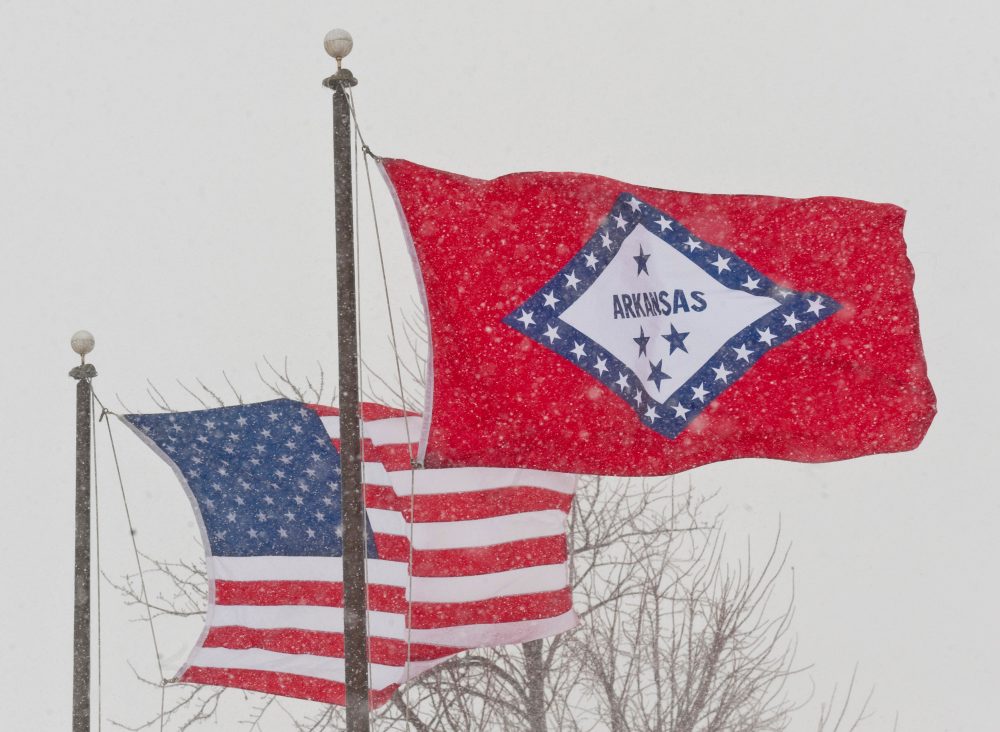

LITTLE ROCK, Ark. — Arkansas residents will head to polling stations Tuesday to select their party’s nominees across a wide range of federal, state and local races during primary election day.
The victorious candidates will advance to compete in the November midterm contests within a state where Democratic statewide victories have been absent since 2010. Beyond state-level positions, the Republican Party currently controls all four of the state’s U.S. House seats and maintains commanding majorities in both legislative chambers.
Senator Tom Cotton, seeking his third term as Arkansas’ Republican U.S. Senator, will compete against two challengers in his party’s primary. On the Democratic side, the nomination contest features Lewisville Mayor Ethan Dunbar against farmer and small business owner Hallie Shoffner.
Governor Sarah Huckabee Sanders, the Republican incumbent pursuing a second term in 2026, encounters no opposition in her primary race. Similarly, the state’s Republican lieutenant governor, attorney general, auditor and treasurer all run without primary challengers as they seek reelection.
The Democratic gubernatorial nomination pits State Sen. Fred Love against magazine publisher Supha Xayprasith-Mays in their effort to challenge Sanders this November. Xayprasith-Mays previously sought the nomination in 2022 but finished fourth in that Democratic primary.
Additional competitive primary battles will determine nominees for secretary of state, commissioner of state lands, two U.S. House districts, and over two dozen state legislative seats in both chambers.
Hotly contested statewide primary races have become uncommon in Arkansas during recent election cycles. Cotton faced no primary opposition in both 2014 and 2020, while Sanders and Republican U.S. Sen. John Boozman secured their 2022 primary victories with 83% and 66% of votes, respectively.
Pulaski County, which encompasses Little Rock, represents the state’s largest population center. As Arkansas’ most Democratic-leaning region — where Vice President Kamala Harris achieved her strongest state performance during the 2024 presidential election — Pulaski and similar Democratic-friendly counties typically exert greater influence in Democratic primaries compared to Republican contests.
During the 2016 GOP presidential primary, then-U.S. Sen. Marco Rubio of Florida captured over one-third of Pulaski County votes, sufficient to win the county against multiple opponents. However, despite strong showings in Pulaski and Benton County in northwest Arkansas, Rubio finished third statewide behind Donald Trump and U.S. Sen. Ted Cruz of Texas. While Pulaski represented Trump’s weakest county performance in 2016, he swept all Arkansas counties eight years later during his 2024 primary campaign against former United Nations Ambassador Nikki Haley.
Arkansas election law mandates that candidates receiving less than 50% of primary votes must compete in a March 31 runoff against the second-place finisher.
The Associated Press maintains its policy of avoiding projections and only declaring winners when no mathematical possibility exists for trailing candidates to overcome their deficits. Should races remain undecided, the AP continues reporting significant developments, including candidate concessions or victory claims, while clearly noting that no winner has been declared.
While Arkansas lacks automatic recount provisions, candidates may request and fund recounts, with costs reimbursed if results change. The AP may announce winners in recount-eligible races when determining that leads exceed margins that recounts or legal challenges could overturn.
Polling locations close at 7:30 p.m. local time, corresponding to 8:30 p.m. Eastern Time.
The Associated Press will deliver vote tallies and winner declarations for contested primaries including governor, U.S. Senate, U.S. House Districts 2 and 4, secretary of state, commissioner of state lands, state legislative races, plus a nonpartisan state Supreme Court position and special elections for state Senate District 26 and state House District 70.
Arkansas permits but doesn’t mandate party registration for voters. State law allows parties to establish specific eligibility criteria for primary participation. For 2026, Democratic Party rules permit registered Republicans to vote in Democratic primaries, while Republicans implemented a rule last June preventing registered Democrats from participating in Republican primaries.
Following the November 2024 general election, Arkansas maintained approximately 1.8 million registered voters.
The 2022 Republican primary drew roughly 348,000 participants, while about 94,000 voted in the Democratic primary. Early voting accounted for approximately 49% of Republican primary ballots and 52% of Democratic primary votes before primary day.
This year’s early voting totals show more than 61,000 Democratic primary ballots and approximately 125,500 Republican primary ballots cast through Saturday.
During the 2022 GOP gubernatorial primary, the AP began reporting results at 8:45 p.m. ET, just 15 minutes following poll closure. The final vote update occurred at 3:11 a.m. ET with roughly 98% of total ballots counted.
Historical patterns show counties typically release complete or near-complete early and absentee voting results in initial updates before reporting Election Day in-person voting totals.
Tuesday’s primaries occur 245 days before the 2026 midterm elections.