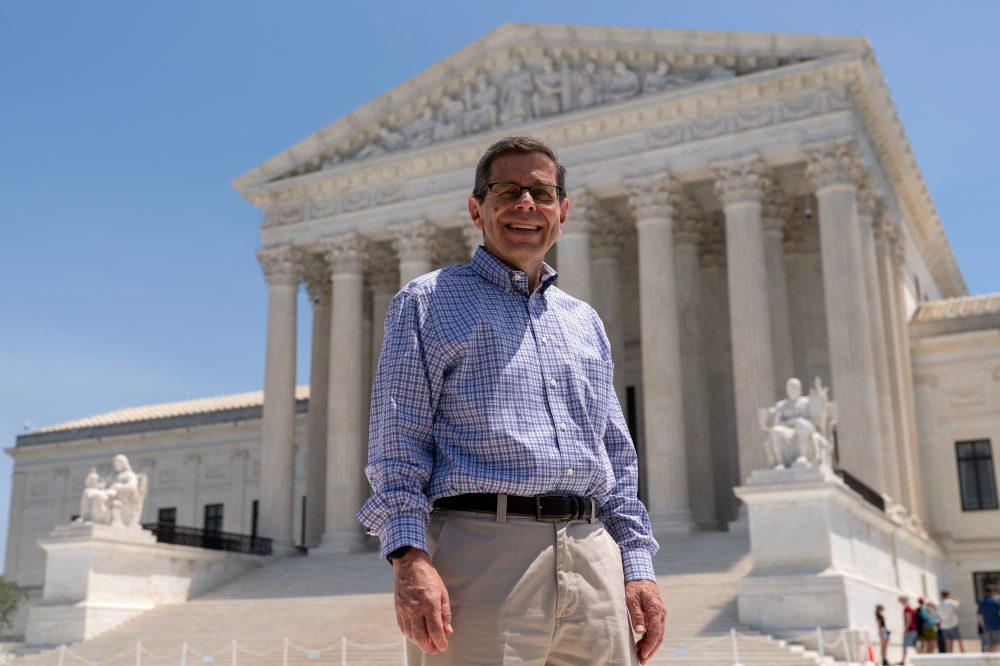

WASHINGTON — After spending two decades at the nation’s highest court, Associated Press Supreme Court reporter Mark Sherman stepped away from the beat on Tuesday — the final day of the court’s current term — offering a candid look back at the sweeping changes he witnessed firsthand.
Sherman’s first term on the job offered an early glimpse of what was to come. Justice Stephen Breyer broke away from his prepared remarks to deliver a pointed rebuke of his conservative colleagues from the bench.
“It is not often in the law that so few have so quickly changed so much,” Breyer said, dissenting in a school integration case.
For Sherman, it was a defining moment — both a window into the human side of the justices and a preview of the ideological battles that would play out over the next 20 years.
Over the course of his career, the court moved steadily to the right — a shift Sherman describes as driven by a combination of chance and deliberate political action. Unexpected vacancies, hardball political tactics, and the presidency of Donald Trump ultimately produced a conservative supermajority that reshaped American law.
When Sherman began covering the court in 2006, the ideological center had just nudged rightward, moving from Justice Sandra Day O’Connor to Justice Anthony Kennedy. Kennedy had joined O’Connor in preserving abortion rights in 1992 and was part of the five-justice majority that settled the 2000 presidential election in Bush v. Gore. He later authored landmark opinions expanding gay rights, including the ruling that established same-sex marriage as a constitutional right, as well as the Citizens United decision that opened the door to large-scale independent political spending.
The bigger transformation began in February 2016, when Justice Antonin Scalia died suddenly of a heart attack. Liberals anticipated a possible leftward turn for the court — one that might roll back gun rights and revisit campaign finance rulings. Justice Ruth Bader Ginsburg told Sherman that summer that abortion and affirmative action would be safe.
During a conversation in her court office — surrounded by modern art and personal mementos — Ginsburg expressed confidence that the next president would be Democrat Hillary Clinton. She suggested the next president, “whoever she may be,” could fill as many as three vacancies. When Sherman pressed her on what would happen if Clinton lost, Ginsburg replied: “I don’t want to think about that possibility, but if it should be, then everything is up for grabs.”
Ginsburg’s prediction proved partially correct. Clinton did lose — in part because conservative voters were focused on the future of the court. Senator Mitch McConnell, then the Senate Majority Leader, had blocked President Obama’s nominee, well-regarded federal appeals court judge Merrick Garland, from receiving a confirmation hearing, keeping the seat open until after the election. Garland had previously earned broad bipartisan support.
Donald Trump went on to appoint three justices, just as Ginsburg had anticipated. And as she warned, everything was on the table — including abortion and affirmative action.
Rather than covering the rise of a more liberal court, Sherman instead reported on the fulfillment of a long-running conservative legal agenda, to the satisfaction of Republicans who had spent decades working to reverse liberal precedents.
Timing retirements to ensure ideological continuity has become standard practice. Ginsburg chose to stay on the bench, and she died less than two months before the 2020 election. Her dying wish — that her seat remain vacant until after the election — was not honored. The two most recent justices to retire, Kennedy and Breyer, were each replaced by someone who had once served as their law clerk.
Sherman notes that is not a knock on Brett Kavanaugh or Ketanji Brown Jackson, both of whom have impressive legal credentials. Rather, it reflects how the prospect of a former clerk filling a vacancy may make a sitting justice more comfortable stepping down.
Chief Justice John Roberts once told Sherman — after Sherman asked whether he had any response to then-President Trump’s criticism of an “Obama judge” — that there are no Trump judges or Obama judges, only an independent judiciary. Sherman acknowledges there is truth in that. Judges do not mechanically side with the president who appointed them. Two Trump-appointed justices, for example, voted against the president’s sweeping global tariffs, drawing a sharp personal rebuke from Trump in response.
But Sherman also concedes Trump had a point. In the current era, presidents nominate justices precisely because their records suggest they can be relied upon. Since 2010, every conservative justice has been appointed by a Republican president, and every liberal justice by a Democrat.
The justices’ public profiles have grown in recent years. Seven of the nine have written or are in the process of writing books, going on promotional tours and collectively earning millions of dollars. That marks a notable change from an earlier era when justices moved around Washington largely unnoticed — Ginsburg spotted at movies and plays, Justice Clarence Thomas attending Mass most mornings, Justice Elena Kagan seen at a grocery store, and Justice Sonia Sotomayor encountered in line at a weekend farmers market on Capitol Hill.
Security has tightened considerably over the years. By the time Kavanaugh joined the court, federal agents were stationed outside his suburban Maryland home. In 2022, an armed man carrying a pistol, knife, and zip ties showed up at Kavanaugh’s residence late at night and later pleaded guilty to attempting to assassinate the justice.
The COVID-19 pandemic also changed how the court operates. For years, news organizations had requested live audio access to oral arguments and were consistently denied. When the pandemic forced the court to hold remote sessions, live public audio became a necessity. The experiment had its awkward moments — including an unexplained toilet flush that was broadcast to listeners — but it largely succeeded. When justices returned to the courtroom in 2021, the live audio stream stayed.
Sherman admits that change made his own role feel less essential. Anyone with interest can now listen to arguments directly and read decisions as soon as they are posted to the court’s website.
The rise of emergency appeals has also complicated the job. In years past, the court calendar made it easy to anticipate the busiest stretches. Now, emergency appeals — which came with notable frequency during Trump’s second term — can arrive and be decided at any hour, including well after midnight.