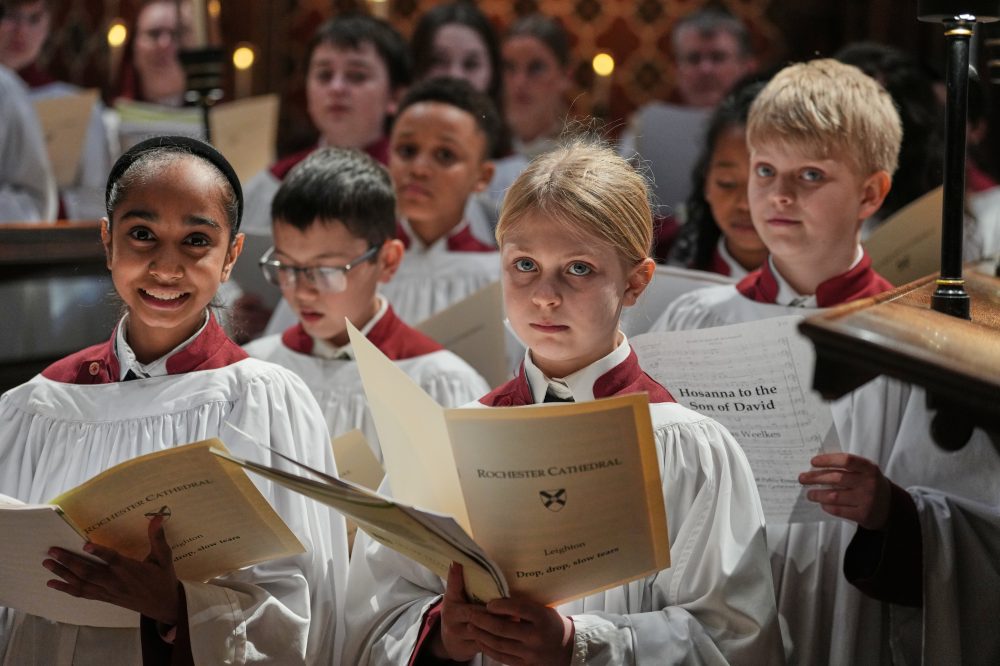

During a cloudy pre-Easter afternoon, approximately a dozen students filed into a Rochester Cathedral annex where an age-old ritual began to unfold.
The children shed their everyday school gear and donned traditional burgundy robes topped with white vestments. Moving into the main cathedral space, they lifted their voices in unified song. This casual group of youngsters had transformed into a formal choir, carrying forward an English church musical heritage that has remained virtually intact for nearly five centuries.
“I think for me, it’s one of the sounds of our country,” said Adrian Bawtree, the choir’s music director. “All of our cathedrals are beautiful, sacred spaces where you can come and just sit and be and you can be immersed, bathed, nourished, sent out back into the world transformed by an experience in 30 minutes.”
The pinnacle of this ancient practice is Choral Evensong, a twilight worship service featuring hymns, biblical psalms and spiritual prayers designed by Archbishop Thomas Cranmer, the Church of England’s initial Protestant leader, in 1549. During this ceremony, the choir provides all musical elements while worshippers participate through listening alone.
However, this centuries-old custom faces serious challenges as contemporary lifestyle pressures, shrinking religious participation and limited financial resources create obstacles in recruiting and developing future choir members.
Advocates are working to change this trajectory by promoting a governmental initiative to designate English cathedral music as significant British cultural heritage through a United Nations framework designed to safeguard “intangible cultural heritage” alongside physical monuments and environmental treasures.
British officials are currently collecting suggestions for a national catalog of cultural practices — ranging from Morris dancing to traditional stone wall construction — deserving preservation. Government leaders emphasize that protecting these customs strengthens local community bonds and supports the national economy through heritage tourism worth billions annually.
Though many recognize English cathedral music through the celestial sounds of young singers in ceremonial garments performing at royal ceremonies and Christmas celebrations, these choirs actually perform daily in far more modest environments.
Many face financial difficulties, reports the Cathedral Music Trust, established in 1956 to address post-World War II church music decline. The organization distributed 500,000 pounds ($661,000) to 28 religious institutions nationwide last year.
The expenses can be substantial. Rochester Cathedral allocates approximately 250,000 pounds ($330,000) annually for musical programs, representing a significant investment for a regional cathedral, though some spend considerably more.
Trust officials believe official recognition would generate public awareness and essential funding for these choirs, which serve as vital training centers for future musicians in both religious and secular fields.
“Whilst it happens every day, it is actually quite fragile,” trust CEO Jonathan Mayes said. “It takes an awful lot of work and it takes a lot of funding to actually make it happen and that doesn’t come without effort.”
Maintaining Evensong carries historical significance because these services played a crucial role in developing and spreading contemporary English language, explained Diarmaid MacCulloch, a Christianity scholar and emeritus Oxford University professor.
The ceremony draws from the Book of Common Prayer, created by Cranmer to establish English as the Church of England’s primary language following its separation from the Latin-focused Catholic Church during the Protestant Reformation.
The goal was establishing inclusive worship services for all participants.
“It is very much a drama, and it is a drama which has been performed by the people of England from 1549 through to the present day,” MacCulloch said. “It’s far more a vehicle of public consciousness performance than any play of Shakespeare.”
While increasing numbers of choirs like Rochester now welcome both male and female participants, most other aspects remain unchanged from centuries past.
“The service would be really quite recognizable to Queen Elizabeth I as much as Queen Elizabeth II,” MacCulloch said. “And that’s quite remarkable.”
Bawtree, Rochester Cathedral’s musical leader, dedicates himself to preserving this tradition while guiding the youngest performers, ages 9-13, called choristers, plus an older youth ensemble. Professional adult vocalists support both groups.
Bawtree recalls being captivated by church music during his first encounter with organ and choral sounds around age 9. Today he emphasizes that services like Evensong welcome anyone to experience exceptional choral performances regardless of personal faith.
“When I heard it, it was like big octopus arms came and grabbed me and said, ‘You’ve got to be part of this.’ So I think I am trying to speak to that 9-year-old child and saying actually this is something that could speak to most people, if not everyone.
“And because I had that experience, I would like to share that with future generations and be passionate about that,” he said. “We talk in the world of mindfulness and the power of music to transform lives. This is an extraordinary arena where that can happen.”