
BEIRUT — A security framework agreement between Israel and Lebanon may do more to cement an ongoing standoff than to resolve the deeper conflict between Israel and Hezbollah, according to regional analysts and politicians who say the deal’s central demand — that Hezbollah disarm — is simply not achievable.
The fundamental problem, analysts say, is that the agreement rests on a trade that doesn’t hold up: Hezbollah has outright rejected any notion of disarmament, and Lebanon’s government lacks the power to force the issue.
Because Hezbollah is unlikely to lay down its weapons, analysts argue that Israel now has political justification to maintain an indefinite military foothold in southern Lebanon — territory it entered after Hezbollah fired on Israel on March 2 in a show of solidarity with Tehran during the war in Iran.
The result, according to those analysts, is that Lebanon finds itself caught between obligations it has no means of fulfilling and a sovereignty it cannot fully reclaim.
The deal also runs headlong into Lebanon’s fragile political landscape. It asks a divided sectarian state to confront the most powerful armed group in the country — a task made even harder by Lebanon’s post-civil war system, which was built on power-sharing rather than confrontation.
“This is not an agreement, it is an imposed settlement,” said a senior Lebanese politician who asked not to be identified.
That politician added that the Lebanese army was neither built nor equipped to disarm Hezbollah, and that expecting it to do so ignores both the group’s deeply rooted military strength and the delicate sectarian balance that holds Lebanon together.
All the Weight on Lebanon
Political analysts say the agreement was designed with a fundamental imbalance — Lebanon is saddled with sweeping responsibilities while Israel faces no binding commitment to pull its forces out.
“This agreement has put all the burden on Lebanon,” said Michael Young, an analyst based in Beirut, who added that it “creates a structure that allows the Israelis to remain (in southern Lebanon) indefinitely.”
Fawaz Gerges, a Lebanese scholar at the London School of Economics and Political Science, went further, calling the deal “born dead” and structurally broken because it hinges on a condition that cannot realistically be met.
Gerges noted that Israel has already established a buffer zone roughly eight to ten kilometers — about five to six miles — deep in southern Lebanon, while making any future withdrawal contingent on Hezbollah’s disarmament. He warned that the deal risks turning that buffer zone into a permanent fixture with diplomatic cover, calling it a political “gift” to Israel.
The Lebanon conflict has been a key element in broader diplomacy surrounding the wider U.S.-Iran war. Gerges said Washington’s decision to treat the Lebanon situation separately from that larger conflict gave Israel more room to act freely in Lebanon.
Fears of Internal Strife
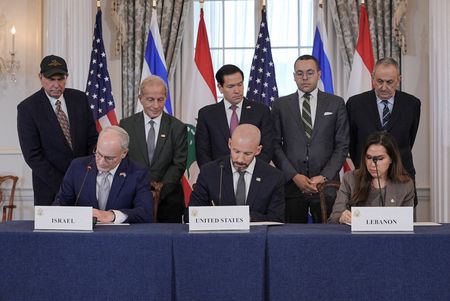
The framework agreement, signed in Washington, states that Israel makes no claim to Lebanese territory and links Lebanese army control in the south to the verified disarmament of non-state armed groups, including Hezbollah.
Netanyahu has described the deal as a historic achievement that could open the door to broader peace, even as Israeli troops remain in what Israel calls a security zone intended to shield northern Israel from attack.
“We will continue to hold it (territory in the security zone) until Hezbollah and other terrorist organisations are disarmed, and until no further threat to Israel is posed from Lebanon,” Netanyahu said on Saturday.
Three senior Israeli officials acknowledged that Israel has little confidence Lebanon can actually disarm Hezbollah, but they view the deal as an important diplomatic step toward eventual peace with Lebanon.
The human toll of Israel’s military campaign against Hezbollah has been severe — approximately 4,000 people have been killed in Lebanon and one million have been displaced.
Lebanese President Joseph Aoun welcomed the agreement as an initial step toward restoring Lebanese sovereignty, expressing hope that it would allow Lebanese citizens to return to fully liberated land.
Parliament Speaker Nabih Berri, however, called it an “agreement of dictates, not one that preserves Lebanon’s rights,” and declared it would not be carried out.
Hezbollah chief Naim Qassem declared the deal “null and void” and a “surrender,” vowing his group would continue fighting until Israel is compelled to leave. Hezbollah lawmaker Hassan Fadlallah raised the specter of “internal conflict” within Lebanon.
Analysts warn that any attempt to forcibly strip Hezbollah of its weapons could ignite dangerous sectarian tensions. Young said the deal “won’t lead us anywhere except to civil conflict, and maybe an insurrection by the Shi’ite (Muslim) community.”
Questions Surround Whether the Deal Can Work
Danny Citrinowicz, a regional analyst and former Israeli military intelligence officer, said Hezbollah’s dismantlement was “something that would never happen” and that the deal effectively gives legal standing to an open-ended Israeli military presence.
“Nothing will happen. Israel won’t withdraw, and Hezbollah won’t dismantle,” he said.
Citrinowicz argued that no Israeli prime minister has the political room at home to order a withdrawal while Hezbollah remains armed and communities in northern Israel remain displaced. He suggested a more limited agreement — one focused on pushing Hezbollah north of the Litani River, expanding the Lebanese army’s presence, and extending state authority — would have had a better chance of succeeding.
Pro-Hezbollah analyst Mohammed Obeid also expressed doubt the deal would ever be implemented, warning that its provisions were “like explosives” capable of blowing apart Lebanon’s internal stability, since they depend on the Lebanese state taking action against Hezbollah.