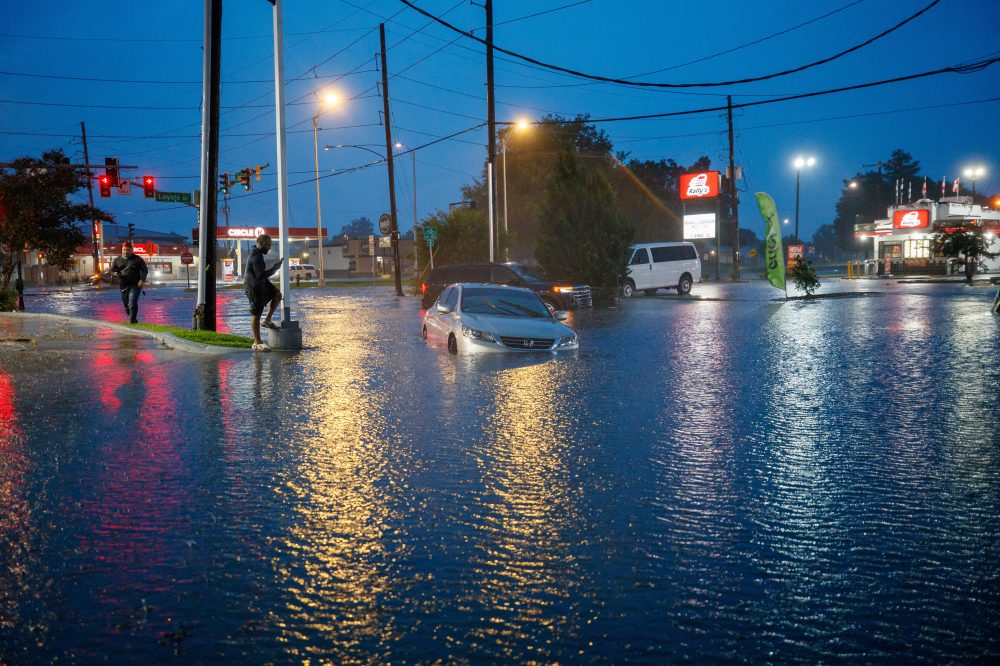

When catastrophic disasters hit communities across the country, Americans are increasingly finding themselves waiting weeks — sometimes months — before the president gives the green light on federal aid. And if they happen to live in a state that didn’t back President Donald Trump, the odds of being denied that assistance are significantly higher.
Since returning to the White House, Trump has signed off on roughly 65 major disaster declaration requests while turning down more than two dozen others from states, tribes, and territories seeking help in the aftermath of hurricanes, tornadoes, storms, floods, and wildfires.
An Associated Press analysis of federal data stretching back to 1989 — when a federal law establishing new guidelines for disaster determinations took effect — found that Trump is taking longer on average to approve disaster requests than any other president in that period. The analysis also found that no other president has shown such a stark difference in denial rates between politically supportive and opposing states.
These delays and rejections are happening as Trump’s administration considers a sweeping overhaul of the Federal Emergency Management Agency, which oversees the distribution of disaster assistance. Major disaster declarations are meant to cover events that exceed what state and local governments can handle on their own.
In his second term, Trump has denied a higher percentage of disaster requests than any president since 1989, and those denials have not fallen evenly across the country.
According to the AP’s review of FEMA data, Trump has approved 80% of disaster requests from Republican governors, compared to roughly 60% from Democratic governors. The gap becomes even more pronounced when looking at how states voted in the 2024 presidential election — Trump approved more than three-quarters of requests from states that supported him, but fewer than half from states that did not. While federal criteria exist for evaluating disaster aid, the final decision rests with the president.
Earlier this month, a round of denials hit four Democratic-led states — Massachusetts, New Jersey, New York, and Rhode Island — all of which had sought federal assistance following a February snowstorm.
Democratic U.S. senators and House members from Rhode Island responded with a joint statement, saying: “The President’s denial is part of a pattern of extreme partisanship as he tries to shift a heavier economic burden onto blue states. Disaster aid should be merit-based, not politicized.”
White House spokesperson Abigail Jackson pushed back, stating that “there is no politicization to the President’s decisions on disaster relief.”
Interestingly, during his first term, Trump actually approved a larger share of requests from states that had voted against him than from those that supported him. Still, no other president has displayed as wide a partisan gap in disaster declarations as currently exists under Trump’s second term. For comparison, during his second term, President Obama approved 87% of requests from Democratic governors and 79% from Republican governors — but his approval rate was the same regardless of how states voted.
When requests are turned down, the financial burden falls on individuals, insurance companies, and local governments to cover the costs themselves.
Since Trump began his current term, the AP found it has taken him an average of about six weeks to approve major disaster declarations after receiving a request. Because damage inspections and paperwork can take several weeks following a disaster, the total time people must wait often stretches beyond two months.
In contrast, Trump moved at an average pace of about three weeks during his first term — a speed similar to that of President Joe Biden. Presidents Barack Obama, George W. Bush, Bill Clinton, and George H.W. Bush all averaged less than two weeks to approve major disaster requests.
While all presidents have occasionally taken longer on certain requests, slow approvals have become standard practice in Trump’s second term. About 70% of Trump’s current approvals have taken at least a month — compared to roughly one-quarter during both his first term and Biden’s administration, and fewer than 10% under their predecessors.
Jackson said Trump conducts a more thorough review than previous administrations, “ensuring American tax dollars are used appropriately and efficiently by the states to supplement — not substitute — their obligation to respond to and recover from disasters.”
The longer the wait for a declaration, the longer displaced residents must go without federal help for basic living expenses, temporary housing, and home repairs. Local officials also face uncertainty about whether they’ll be reimbursed for debris removal and infrastructure repairs, which can slow down recovery efforts.
FEMA has cycled through four different temporary leaders since Trump returned to office in January 2025. One of them, Cameron Hamilton, is currently awaiting Senate confirmation to serve as the agency’s permanent director.
At a Senate committee hearing last month, Hamilton pledged to work toward faster disaster declaration decisions and reimbursements, and promised that FEMA would be objective, fair, and consistent in reviewing requests and making recommendations to the president.
Hamilton, a former Navy SEAL, had previously been fired from his role as FEMA’s acting director in May 2025 after publicly disagreeing with Trump’s suggestion of dismantling the agency. His return to consideration for the permanent role suggests the administration may now be leaning toward reforming FEMA rather than eliminating it entirely.
A council appointed by Trump has put forward a series of recommended changes to FEMA that would place more responsibility on individual states, which could result in fewer major disaster declarations and less federal money being distributed.
Among the recommendations is a revised eligibility standard that would require states, territories, and tribes to meet annual minimum spending thresholds before qualifying for a presidential disaster declaration.
Another proposal — which would need congressional approval — would lower the federal government’s minimum share of disaster costs from 75% to 50%, leaving states and local governments to cover more of the tab. However, the funding that is approved could arrive more quickly — within 30 days of a federal disaster declaration — rather than the current system where reimbursements based on documented expenditures can take months or even years to arrive.
For individual disaster survivors, the council recommended combining several types of assistance into a single payment aimed at people whose homes have been rendered uninhabitable.