
A dramatic public confrontation has erupted between President Donald Trump and Pope Leo XIV, marking an unprecedented clash between two of the world’s most influential American leaders. The dispute centers on the ongoing conflict in Iran and reveals stark differences in how each views warfare and diplomacy.
Trump launched a social media attack calling Leo XIV ‘Weak’ and influenced by the ‘Radical Left,’ even claiming the Pope owed his position to Trump’s influence. Meanwhile, Leo XIV has condemned Trump’s military threats against Iran as ‘truly unacceptable’ and has directed Catholics to scripture and church teachings about war and peace.
‘I’m not afraid of the Trump administration,’ Leo said Monday on the way to Africa, ‘or of speaking out loudly about the message of the Gospel, which is what the Church works for.’
This extraordinary public dispute involves two Americans wielding unprecedented global influence for the first time in history. Their conflict has deep roots.
EARLY POSITIONS: During Russia’s 2022 invasion of Ukraine, the future pope served as a bishop in Peru and didn’t hesitate to blame Moscow directly. On the Peruvian program ‘Weekly Expression,’ Prevost called it an ‘imperialist invasion in which Russia wants to conquer territory for reasons of power given Ukraine’s strategic location.’
This footage gained attention in Italian media after his papal election on May 8, 2025.
Earlier in 2025, Cardinal Prevost shared social media content criticizing Vice President JD Vance, a Catholic convert, for defending strict immigration policies by claiming Christianity prioritizes caring for family and citizens over foreigners.
‘JD Vance is wrong: Jesus doesn’t ask us to rank our love for others,’ read the headline the future pope shared.
SIGNIFICANCE: While Catholic bishops frequently comment in local media, they differ widely in their political specificity. Many limit themselves to broad doctrinal statements rather than challenging individual politicians. Prevost’s Peru comments and his rare social media sharing as a cardinal demonstrated his engagement with global affairs and willingness to speak directly.
TRUMP’S INITIAL RESPONSE: ‘Congratulations to Cardinal Robert Francis Prevost, who was just named Pope,’ Trump posted on Truth Social on May 8, 2025. ‘It is such an honor to realize that he is the first American Pope. What excitement, and what a Great Honor for our Country. I look forward to meeting Pope Leo XIV. It will be a very meaningful moment!’
Trump later told the White House press that ‘we were a little bit surprised and very happy’ with Leo’s election.
By Monday, he was claiming credit for Leo’s selection on Truth Social: ‘He wasn’t on any list to be Pope, and was only put there by the Church because he was an American, and they thought that would be the best way to deal with President Donald J. Trump.’
ANALYSIS: Trump views Leo through the lens of national pride and personal loyalty. His immediate interest in meeting Leo (which hasn’t occurred) reflects his typical attraction to power and celebrity, regardless of political compatibility. Trump’s perspective lacks understanding of Leo’s background or Vatican-U.S. relations.
The College of Cardinals has historically approached the U.S. with caution — particularly regarding Washington’s military and economic policies affecting global poverty, and general reluctance to give the papacy to someone from the world’s dominant superpower.
Leo was raised, educated and ordained in America but spent decades leading churches elsewhere, including impoverished South American regions. ‘He was the least American of the Americans,’ said Steven Millies, a professor at Chicago’s Catholic Theological Union, where young Leo earned his master of divinity.
LEO’S FIRST WORDS: ‘Peace with you all … the first greeting of the risen Christ, the Good Shepherd who gave his life for the flock of God.’
These were Leo’s initial words from St. Peter’s balcony. During his first Sunday blessing, he addressed Russia’s war on Ukraine and Israel-Gaza violence, lamenting a ‘third world war in pieces.’ The next Monday, Leo began a journalist audience by quoting Jesus. ‘In the Sermon on the Mount, Jesus proclaimed: ‘Blessed are the peacemakers,” the pontiff said.
SIGNIFICANCE: Leo’s earliest papal statements centered ‘peace’ as Jesus’s core message — previewing a major theme of his papacy. Mentioning Ukraine, Russia, Israel and Palestine showed his readiness to move beyond theory and apply doctrine to current global suffering.
LANGUAGE CHOICES: Equally significant as Leo’s peace-focused words were the languages this polyglot chose: None were English.
At his St. Peter’s Square introduction, Leo spoke Italian, then used Spanish to address Peruvian Catholics where he’d served. His Sunday blessing was in Italian. He briefly greeted journalists in English with obvious Chicago inflection, but quickly switched to Italian for his remarks. Even in recent reporter encounters, Leo opens in Italian before answering in English.
MEANING: While Latin and Italian are Vatican’s official languages, Leo’s conscious choice to use fluent Italian and Spanish emphasizes his role leading a global institution with 1.4 billion followers.
‘He doesn’t want to be perceived, I think, as coming from the American side or as relying on his authority as American,’ said Catholic University professor William Barbieri. ‘He wants to speak in the name of the church.’
EASTER CONFRONTATION: Trump intensified Iran threats around Easter, when Christians commemorate Jesus’s resurrection. Leo used his Palm Sunday message to call Jesus the ‘King of Peace’ and say God ‘does not listen to the prayers of those who wage war, but rejects them, saying: ‘Even though you make many prayers, I will not listen: your hands are full of blood.”
Trump hosted conservative religious leaders at the White House for Holy Week observance. His spiritual adviser Paula White compared the president to Jesus, saying they’re both persecuted figures who endured.
In Rome, Leo washed others’ feet, as the Last Supper records Jesus doing for his disciples. Speaking to reporters, Leo named Trump directly for the first time and said he hoped the president would seek an ‘off-ramp’ in Iran. On Easter, Trump threatened extensive bombing of Iran’s civilian infrastructure and destruction of a ‘whole civilization.’ Leo called that threat ‘truly unacceptable.’
SIGNIFICANCE: Their contrasting viewpoints and personalities, combined with the Iran war’s seriousness, finally eliminated any possibility that Trump and Leo could avoid direct engagement.
CURRENT EXCHANGE: In Trump’s Sunday post attacking Leo as ‘weak,’ among other criticisms, the president said, ‘I don’t want a Pope who criticizes the President of the United States because I’m doing exactly what I was elected, IN A LANDSLIDE, to do.’ He added that Leo should ‘focus on being a Great Pope, not a Politician.’
Leo, meanwhile, reiterated that he’s not speaking politically.
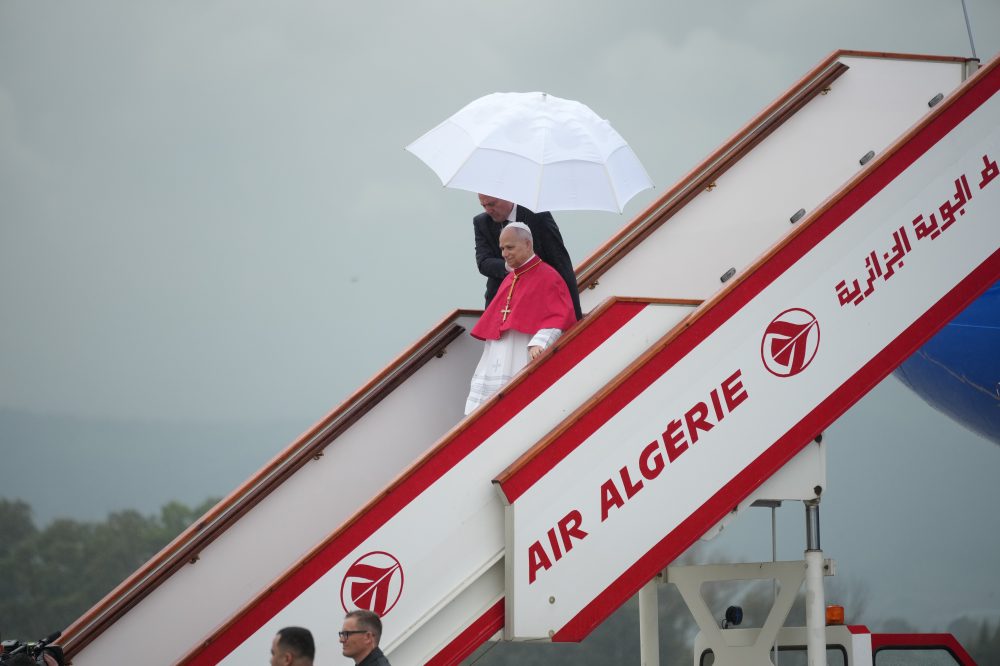
‘To put my message on the same plane as what the president has attempted to do here, I think is not understanding what the message of the Gospel is,’ Leo told The Associated Press aboard the papal flight to Algeria. ‘And I’m sorry to hear that but I will continue on what I believe is the mission of the church in the world today.’
BROADER IMPLICATIONS: This represents an unusual situation for the papacy, whose occupants typically comment on global affairs without specifically naming secular politicians. While Trump routinely attacks perceived enemies, these dynamics are uncommon for him too: This time, Trump is confronting someone who rejects the president’s terms and faces no political pressure to comply.