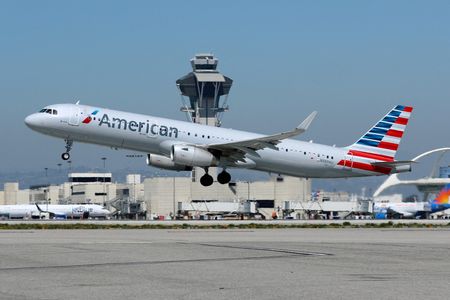

American Airlines plans to maintain its current annual profit projections despite facing a significant increase in fuel expenses, according to company leadership speaking at an investor event Wednesday.
Chief Executive Officer Robert Isom told attendees at a Bernstein investor conference that the airline is “not making any changes” to its financial outlook, even though elevated fuel costs are projected to increase expenses by $4 billion to $5 billion during the current year.
The executive noted there was “no doubt” that travel patterns show a K-shaped recovery, with affluent passengers traveling at higher rates compared to middle- and lower-income customers.
However, Isom reported that travel is expanding across all income levels, with the airline approximately 80% booked for the second quarter, business travel increasing 13% compared to the previous year, and leisure travel demand described as “incredibly” robust.
Company stock prices climbed roughly 1% during afternoon trading sessions.
The airline previously reduced its 2026 profit projections last month when jet fuel expenses climbed, announcing expectations for fuel costs to increase by more than $4 billion annually. The company now forecasts 2026 results between a 40-cent per share loss and a $1.10 per share profit, compared to earlier projections of $1.70 to $2.70 per share profit.
Isom projected second-quarter revenue would climb 15% from the same period last year with approximately 5% capacity expansion, suggesting around 10% unit revenue growth.
The carrier has consistently lagged behind competitors Delta Air Lines and United Airlines in profitability metrics for several years, creating concerns among labor unions and shareholders.
To address this performance gap, the airline has increased spending on premium services and customer improvements as part of efforts to boost revenue streams.
The company is expanding premium offerings, with Isom stating that premium seating capacity would expand at double the pace of standard cabin seating, while lie-flat seats would grow nearly 50% during the next three years.
According to Isom, the airline’s financial recovery hinges on revenue performance. He said the company anticipates maintaining much of its recent revenue gains through premium upgrades, sales and distribution modifications, stronger hub operations, and baggage fee income.
While maintaining projections that span from losses to profits, Isom expressed confidence that the airline would “repeat the profitability we had last year.”
Domestic carriers are also receiving benefits from a more constrained market following the departure of a major discount airline, which removed low-cost capacity and supported fare levels in certain markets. The ultra-low-cost carrier, known for aggressive pricing, stopped operations earlier this month after unsuccessful attempts to secure creditor backing for a government assistance package.
Isom reported that the airline experienced a temporary increase in basic economy fare purchases following the competitor’s exit, though this impact has since stabilized. He noted the defunct carrier represented approximately 1.5% of market share at the time of closure.
Challenges facing ultra-low-cost airlines stem from increasing operational expenses and broader efforts by major network carriers to compete across multiple fare categories through basic economy options, customer loyalty programs, airport lounges, and premium cabin services, according to Isom.
The executive clarified he was “not out here declaring ULCCs are dead,” but emphasized that the airline’s size, route network, and service offerings provide competitive advantages as consumers continue investing in travel experiences.