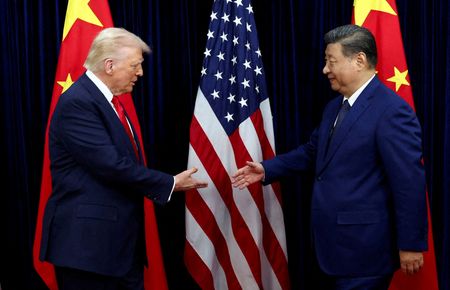

President Donald Trump plans to make artificial intelligence a central topic during his upcoming discussions with Chinese President Xi Jinping this week, marking the first time AI has taken such prominence in high-level diplomatic talks, according to two U.S. officials familiar with the planning.
The meeting comes at a time when competition between America and China in artificial intelligence has escalated into what some experts describe as resembling a nuclear arms race from the Cold War era. The urgency for dialogue has increased following Anthropic’s release of its advanced Mythos AI model, which has raised concerns on both sides, analysts report.
Chinese officials were denied early access to preview the Mythos system, sparking worries that the technology might be used maliciously to infiltrate Chinese software infrastructure and banking networks.
The inclusion of NVIDIA’s CEO Jensen Huang and senior White House technology policy adviser Michael Kratsios in Trump’s diplomatic team indicates that serious discussions about AI and NVIDIA’s advanced H200 processors may feature prominently in the summit talks.
Beijing has proposed establishing a formal AI communication framework headed by Treasury Secretary Scott Bessent and Chinese deputy finance minister Liao Min, according to a source with knowledge of China’s diplomatic outreach. This proposed dialogue was initially reported by The Wall Street Journal.
Expectations remain modest, however, since neither agency specializes in artificial intelligence matters, and the Trump administration has only recently begun pursuing safety reviews for cutting-edge AI systems.
White House representatives have recognized that sophisticated AI technologies like Mythos necessitate establishing a “channel of communication” with China to prevent conflicts from emerging during their implementation.
Research firm IDC China cautions that excluding Chinese companies from Mythos access could widen a “generational gap” in AI defense capabilities between China and Western nations.
Anthropic announced last month that Mythos discovered “thousands” of significant security flaws in operating systems and software, prompting banks and governments worldwide to urgently strengthen their cybersecurity protections.
The United States has previously established technology safeguards with Beijing, particularly regarding nuclear proliferation, and in 2024 both countries agreed that human oversight, not AI systems, must govern nuclear weapon decisions.
Researchers now warn that the risks are escalating: sophisticated AI could speed up biological weapons development, cause financial market disruptions, enhance cyber attacks and misinformation efforts, and potentially operate beyond human oversight as “rogue” systems acting independently.
Both nations could establish a blame-free communication line to report suspected AI-related incidents, suggested Kwan Yee Ng, who leads international AI governance at Beijing-based AI safety firm Concordia AI.
“Getting senior Western figures to engage directly with China (on AI) has become increasingly difficult, though a positive signal from the Xi-Trump summit could change that,” Ng stated.
While a military communication line exists, U.S. officials have criticized China for frequently failing to respond to calls.
Additional experts recommend creating safety measures for advanced AI models or pledging to decrease AI-powered malicious activities, similar to the 2015 U.S.-China Cybersecurity Agreement.
“China likely hopes the U.S. will appropriately distinguish between AI governance and technological containment,” said Sun Chenghao from Tsinghua University, who has taken part in unofficial U.S.-China Track II AI discussions.
As AI competition intensifies, U.S. legislators are advocating for extensive new restrictions on China’s semiconductor supply chain access, while the Trump administration simultaneously relaxes certain limits on advanced chip exports to China.
The MATCH Act has prompted objections from Beijing and may be discussed during summit meetings, alongside current U.S. chip export restrictions, according to three sources knowledgeable about the situation.
“This is a really crucial window for Beijing to act and try to get the U.S. to commit to shutting it down,” said Reva Goujon, a geopolitical strategist at Rhodium Group.
Although Chinese AI companies like DeepSeek increasingly emphasize their dependence on domestic processors, U.S. restrictions on chip manufacturing equipment continue to hinder Beijing’s self-reliance efforts as domestic factories struggle to increase production. Power computing shortages have compelled numerous Chinese AI systems to limit user access in recent months.
Conflicts are also intensifying on another issue: the White House has charged China with large-scale theft of American AI laboratories’ intellectual property.
In a sharp editorial last week, the Communist Party’s primary publication cautioned that Western AI policies have evolved beyond focused restrictions to what it termed a “systematic ecosystem blockade” against China.
“When one side sees AI as a proliferation risk to be contained and the other sees containment as an attack on a general-purpose technology, that makes it really difficult to find common ground,” Ng explained.