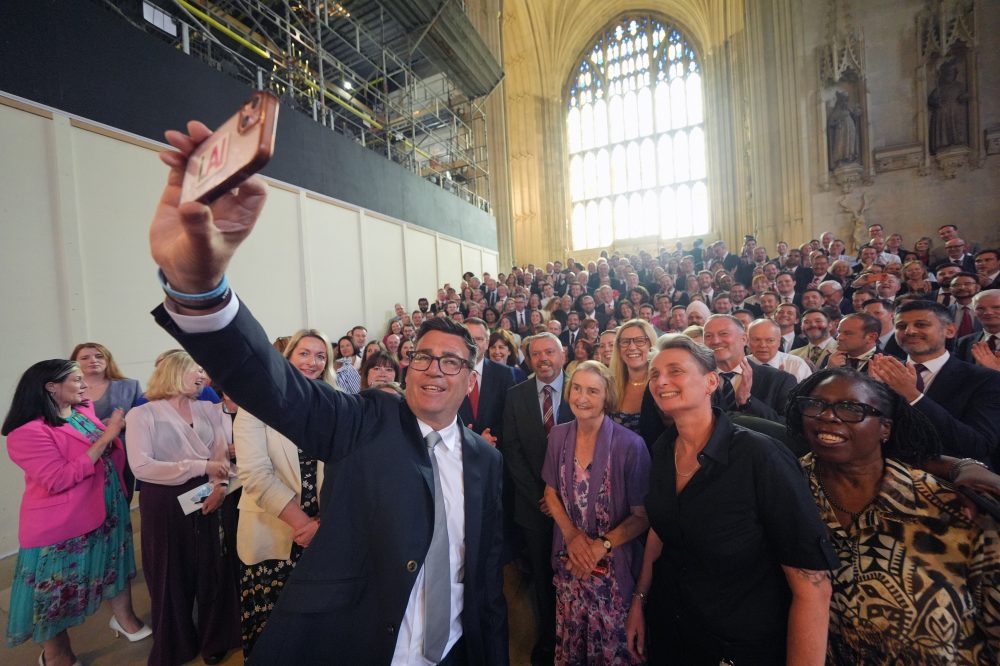

LONDON (AP) — Andy Burnham, Britain’s newest member of Parliament and the man most likely to become its next prime minister, spent Tuesday meeting with fellow Labour Party members as he gears up for a leadership race that could end before it even begins.
Burnham holds a commanding lead in the contest to succeed Prime Minister Keir Starmer, who announced Monday that he plans to step down within weeks. Starmer’s two years in office were clouded by a series of poor decisions and misjudgments that steadily damaged his standing with both the public and his own party.
A former Cabinet minister, Burnham served as mayor of Greater Manchester from 2017 until recently. He won a special parliamentary election last week specifically to position himself to challenge Starmer for the top job.
His path to the leadership became even clearer on Monday when former Health Secretary Wes Streeting — widely seen as Burnham’s chief rival — threw his support behind him instead of launching his own bid.
Under Britain’s parliamentary system, a governing party can swap out its leader — and by extension, the prime minister — without triggering a national election. The next scheduled general election is not required until 2029.
Labour’s leadership nomination window opens July 9 and closes one week later. Should Burnham be the sole candidate, he could be installed as prime minister as soon as July 17. If a competitive race does develop, a winner is expected to be in place by September 1, when Parliament resumes after its summer recess.
As Manchester’s mayor, Burnham earned a strong reputation, guiding the city through a period of significant growth and revitalization. He has promised to bring his distinctive governing philosophy — which he calls “Manchesterism” — to the national stage.
Many within Labour hope Burnham’s personality and ability to connect with everyday people will prove more effective than Starmer’s more reserved, bureaucratic style. However, his stances on many policy issues remain largely undefined and untested, prompting some Labour lawmakers to call for a full leadership contest that would force him to face public debate and scrutiny.
Burnham is expected to deliver a speech next week laying out elements of his economic agenda.
Former Armed Forces Minister Al Carns, who resigned earlier this month over what he described as insufficient defense spending, said the country needs “a clear and concise discussion about what this country wants to be.” Carns has hinted he could enter the leadership race but told broadcaster ITV, “I’m not ready to make a decision on this in any way, shape or form.”
Some Labour members have floated the idea of Darren Jones, a senior Cabinet minister and close ally of Starmer, entering the contest, though Jones has not yet made any public statement on the matter.
Any candidate hoping to run must secure the backing of at least 81 Labour lawmakers — one-fifth of the parliamentary party — to qualify.
Many party members argue that a drawn-out leadership battle would only highlight Labour’s internal divisions and prolong political instability. “I think the transition should be swift and orderly,” Cabinet Office Minister Nick Thomas-Symonds told the BBC.
Starmer stepped down Monday following a weekend of reflection, acknowledging that the Labour Party no longer believes “I am best placed to lead us into the next general election.” He becomes the sixth prime minister in ten years to announce a departure from outside No. 10 Downing Street — a milestone that coincides with Britain marking a decade since its historic vote to leave the European Union, a decision that continues to shape the country’s economy and political landscape.
After weeks of publicly insisting he intended to fight for his position, Starmer ultimately yielded to mounting pressure to hand the reins to someone capable of turning around the government’s struggling fortunes. While he led Labour to a sweeping election victory in July 2024, his approval ratings and those of the party have fallen sharply since then.
Starmer faced persistent difficulties in delivering on promises of economic growth, fixing deteriorating public services, and reducing the cost of living. His tenure was also damaged by controversies, including his appointment of Peter Mandelson — a figure with a scandal-filled past and reported ties to Jeffrey Epstein — as the UK’s ambassador to the United States.
Labour is currently being squeezed on two fronts: losing progressive voters to an expanding Green Party while simultaneously facing a surge from Reform UK, the anti-immigration party led by Nigel Farage that has consistently topped national opinion polls.