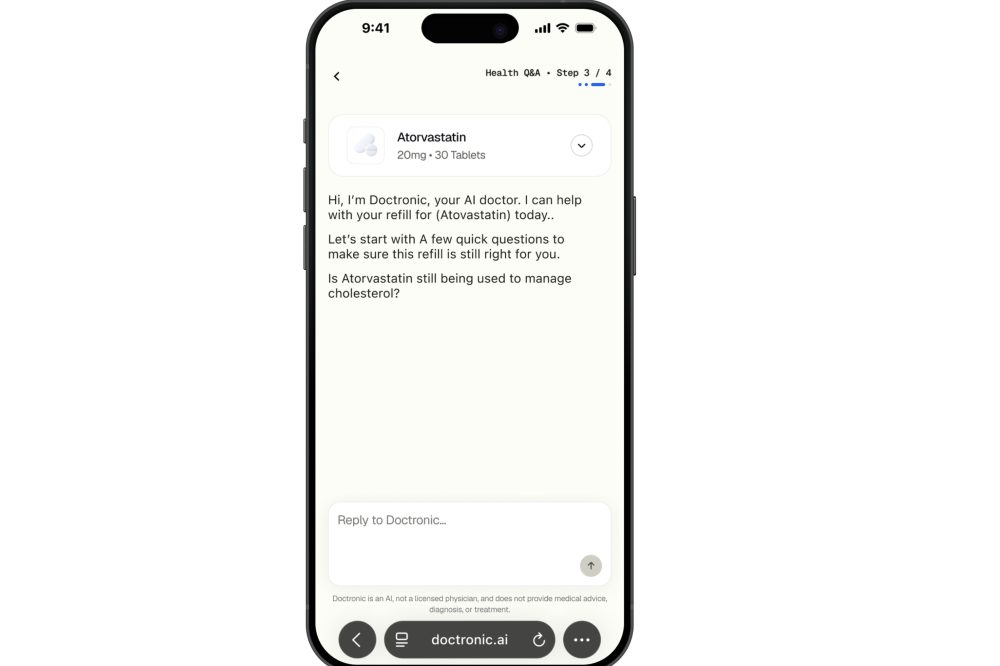

A prescription refill program that launched quietly in Utah earlier this year has sparked a major debate in the medical community: Is artificial intelligence truly ready to handle tasks that have always required a licensed physician?
Through the program, Utah residents can bypass a doctor’s office entirely and use an AI chatbot called Doctronic to get their prescriptions renewed online. While it may sound like a straightforward convenience for patients, the pilot program has raised serious alarms among physicians, legal experts, and public health professionals.
At the heart of the controversy is a long-standing legal principle: only licensed medical professionals are allowed to prescribe medications. Supporters of the program argue that those laws — which have shaped American medicine for more than a century — need to be updated to account for AI technology.
“We have crossed a threshold in terms of giving something that is not human a medical license, whether or not we want to call it that,” said Dr. Eric Bressman of the University of Pennsylvania.
Bressman and others aren’t necessarily opposed to AI playing a role in prescribing, but they argue it should be held to the same high standards as human doctors, who must complete years of rigorous training and testing before earning a medical license.
Doctronic was able to launch in Utah through what the state calls a “regulatory sandbox” — a mechanism that allows officials to waive existing laws for AI companies with promising technology. The program is currently managed by a five-member board made up of AI specialists, none of whom are medical doctors. The board says various safety measures are in place, including having human physicians review all refill orders during the initial phase. The company expects to move toward fully automated refills in the near future.
The chair of Utah’s medical licensing board revealed that he and fellow board members only found out about the program when its January launch was covered in the news. In March, 11 board members signed a letter calling for the program to be suspended, pointing to the dangers of automatically renewing medications that can cause harmful side effects or dangerous drug interactions.
“We were essentially told: ‘Yes this is going on. And no, you don’t have a say in it,’” said Dr. Alan Smith, a family physician who chairs the board, though he noted he was speaking in a personal capacity.
Adding to the complexity is the fact that medical technology is typically regulated at the federal level, while the licensing of medical professionals falls under state authority. Doctronic’s leadership views their AI as part of state-regulated medical practice, but some experts believe the federal Food and Drug Administration should have oversight since the technology directly affects medical decisions. When asked in an interview, Doctronic’s executives declined to say whether they had sought approval from the FDA.
“Our goal here is really just to meet patients where they need healthcare,” said Dr. Adam Oskowitz, who co-founded the company alongside a technology entrepreneur. “We try not to get too deep into the weeds on the regulatory side.”
Here’s how the program works: Utah residents visit a Doctronic website, confirm their identity, and answer the chatbot’s questions about their prescriptions and medical history. The AI checks a national pharmacy database to confirm a valid prescription exists. If everything looks routine, it renews the prescription and sends it to a local pharmacy. If a case needs more attention, the patient is connected with a doctor through Doctronic’s telehealth service.
Oskowitz has described a future in which AI handles many routine medical tasks — including ordering tests and reviewing results — freeing up doctors to manage far more patients than they currently can.
Utah isn’t alone. Texas and Wyoming have also moved to waive certain regulations for AI companies. Meanwhile, lawmakers in Iowa, Idaho, and other states have introduced bills that would formally license AI medical services. Many of those bills follow a template developed by the nonprofit Cicero Institute, a pro-AI think tank founded by Joe Lonsdale, who also co-founded the artificial intelligence software company Palantir.
According to Cicero’s director for health policy, Adam Meier, much of the pushback against medical AI comes down to economic concerns among doctors and healthcare workers.
“Whoever goes first is going to take the slings and arrows because there’s economic interests, concerns about the workforce and what that’s going to mean for jobs,” Meier said.
Dr. Smith, however, insists the patient safety risks are very real. He noted that Doctronic’s list of 190 refillable medications includes blood thinners, which can become life-threatening if a patient develops stomach ulcers or internal bleeding.
“Many times when I see people after six months I find that their medical history or situation has changed,” Smith said. “Just because something was prescribed before does not mean it’s appropriate now.”
The American Medical Association has echoed those concerns, stating that “prescription renewals aren’t routine checkboxes.”
The head of Utah’s AI office said Doctronic has actually been overly cautious so far, frequently escalating straightforward decisions to physicians. In response to safety concerns, some medications have been removed from the eligible refill list, including one used to treat irregular heartbeats.
Utah has released some early data on the program, and Doctronic says it plans to publish peer-reviewed research later this year. So far, the only published study about the technology was written by the company’s own scientists and has not undergone independent review. That study examined whether Doctronic could accurately diagnose medical conditions based on records from 500 telehealth appointments, finding that its diagnoses matched those of human doctors 80% of the time.
Bressman argues that Utah should have required solid data on prescription refills before the program ever launched, not after the fact.
“Mostly they’re accepting the company’s word on good faith that they’re up to the task,” he said.
Bressman compared the current situation to the disorganized state of medical standards in the early 1900s, before medical schools and licensing boards established national benchmarks for training physicians.
Normally, the FDA would provide national guidance on medical technology, but the agency has signaled it intends to take a more hands-off approach, at least under the current administration. An FDA spokesperson said the agency has not authorized any AI chatbots but stated it “is committed to encouraging medical innovation and helping bring promising new technologies to patients, while keeping safety at the center of every decision.”
As the regulatory landscape remains unsettled, companies like Doctronic are expected to continue expanding into states with varying rules.
“Companies may benefit in the short term by expanding their business models and kind of having the technology go beyond the evidence,” said Daniel Aaron of the University of Utah’s law school. “But in the long-term, I think they risk compromising public trust and fueling backlash.”