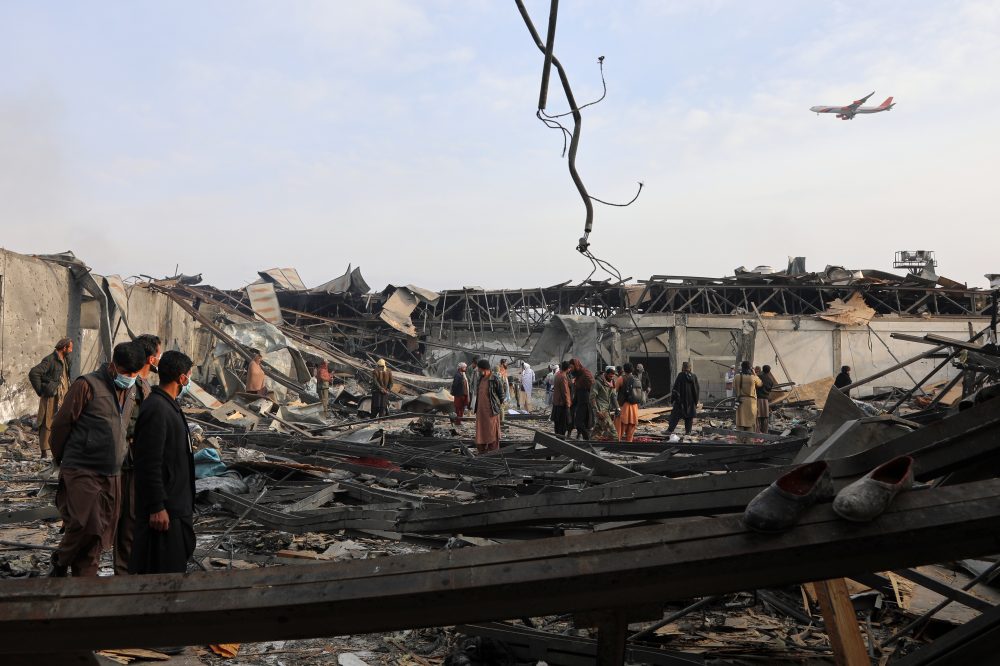

KABUL, Afghanistan (AP) — Emergency workers continued pulling victims from the wreckage of a drug treatment center in Afghanistan’s capital Tuesday, following what Afghan authorities described as a devastating Pakistani airstrike that claimed at least 400 lives at the medical facility.
Pakistani officials have rejected Afghanistan’s claims that they deliberately struck a hospital, asserting that their military operations conducted Monday in eastern Afghanistan avoided all civilian locations.
Monday evening’s attacks represent a significant intensification of hostilities that erupted between the neighboring countries in late February, featuring repeated border skirmishes and aerial bombardments within Afghan territory. Efforts by the international community to broker a ceasefire have been unsuccessful.
Afghanistan’s deputy government spokesperson Hamdullah Fitrat announced on X late Monday that the bombing struck the Omid Addiction Treatment Hospital, which houses 2,000 beds in Kabul, around 9 p.m. local time. He reported that substantial portions of the complex were leveled, with casualties reaching 400 deaths “so far” and approximately 250 wounded. No updated casualty figures were available early Tuesday.
Video footage shared by local news outlets on X depicted security personnel using flashlights to evacuate victims while firefighters battled blazes throughout the destroyed structure’s remains.
The hospital bombing occurred following earlier border exchanges that Afghan officials said killed four people in Afghanistan, as the most severe fighting between these nations in years continued into its third week.
Afghan government spokesperson Zabihullah Mujahid denounced the attack on X, charging Pakistan with “targeting hospitals and civilian sites to perpetrate horrors.” He described the victims as “innocent civilians and addicts.”
“We strongly condemn this crime and consider such an act to be against all accepted principles and a crime against humanity,” he stated in another X post.
Pakistani Prime Minister Shehbaz Sharif’s spokesperson, Mosharraf Zaidi, rejected these accusations as unfounded, maintaining that no medical facility was attacked in Kabul.
Pakistan’s Information Minister Attaullah Tarar wrote on X early Tuesday that Pakistani forces had “carried out precision airstrikes” against military targets in Kabul and Nangarhar province in the east. He claimed that “technical support infrastructure and ammunition storage facilities” at two Kabul locations were eliminated.
“All targeting has been done with precision only at those infrastructures which are being used by Afghan Taliban regime to support its multiple terror proxies,” he posted.
Pakistan’s Information Ministry earlier labeled Mujahid’s accusations as “false and misleading,” designed to inflame public opinion and conceal what it called “illegitimate support for cross-border terrorism.” The ministry insisted Pakistan’s operations were “precise and carefully undertaken to ensure no collateral damage is inflicted.”
The bombing followed a unanimous U.N. Security Council resolution calling on Afghanistan’s Taliban government to intensify counterterrorism efforts immediately. Pakistan maintains that Kabul provides sanctuary to militant organizations, especially the Pakistani Taliban, which allegedly conducts attacks within Pakistani borders.
While the Security Council resolution didn’t specifically mention attacks in Pakistan, it condemned “in the strongest terms all terrorist activity including terrorist attacks.”
Pakistan’s administration alleges that Afghanistan shelters the Pakistani Taliban, designated as a terrorist group by the United States, along with banned Baloch separatist organizations and other militants who regularly attack Pakistani military and civilian targets nationwide. Afghanistan disputes these allegations.
The current violence — the most intense between these neighbors — started in late February when Afghanistan launched cross-border operations responding to Pakistani airstrikes within Afghanistan that Kabul claimed killed civilians. The fighting shattered a Qatar-mediated ceasefire from October that followed earlier battles killing dozens of soldiers, civilians and suspected militants.
Pakistan has announced it is engaged in “open war” with Afghanistan. The escalation has concerned the international community, especially given the region’s continued presence of other militant groups, including al-Qaida and the Islamic State, which have been attempting to reestablish themselves.
Pakistani President Asif Ali Zardari declared Saturday that Afghanistan’s Taliban leadership crossed a “red line” by deploying drones that wounded several Pakistani civilians last week.