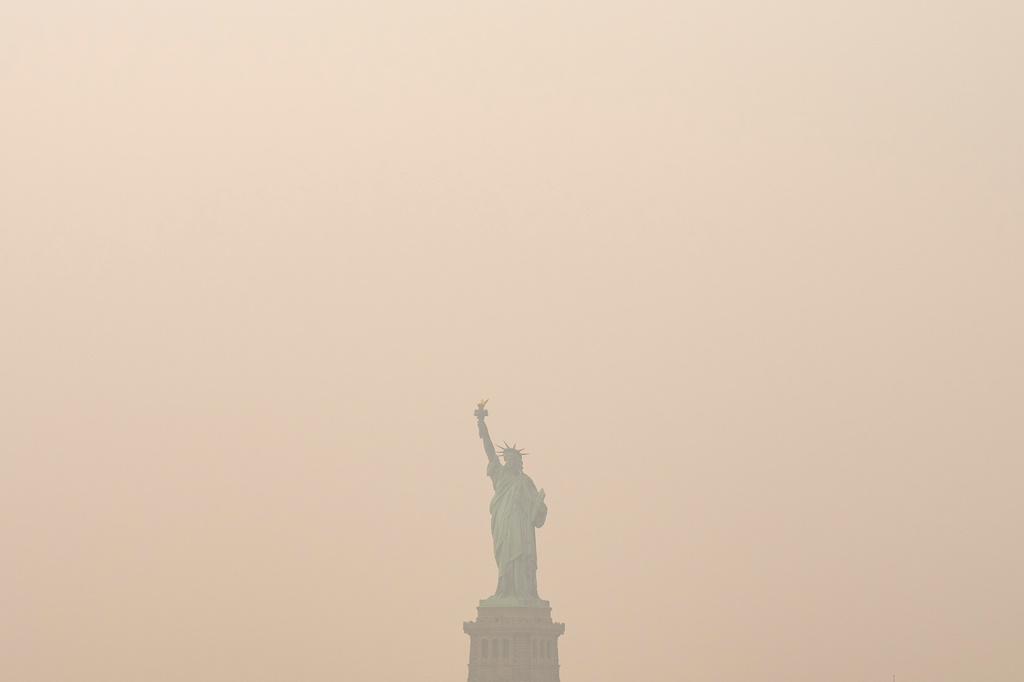

Thick, foul-smelling wildfire smoke rolled across a broad stretch of the country on Thursday, stretching from the Great Lakes all the way to portions of the East Coast. The haze reduced visibility and triggered urgent warnings from officials telling people to avoid breathing outdoor air.
Across many cities, residents were told to remain indoors or wear protective masks if going outside was unavoidable. Air quality climbed to unhealthy and hazardous levels — conditions considered dangerous for everyone, not just those with pre-existing health concerns. The smoke originates primarily from wildfires burning in Canada, with additional fires in northern Minnesota also contributing. A stalled high pressure system has been pushing the smoke down toward ground level, according to Steven Freitag, a meteorologist with the National Weather Service in Detroit, where air quality ranked among the worst of any major city in the world.
“Sure enough, it arrived in force here and it’s really pretty extreme levels,” Freitag said, adding that visibility in certain spots had dropped to just half a mile.
Detroit resident Omar Mitchell, 50, had a mask on as he made his way to his restaurant, glancing up at the sky with concern. “It’s scary,” he said. “You don’t know necessarily what the side effects may be. That’s days or months later.”
Health experts warn that the tiny particles in wildfire smoke can penetrate deep into the lungs and enter the bloodstream, potentially causing heart and lung complications along with other serious long-term health consequences.
Sky turns yellow, air reeks across the region
The entire state of Michigan and large portions of Minnesota were placed under hazardous air quality alerts. In the Chicago metropolitan area, air quality fluctuated between very unhealthy and hazardous readings.
National Weather Service meteorologist Jake Petr cautioned that even if northwest winds help clear the air later in the week as forecast, smoky conditions could keep returning until the fires are fully extinguished — a process that could stretch on for months, possibly until snowfall arrives in Canada and northern Minnesota.
In downtown Chicago, 76-year-old Bill Ostrowski walked through streets shrouded in smoke, a mask covering his face. “It stinks. It’s not a good sign when you wake up in the morning and you can smell the air,” he said.
In St. Paul, Minnesota, Brent Williams, who heads the soil, water and climate department at the University of Minnesota, described the sky as “glowing yellow.” He said the region “could be looking at weeks to months of continued smoke and flare-ups off and on as the winds blow in different directions.”
A study released this year determined that prolonged exposure to fine particles from wildfire smoke was linked to an average of 24,100 deaths annually across the lower 48 states. Extended exposure can worsen existing medical conditions and lead to serious chronic illnesses, including respiratory disease, cardiovascular and neurological problems, and early death.
New York City hands out masks, cancels outdoor plans
Over the New York City area, a dense haze cast an orange and yellow tint across the morning sky, partially hiding Manhattan’s skyline from view.
City officials opened cooling centers, and health authorities asked New Yorkers to cut back on vigorous or lengthy outdoor activities. Schools, parks, and other city agencies moved programming indoors, postponed events, and adjusted how they operated. State officials handed out tens of thousands of face masks at transit hubs and other high-traffic locations.
Gwen Moseley, 65, was among the first to pick up a free mask at Rosedale Library in Queens. She spends much of her workday traveling as a therapist for children with autism. “Who wants to be breathing this? It’s not healthy,” she said while waiting for a young client. “When I’m out walking, I can feel the scratchiness in my throat.”
Weather service meteorologist Maureen Hastings said the smoke had eased somewhat but was expected to thicken again by late afternoon or evening, potentially lingering through the night. She indicated it might shift southward briefly on Friday before returning after dark.
The state Department of Environmental Conservation flagged the potential for temporary spikes of “very unhealthy” air quality stretching from Buffalo in the western part of the state to Rochester near Lake Ontario, then to Syracuse in the central region and down into the greater New York City area.
In Philadelphia, officials encouraged residents to avoid strenuous outdoor activity and to stay inside when possible, or wear N95 or KN95 masks if heading out. “Today is not the day to start your marathon training plan,” said Dr. Palak Raval-Nelson, the city’s public health commissioner.
Minnesota wildfires continue to spread
In Minnesota, forest rangers spent Thursday searching a remote wilderness area to locate anyone who might still be present, days after wildfires forced officials to close the region.
The Boundary Waters area along the U.S.-Canada border was shut down on Tuesday. Between 6,000 and 10,000 people were believed to be inside at the time of the closure, though Superior National Forest staff estimated by Wednesday that they had made contact with approximately 90 percent of them, according to Karen Harrison, a spokesperson for the state and federal agencies coordinating the response.
Harrison said Thursday that heavy smoke has grounded helicopters and that the fires are continuing to spread despite active firefighting efforts. “There will be fire on the landscape until fall, and some fire will be burning until snow cover,” she said.
In a separate development, the Royal Canadian Air Force successfully evacuated 11 Minnesota teenagers and four staff members on Wednesday from wildfires burning in an Ontario provincial park located roughly 175 miles north of the Minnesota border.