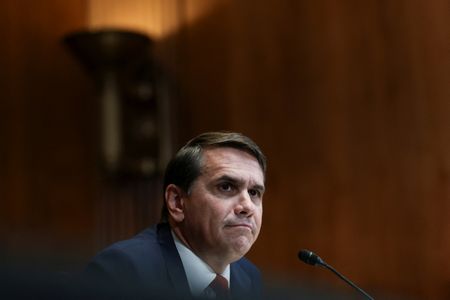

WASHINGTON – During his first appearance before Congress since taking over the Justice Department, acting Attorney General Todd Blanche declined to promise that President Donald Trump’s newly established “weaponization” compensation fund would exclude individuals who attacked law enforcement officers, including those involved in the January 6, 2021, Capitol uprising.
Speaking to Democratic senators on Tuesday, Blanche also refused to guarantee that none of the approximately $1.8 billion settlement would go to Trump campaign contributors.
The Justice Department established the massive compensation fund on Monday as part of resolving a lawsuit Trump had brought against the federal government regarding alleged improper handling of his tax documents. The fund aims to provide financial relief to individuals claiming they suffered from political “weaponization or lawfare” by federal authorities.
Trump associates will oversee the distribution of these payments to those alleging government targeting.
When questioned by lawmakers, Blanche rejected claims that Trump “set up” the settlement arrangement. He emphasized that a five-member commission, with four members he will personally select, would operate without interference. Blanche compared the initiative to a comparable fund managed under former President Barack Obama’s Justice Department, noting that the earlier version received federal court approval.
“The president did not direct me to do anything,” Blanche stated, explaining later that funding could benefit individuals from any political affiliation and extends beyond January 6 cases. He described the eligibility criteria broadly as covering those who experienced “weaponization.”
Senator Patty Murray, a Democrat from Washington state, strongly criticized the arrangement, stating: “What we’re talking about is nothing short of the sitting president of the United States looting from the Treasury for his own gain. Do you seriously think this arrangement is appropriate?”
Under Trump’s administration, the Justice Department has pursued legal action against his political opponents while dismissing cases involving his supporters, leading to a reduction of 8,500 personnel from the nation’s primary law enforcement agency.
The hearing, lasting more than two hours, became heated as Democrats and Blanche clashed over both the compensation fund and the department’s approach to the Jeffrey Epstein case. The session highlighted nearly universal Republican support for Blanche and the president’s policies.
Republican legislators largely praised Blanche for what they characterized as correcting ineffective and retaliatory enforcement practices from the previous administration, crediting him with improving public safety.
However, Senator Susan Collins, a Republican from Maine, questioned Blanche about the distribution process and recipient selection criteria.
Blanche explained that the commission would function independently while providing quarterly updates to the attorney general, with details shared with Congress. He indicated that any individual could submit an application for consideration.
Collins noted that the funding would come from a judgment fund typically used for other government legal settlements.
Regarding the Epstein investigation, Blanche faced additional scrutiny but committed to not recommending a presidential pardon for Ghislaine Maxwell, a former associate of Epstein.