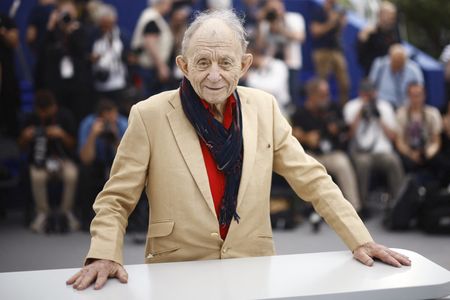

Legendary documentary filmmaker Frederick Wiseman has died at age 96, according to an announcement from Zipporah Films, the distribution company he established.
The filmmaker passed away peacefully on Monday, though no specific cause of death was released.
Throughout his remarkable six-decade career, Wiseman created approximately 50 documentaries that took viewers inside the everyday institutions that shape American life – from neighborhood stores and public schools to city halls, zoos, courthouses, and hospitals.
His approach was uniquely immersive and unbiased, allowing audiences to witness how these organizations function and affect the people within them.
“The audience is placed in the middle of these events and asked to think through their own relationship to what they are seeing and hearing,” Wiseman explained to Documentary Magazine in 1991. “They are asked to ask themselves why I have selected and arranged the material in this particular form.”
A DISTINCTIVE FILMMAKING APPROACH
Wiseman pioneered what became known as “direct cinema,” a documentary style similar to the French “cinéma vérité” movement. His films featured no narrator explaining events, no formal interviews with subjects, and no added soundtrack – only the natural sounds occurring within each scene.
The filmmaker would typically shoot around 200 hours of raw footage, then personally edit the material down to feature length. He described his documentaries as “reality dreams” and “expressions of my curiosity.”
Born on January 1, 1930, in Boston, Wiseman was the sole child of Jacob Leo Wiseman, a Russian immigrant who worked as an attorney, and Gertrude Kotzen, who held an administrative position at a children’s hospital psychiatry department.
Initially pursuing law, Wiseman studied and taught in the field before discovering his passion lay elsewhere.
“I didn’t like law school because the stuff I had to read was so badly written,” he told the Metrograph journal in 2016. “I detested teaching as much as I detested law school.”
After completing military service following the Korean War, Wiseman transitioned into filmmaking at age 37.
GROUNDBREAKING EARLY WORK
His debut documentary, “Titicut Follies,” provided an unprecedented look inside a Massachusetts facility for the criminally insane. Despite legal restrictions that limited its screening to academic venues for decades, the film established Wiseman’s observational methodology.
“It seemed to me an appropriate style to use when I was trying to make films about real situations, where I wasn’t asking people to do anything especially for me,” Wiseman explained in 2016. “The idea always has been to capture as many different aspects of what’s going on in the world as I can on film.”
His 1968 production “High School” documented teenagers and educators in Philadelphia during a period of significant social change. Both “Titicut Follies” and “High School” earned places in the National Film Registry at the Library of Congress.
PBS aired several of his works, including “Law and Order,” which followed Kansas City police officers, and “Domestic Violence,” examining a women’s shelter in 2001.
RECOGNITION AND LEGACY
The Academy of Motion Picture Arts and Sciences honored Wiseman with an honorary Oscar in 2016, praising his “masterful and distinctive documentaries examine the familiar and reveal the unexpected.”
“Constantly working keeps me off the streets,” he quipped during his acceptance speech. “This compulsion has always been understood by my wife, Zipporah, and my sons, David and Eric.”
He named his production company after his wife Zipporah, a law professor who died in 2021.
Among his numerous accolades were four Emmy Awards and recognition from major international film festivals including Cannes, Berlin, and Venice. He also received prestigious MacArthur and Guggenheim fellowships.
Journalist Sean Cooper noted in Tablet magazine that “even the most critical acknowledge that Frederick Wiseman is a genius of some kind.”
INTERNATIONAL SUBJECTS AND FINAL WORKS
While primarily focused on American institutions, Wiseman also explored international subjects. He documented the historic Comédie-Française theater in Paris and created “The Last Letter,” a fictional work set in a Ukrainian Jewish community during World War II.
His four-hour film “Menus-Plaisirs — Les Troisgros” profiled French restaurateurs with characteristic depth and patience.
When questioned about creating lengthy films that challenged some viewers’ attention spans, Wiseman responded: “I make them at whatever length I think is appropriate … I don’t know how to take into account an audience.”
His diverse subject matter included London’s National Gallery, the Panama Canal, and end-of-life care.
“Each movie is a different experience with different people and situations that I have never experienced before,” Wiseman reflected. “I hope in each case I’ve learned something.”
Despite never achieving mainstream commercial success, Wiseman’s documentaries found devoted audiences through film festivals, university screenings, and independent theaters, cementing his reputation as one of America’s most important documentary filmmakers.
Source: https://srnnews.com/frederick-wiseman-american-documentary-filmmaker-dies-at-96/