
By Vivian Sequera
LA GUAIRA, Venezuela — She was lying on her bed, thinking about watching a Brazil soccer match, when the bedframe began shaking violently, like a mechanical bull.
Reuters journalist Vivian Sequera pressed herself against the mattress, fixed her eyes on the open window, said a prayer for her parents, shut her eyes, and braced for the ceiling to come down on her.
The two earthquakes that hit Venezuela on Wednesday evening arrived just 39 seconds apart — the first registering a magnitude 7.2, followed almost immediately by a magnitude 7.5.
Then, suddenly, it stopped.
She grabbed her phone and sent a message to her Reuters colleagues. The power had held — at least for the moment. In other parts of the area, electricity had already gone dark.
The walls of her apartment were left with long cracks running through them, resembling claw marks on fabric. As she made her way down the emergency stairwell from the sixth floor, the damage grew progressively worse. By the time she reached the ground floor, the glass doors had been completely shattered.
Outside, there was no cell signal. Anxiety set in. She photographed neighbors gathered in the street and documented damage to surrounding buildings before steeling herself to go back upstairs to retrieve her laptop and phone charger.
These were the fifth and sixth earthquakes she has covered since beginning her journalism career with newswires in 1991 in Caracas.
Each one, she said, shares a familiar pattern in its early moments: chaos, silence, pain, uncertainty, and thousands of stunned faces trying to process what just happened — followed by the arrival of foreign rescue teams, varying levels of government response, delays in aid, looting, and ultimately, burials.
TWO DAYS LATER: RANDOM, INDISCRIMINATE DESTRUCTION
Two days after the quakes, Sequera traveled to the city of La Guaira, roughly a 30-minute drive from Caracas — the area the government had designated as ground zero for the disaster.
The contrast she encountered was striking.
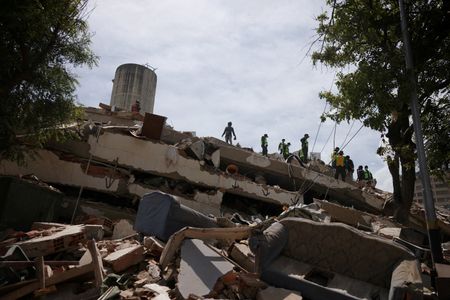
In some parts of the city, streets were clean, buildings were standing, and avenues were nearly empty, all bathed in soft Caribbean morning sunlight. Then, just one block away, structures on both sides of the road had been reduced to rubble.
The further her team ventured into the city’s parishes — Caraballeda and Los Corales — the more devastating the scenes became. In the early morning hours, near silence dominated the streets.
But as the sun climbed higher, voices grew louder and movement increased. Swarms of motorcycles carried aid and transported survivors through a backdrop of noise, disorder, and scattered sobbing.
Thousands of young people in shorts and t-shirts — some barefoot or wearing sandals — moved rocks from debris piles that towered more than 10 meters high. Others swung sledgehammers at concrete slabs in a desperate race to find anyone still alive beneath the wreckage.
Meanwhile, exhausted survivors sat motionless in plastic chairs under trees, seeking whatever shade they could find from the relentless midday Caribbean heat.
To cope, Sequera pressed handfuls of ice from a cooler in the car against her skin. She made a mental note: next time, bring two coolers.
Many residents of La Guaira expressed frustration over delays in the arrival of rescue equipment and food. There was also some looting reported in the disaster zone.
Standing amid the wreckage, she described the feeling that the mountains of rubble seemed immovable — and the question that kept surfacing: when can any of this be repaired?
What struck her most, she said, was the sheer and indiscriminate force of tectonic violence. It does not distinguish between neighborhoods, social classes, or religions. And yet it is also unpredictable — one building left completely intact while the one right next to it is entirely gone.
Back home, on her nightstand, a glass of wine sat untouched and upright. Nearby, photographs of her parents from when they were dating remained standing, along with a photo of her elderly mother at a flower market in Caracas.
Everything still in place.
She said she feels very fortunate.