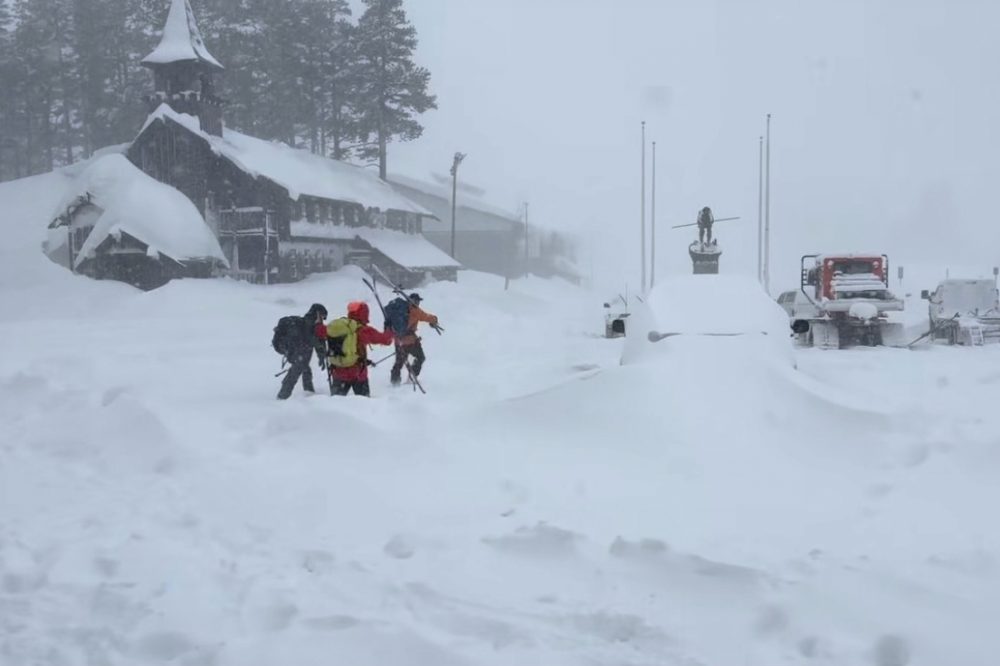

Emergency teams fought through harsh winter conditions in the mountains near Lake Tahoe to reach six backcountry skiers who survived an avalanche but became trapped in snow and ice. Nine members of their skiing party are still unaccounted for.
According to Ashley Quadros, a spokesperson for the Nevada County Sheriff’s Office, two of the rescued skiers required hospital care.
Officials corrected earlier reports Tuesday evening, confirming that 15 skiers were part of the expedition, not the previously reported 16.
Emergency responders were called to the Frog Lake area near Castle Peak, located northwest of Lake Tahoe, following a 911 report of an avalanche with people buried beneath the snow. A severe winter storm was battering California during the incident.
The harsh weather conditions in Northern California’s mountains hampered rescue operations. It required several hours for teams to reach the trapped skiers and transport them to safety, where Truckee Fire Department personnel provided medical evaluations.
Sheriff’s officials announced they will share additional information about the ongoing rescue operation during a Wednesday morning press briefing.
The group was completing the final day of a three-day wilderness skiing adventure, according to Steve Reynaud, an avalanche forecaster with the Sierra Avalanche Center at Tahoe National Forest, who maintained communication with personnel in the field. He explained the skiers had stayed two nights in mountain huts during an expedition requiring travel through “rugged mountainous terrain” for distances up to 4 miles while carrying all necessary food and equipment.
Nevada County Sheriff Captain Russell Greene reported that authorities learned of the avalanche through both the tour operator, Blackbird Mountain Guides, and emergency signals from devices carried by the skiers. Rescue teams approached the avalanche site with extreme caution due to the risk of additional slides.
Blackbird Mountain Guides posted a statement on their website confirming their cooperation with officials in the rescue mission.
A powerful winter storm is currently pummeling California, delivering dangerous thunderstorms, strong winds, and heavy mountain snowfall.
“Backcountry conditions are extremely hazardous right now because we’re experiencing the storm’s peak intensity,” stated Brandon Schwartz, the lead avalanche forecaster for Tahoe National Forest at the Sierra Avalanche Center in Truckee.
The center issued avalanche warnings for the Central Sierra Nevada region, including areas around Lake Tahoe, beginning Tuesday at 5 a.m., with expectations of major slides continuing through Wednesday.
Soda Springs, located close to the avalanche site, measured at least 30 inches of snowfall in a 24-hour span, according to data from Soda Springs Mountain Resort.
The hazardous situation resulted from rapidly building snow accumulation on unstable snowpack layers, combined with powerful winds.
The storm caused significant transportation problems from the Sierra Nevada to Sonoma County. Officials temporarily stopped traffic in both directions on Interstate 80 over and around Donner Summit because of vehicle spinouts and accidents.
Multiple Tahoe area ski resorts closed completely or partially due to weather conditions. Resort areas along highways maintain avalanche prevention programs and face lower risk compared to backcountry regions, where the center strongly advised against traveling in, near, or below avalanche-prone areas.
Castle Peak, standing 9,110 feet tall north of Donner Summit, attracts many backcountry skiing enthusiasts. The mountain bears the name of the notorious Donner Party, pioneers who turned to cannibalism after becoming stranded there during the winter of 1846-1847.
Earlier this year in January, an avalanche in the same region buried and killed a snowmobile rider, according to authorities. The National Avalanche Center reports that avalanches claim the lives of 25 to 30 people annually across the United States.
Experts strongly recommend avalanche assessment training, rescue instruction, and proper safety gear for backcountry skiing, also called off-piste skiing, which involves traveling deep into wilderness areas far beyond resort boundaries. Backcountry skis feature wider, heavier designs with specialized components for navigating ungroomed mountain terrain, unlike cross-country skis that are narrower and built for flatter, maintained trails.