
Thirty-three people have been rescued so far this weekend in the aftermath of Venezuela’s catastrophic twin earthquakes, the country’s interim president announced, among them several children. However, tens of thousands of people remain unaccounted for, and rescuers say the critical window for finding survivors alive is rapidly closing.
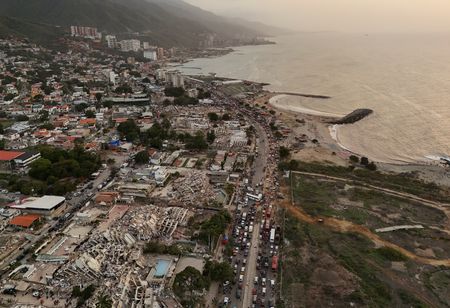
The death toll from Wednesday’s dual earthquakes climbed past 1,400 as of Saturday, as international rescue teams flooded into La Guaira — the coastal state that bore the brunt of the destruction.
Before those more than 1,600 foreign rescue workers arrived, families and volunteers spent days pulling both survivors and bodies from collapsed buildings. Many complained of a lack of heavy equipment and minimal official support, while hundreds of aftershocks continued to cause additional damage and kept residents living in fear.
Venezuela’s government — currently led by interim President Delcy Rodriguez, who took over after her predecessor was removed by the United States in a January raid — had initially praised civilian volunteers for delivering aid to La Guaira. The government later significantly restricted access to the road leading to the area, citing traffic as an obstacle to emergency vehicles and limiting use of the roadway to accredited individuals only.
While the government has acknowledged hundreds of people as missing or trapped, a website run by the country’s political opposition listed just under 50,000 people as unaccounted for as of Sunday. That number represented a slight drop from Saturday’s figure of 55,000.
The U.S. Geological Survey has estimated that more than 10,000 deaths could ultimately result from the magnitude 7.2 and 7.5 earthquakes — a toll that would rank them among the deadliest in Latin America over the past century.
Rescue experts stressed that time is running out. “There exists a window of roughly three days, 72 hours, where the probability afterwards decreases that you can save people alive,” said Sebastian Eugster, the leader of the Swiss rescue team, speaking to reporters on Saturday. His 80-member team had located multiple living survivors in the rubble with the help of eight search dogs, but was unable to extract them in time to save their lives. Saturday evening marked exactly 72 hours since the earthquakes struck.
Eugster said the Swiss team will coordinate with other rescue groups and local authorities to determine when to officially end rescue operations, though the team plans to stay in the region to assist with broader relief efforts.
Among those rescued were several children. The U.S. State Department celebrated the rescue of an infant by American crews on Saturday, sharing video footage on social media showing rescuers in helmets lifting a blanket-wrapped, crying baby from the debris.
A Colombian rescue team saved an 11-year-old boy named Moises, who had been buried roughly 3 meters — about 10 feet — underground. Rescuers used a scanner to pinpoint his location and removed him on a stretcher with a broken arm, his eyes covered with cloth to shield them from the sudden exposure to daylight. His mother and sister did not survive.
In the town of Caraballeda, Mexican rescuers pulled another 11-year-old boy from the ruins of a collapsed building, interim President Rodriguez announced late Saturday on social media, sharing video of crews carrying the child out on a stretcher. “In these hours each life is hope for Venezuela,” Rodriguez said. The government also shared footage of a young man being freed from debris by rescue workers.
Additional government videos showed Rodriguez meeting with international rescue teams, during which she provided the updated count of people saved on Saturday. Officials also reported that more than 3,000 people have been injured and a similar number are currently living in emergency shelters.
In Caraballeda on Saturday, U.S. rescuers worked side by side with civilian volunteers, some of whom were searching for their own missing family members. Rescuers had originally marked the rubble with the name of the apartment building that once stood there. By Saturday evening, they had updated the markings with codes indicating they no longer believed any living person remained in that section of ruins.
Pope Leo addressed worshippers gathered for the Angelus prayer in Rome on Sunday, expressing his desire to “express my closeness to the Venezuelan sisters and brothers affected by the recent earthquakes” and offering gratitude to all rescue workers involved.
The European Union’s foreign policy chief announced on social media that the EU had mobilized 5 million euros — approximately $5.9 million — in emergency aid, and that the EU’s Copernicus satellite system is being used to map the damage and guide assistance to the areas most in need.
A senior U.S. official said Saturday that a funding package worth hundreds of millions of dollars is expected to be announced within the next day or so, in addition to $150 million already committed by the Trump administration.
The disaster may carry political consequences for Rodriguez, who has presented herself as a force for change despite having previously served as vice president under her predecessor. Meanwhile, electrical power was gradually being restored across the region, though Venezuela’s power grid — weakened by years of underinvestment and economic sanctions — routinely suffers from failures that cause hours-long blackouts in parts of the country.