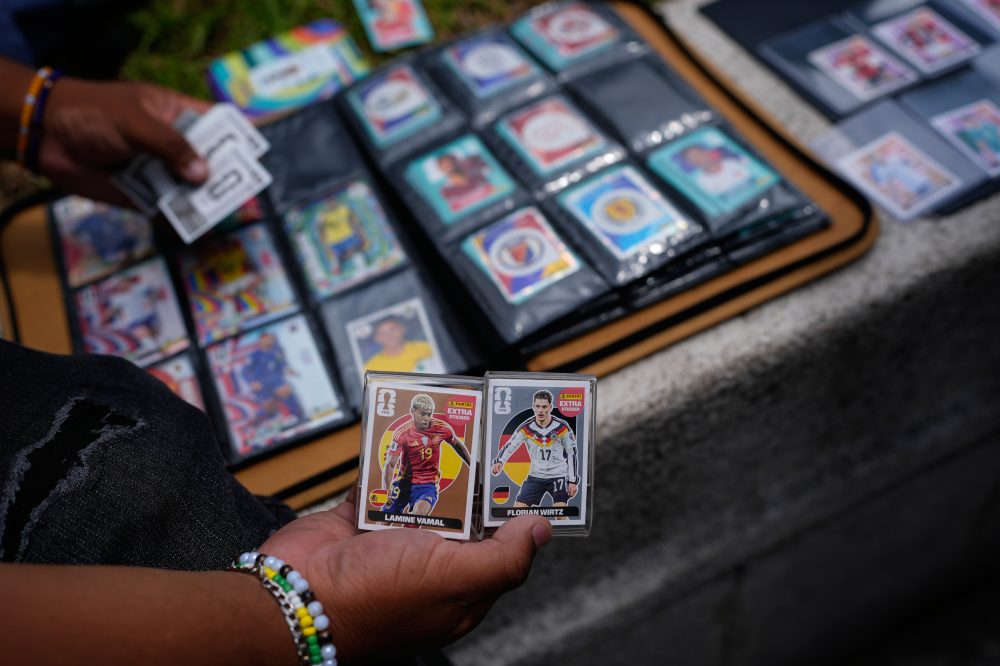

KANSAS CITY, Mo. — Adam Martin hauled a box of Panini stickers and World Cup albums to a Formula 1 race back in May, not long after his shop had received a fresh shipment and well before the tournament kicked off. His original plan was simple — hand them out to friends who had kids.
What happened instead caught him completely off guard.
“When I walked in with this box of cards,” Martin recalled, “hundreds of people of all creeds and cultures said something: ‘Where did you get those? How can I get some?’ Those Panini stickers are just that iconic collectible that goes beyond sports collectors.”
Panini World Cup stickers have been a global tradition since 1970, when four Italian brothers spent $1,000 to secure the rights to produce the images. More than half a century later, fans everywhere — young and old — are not only buying the packs but trading duplicates with one another to fill their keepsake albums.
This year’s album is the biggest in the product’s history, driven in part by an expanded 48-team tournament field. It contains 980 unique stickers. Demand has been so intense that store shelves are bare across the country, and backorders may not be fulfilled until after the tournament has already declared a winner.
“We’ve sold an unbelievable amount of the stickers,” said Martin, one of the owners of Dave and Adam’s Card World, which operates shops in New York and Europe.
“We thought the order we placed months ago would be enough to tide us over,” Martin added. “We’ve had to reorder twice.”
Panini had manufactured more than 2 billion packs — each holding seven stickers — before the tournament even began, according to Jason Howarth, the company’s senior vice president of marketing and athlete relations for Panini America. That’s a remarkable output given that the full tournament field wasn’t finalized until April 1.
Most individual stickers carry little monetary value on their own, though older editions — including the debut stickers of Lionel Messi and Cristiano Ronaldo — can sell for hundreds of dollars. The real draw is the challenge of completing the entire album.
“In European and South American culture, completing the sticker album is something almost every child does at some point,” said Matt Blazey, from Milton Keynes, England, whose YouTube channel covering cards and collectibles has drawn more than 62,000 subscribers.
“Most rediscover it in adulthood,” Blazey said, “when they realize they have adult money, which brings back all of those memories of bringing stickers into school, showing them off to your mates and swapping them to complete the album.”
Accessibility is a big part of the appeal — each pack runs just about $2, or roughly 1.50 euros.
Starting with the last World Cup held in Qatar, Panini introduced limited-edition variations featuring special colored borders that are far harder to come by. Stickers with red, purple, or orange edges quickly became highly sought after. The rarest of all — black-bordered, one-of-a-kind stickers featuring stars like Messi, Ronaldo, and Lamine Yamal — have collectors offering enormous sums to track them down.
Some industry insiders believe the black Messi sticker alone could bring in $200,000 at auction.
“We’re tracking and following through social media who pulls the black 1-of-1s,” Howarth said. “Neymar, Leo, Ronaldo — this is probably their last World Cup. What do those stickers sell for? That’s going to be a new high mark for the category.”
For Sammi Kaewsawang, a content creator from Long Beach, California, this was his first time experiencing the World Cup album tradition. He set out to see just how long it would take to peel and place all 980 stickers into the album by hand.
By the time he finished with Panama — the last of the 48 teams — he had spent roughly 7 hours and 47 minutes on the task.
“Now I’m on my second one, helping my fiance’s nephew complete his,” Kaewsawang said. “What made the experience so memorable was the people I met along the way. Trading stickers brought me together with fans of all ages.”
That sense of community is a major part of what makes Panini stickers special. Even though a digital version of the collection exists, there’s something uniquely nostalgic about swapping duplicate stickers with strangers — not unlike the way American kids have traded baseball cards for generations.
Many retailers host swap meets to bring collectors together. Panini itself has a truck stationed at Rockefeller Center in New York, where thousands of fans have gathered in the evenings to trade. Online message boards connect collectors from around the world, and approximately 8,000 fans recently turned out at a stadium in Santiago, Chile, for a large-scale swap event.
“I’ve made genuine new friends through this hobby,” Kaewsawang said, “and that means more than completing the collection itself.”
Despite the stickers being more popular than ever — a partnership with Coca-Cola even places them under certain bottle labels — the Panini era is drawing to a close. After the 2030 World Cup, set to be held in Morocco, Portugal, and Spain, the rights to produce World Cup cards, stickers, and other FIFA collectibles will transfer to the Fanatics brand Topps. Whether the U.S.-based company will offer a similar sticker album experience remains uncertain.
“It is a real bittersweet moment,” Blazey said. “From my side, and for probably 90% of collectors at the moment — more so outside the U.S., where Panini is a household name — it’s a very sad moment for this to be the end. So many people grew up collecting them, and it’s synonymous with their childhood, so the loss of the license is very much seen as sacrilege.”
Still, some collectors hold out hope that Fanatics — which recently took over the license for the Premier League as well — can bring fresh ideas to a sticker product for the 2034 World Cup, making it less of an ending and more of a reinvention.
“We’re very privileged to be a significant partner with both Panini and Fanatics. We try not to pick sides,” Martin said. “I think Fanatics will do an amazing job with World Cup products, but I’m not sure they’ll be able to capture the cultural impact.”