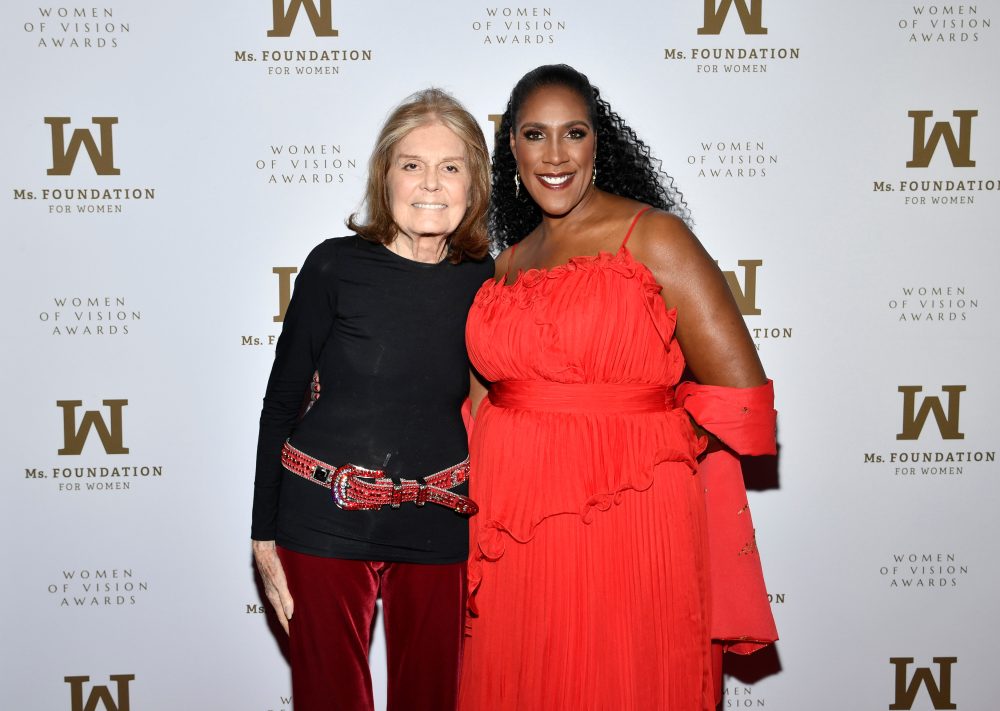

Teresa Younger will conclude her leadership of the Ms. Foundation in June, wrapping up her time at the helm of America’s pioneering women-focused philanthropy during a period marked by significant social and political upheaval under Donald Trump’s return to the presidency.
While acknowledging current challenges in achieving political equality for all people – a core mission of the Ms. Foundation – Younger remains committed to continuing her advocacy work beyond her CEO role.
“I believe feminism is still alive and well,” Younger told The Associated Press during a recent interview. “In fact, it has been the one thing that has been the preservation of democracy and our constitutional rights in some way over the past 12 years.”
During her leadership, Younger addressed domestic violence issues involving NFL players, broadened the organization’s support for community-based groups across Southern and Midwestern states, and successfully secured more than $100 million for the foundation’s permanent fund. In 2018, the organization adopted a new approach prioritizing investments in programs serving girls and women of color – a shift that carried special significance under Younger’s guidance as a leader with Black and Indigenous heritage.
“The institution was explicit in our strategic plan to say that we want to center women and girls of color as a point of inclusion, not exclusion,” Younger explained. “And now we are sitting in a spot where quote-unquote DEI is looked at as bad. And we refuse to accept that.”
This strategic pivot led to the foundation’s 2020 research study titled “Pocket Change: How Women and Girls of Color Do More with Less,” which challenged other charitable organizations to reconsider both their funding priorities and methods.
The study revealed that charitable foundations allocated approximately $356 million to organizations serving women and girls of color in 2017 – representing less than 0.05% of all foundation grants distributed in 2018.
Beyond exposing this minimal investment in some of America’s most underserved communities, the research uncovered significant disconnects between funders and organizations led by women of color. Many of these nonprofits employ comprehensive approaches, combining services like childcare and diaper distribution with reproductive rights advocacy. However, funders often compartmentalize their grants by specific populations, strategies, or issues, choosing to support only portions of these organizations’ work.
The study recommended that foundations offer flexible, long-term financial support, align their strategies with recipient organizations, actively seek feedback from grant recipients, and back intermediary organizations with strong connections to these groups.
This approach has historically defined the work of women’s funds and the Ms. Foundation within the philanthropic sector. These organizations both assist grassroots groups serving marginalized communities and develop innovative funding and partnership models that other funders later adopt as standard practices.
The first women’s funds in America emerged during the 1970s, with the Ms. Foundation becoming the initial national organization dedicated to supporting women’s groups and feminist causes. Gloria Steinem, Patricia Carbine, Letty Cottin Pogrebin, and Marlo Thomas established it in 1973.
Sunny Fischer, who helped establish the Chicago Foundation for Women, explained that the women who created it around 1983 sought to serve women differently than many large social service organizations were doing at that time.
Instead of advising women facing domestic violence to return home and repair their marriages, Fischer noted, “There were new groups that were trying to help women where they were, to really understand what was going on in the home and to try to give women choices about what they could do if they were in an abusive situation.”
Lucia Woods Lindley, a photographer and heir to a wealthy Nebraska family whose wealth originated from telecommunications and coal industries, was another Chicago Foundation for Women founder whom Fischer remembered as “a great planner.”
In 2023, the Ms. Foundation revealed that Woods Lindley had bequeathed $50 million through her estate – the largest donation the organization had ever received. This gift comprised nearly half of the $106 million the foundation eventually secured for its endowment.
During an interview at that time, Younger said the Ms. Foundation had not anticipated Woods Lindley’s bequest would be so substantial.
“She trusted and believed that Ms. (Foundation)’s role as the national public women’s foundation was critical to the thought leadership that needed to happen in philanthropy around feminism and around challenging the field and around growing and asking the right kinds of questions,” Younger said.
Despite these gains, the financial resources managed by women’s funds remain small compared to major foundations’ assets and the largest individual philanthropists’ wealth. Melinda French Gates stands as a notable exception, having pledged billions of dollars to benefit women and girls.
The Women’s Philanthropy Institute at Indiana University’s Lilly Family School of Philanthropy has monitored charitable giving to women and girls, finding that over a decade, their share of overall philanthropic support increased from 1.59% in 2012 to 2.04% in 2023, with a peak of 2.18% in 2022.
“The vast majority of philanthropic dollars are going to the general population and based on need rather than identity,” said Jacqueline Ackerman, the institute’s director. However, she noted they monitor giving to historically underfunded groups to determine whether these patterns are shifting.
The Ms. Foundation will announce Younger’s successor this spring, while Younger has not yet revealed her future plans. Speaking with visible emotion, Younger expressed her love for her work with the foundation while expressing confidence it will thrive under new leadership.
“I want to look back and see somebody who’s built on what I’ve been able to do and take it to the next level,” she said. “And I will sit back with pride in what they are able to accomplish.”