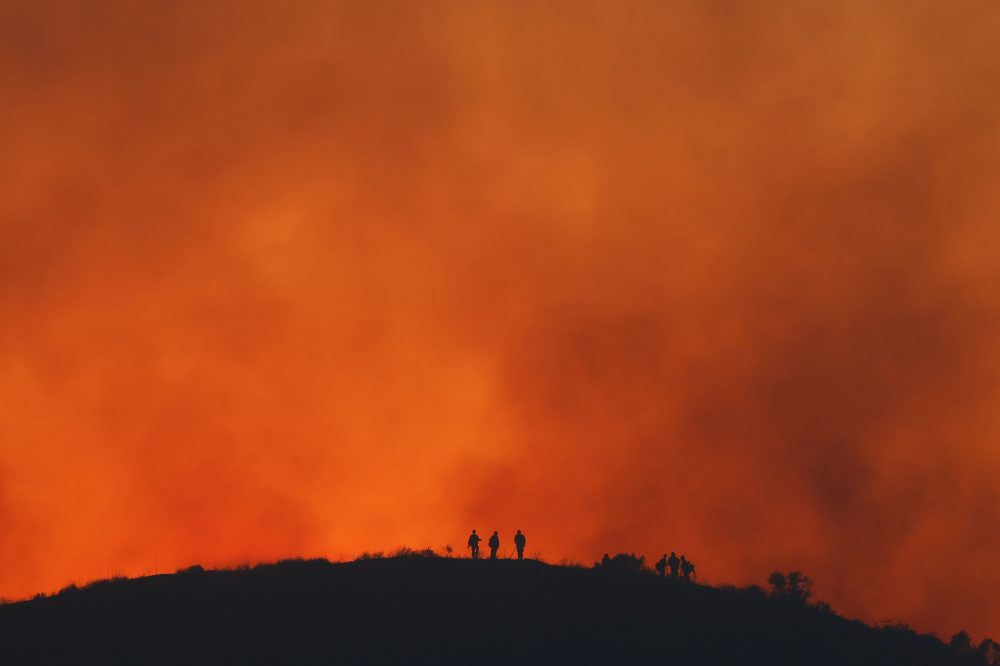

WASHINGTON — America achieved remarkable success in cutting smog pollution for more than ten years, but research published Thursday shows wildfire smoke has been undoing those gains since 2015, creating dirtier and more dangerous air conditions nationwide.
Researchers point to climate change as a major factor, though not the only cause behind this troubling reversal.
Between 2003 and 2015, nationwide smog pollution fell 11% thanks to tough federal rules targeting power plants, vehicles and diesel equipment. However, as wildfire activity has intensified, the country’s average ground-level ozone — the scientific term for smog — has climbed 4%. At this pace, smog could return to 2003 levels within two decades, according to lead researcher Weizhi Deng, an atmospheric scientist at the University of Iowa.
The research, published in the journal Science, also calculated rising death tolls from ozone’s harmful effects on respiratory systems. Using established health studies comparing mortality rates in clean versus polluted areas, scientists estimated 318 additional American deaths annually since 2013.
“For the last 20 years, by regulations, we keep decreasing the emissions” for human-caused smog-inducing chemicals, explained study co-author Meng Zhou, a University of Iowa wildfire researcher. “However, because of wildfires, that is actually from natural hazards, all those kinds of effort were wiped out.”
The research broke new ground by estimating smog levels across the entire nation, addressing limitations in the U.S. Environmental Protection Agency’s monitoring network. Current monitors cover just 2% of the country, concentrated mainly in cities. Deng’s team combined these readings with satellite information, pollution data, weather records and computer models, then applied artificial intelligence to map ozone concentrations nationwide at a resolution finer than half a mile.
While EPA data suggests national ozone levels have remained relatively stable since 2015 with minor fluctuations, Deng noted, “by considering everywhere in the U.S., we actually found an increase in ozone starting from 2015.”
University of Delaware environment professor Cristina Archer, who didn’t participate in the research, praised the artificial intelligence approach as reliable because it builds from “massive and reliable datasets,” then uses computer modeling to intelligently fill gaps and create an “exceptional” detailed picture.
Teresa Feo, policy director for Megafire Action, noted that “experts have long called for expanding the air pollution monitoring network to improve research on wildfire smoke exposure and provide the data needed to better protect public health.”
For years, the U.S. has monitored six key air pollutants, including smog and tiny particles called soot. This latest research focused specifically on ozone, while a 2023 study by the same research team examined small particle pollution and found similar trends — the downward trajectory in soot levels had also reversed. That earlier study calculated wildfire smoke increased particle pollution deaths by roughly 670 annually.
Wildfires don’t directly create ozone, but they release chemical compounds that transform into smog when exposed to sunlight, scientists explained.
“Higher daily ozone concentrations can increase asthma attacks, hospital admissions, and mortality,” said University of Washington public health and climate scientist Kristie Ebi. While not as lethal as tiny particles, she noted, ozone remains “still a very important pollutant, which is why it’s regulated.”
During the severe wildfire seasons of 2022, 2023 and 2024, many blazes originated in Canada but sent smoke southward. The study found 43 million Americans were exposed to smog levels exceeding current EPA safety thresholds.
Those standards need strengthening, argued Dr. Lynn Goldman, former dean of the George Washington University School of Public Health and a former EPA assistant administrator. The administration delayed plans to tighten standards in 2023, and subsequent regulatory changes affected how deaths and health impacts factor into smog and soot rules.
The Northern Rockies saw the largest ozone increases due to proximity to fires, while the Midwest experienced significant impacts as smoke drifted eastward, Deng reported.
Annual wildfire activity now burns 9% more U.S. land compared to 2003-2014 levels, according to the National Interagency Fire Center. Canadian wildfires have been especially severe since 2022, with 2023 bringing the orange skies and face mask-wearing conditions many easterners remember.
Canada’s 2023 burned area not only set records but doubled the previous high, said Brendan Rogers, an atmospheric scientist at the Woodwell Climate Research Center. Smoke from those Canadian fires caused 82,100 deaths worldwide — including 33,000 in the United States — due to particle pollution, according to a 2025 study.
Climate change from burning coal, oil and gas intensified Canada’s 2023 fire season by at least 50% and doubled the likelihood of the hot, dry conditions that fueled the blazes, research from 2023 determined.
“Human-caused climate change is an important contributor, because it increases hot, dry fire-weather conditions in many regions,” said Lixu Jin, a Rutgers atmospheric scientist not involved in the study. “But wildfire emissions also depend on fuels, land management, ignitions, suppression, and year-to-year meteorology.”
Former EPA Administrator Gina McCarthy, who served during the administration, expressed disappointment at seeing smog progress eroded.
While wildfires bring obvious death and destruction, she argued the greatest threat may come from smoke and extreme heat boosting ozone levels that damage public health.
“So the big question is,” she said, “when are we going to stop the nonsense from this administration to burn more and more ‘beautiful’ fossil fuels?”