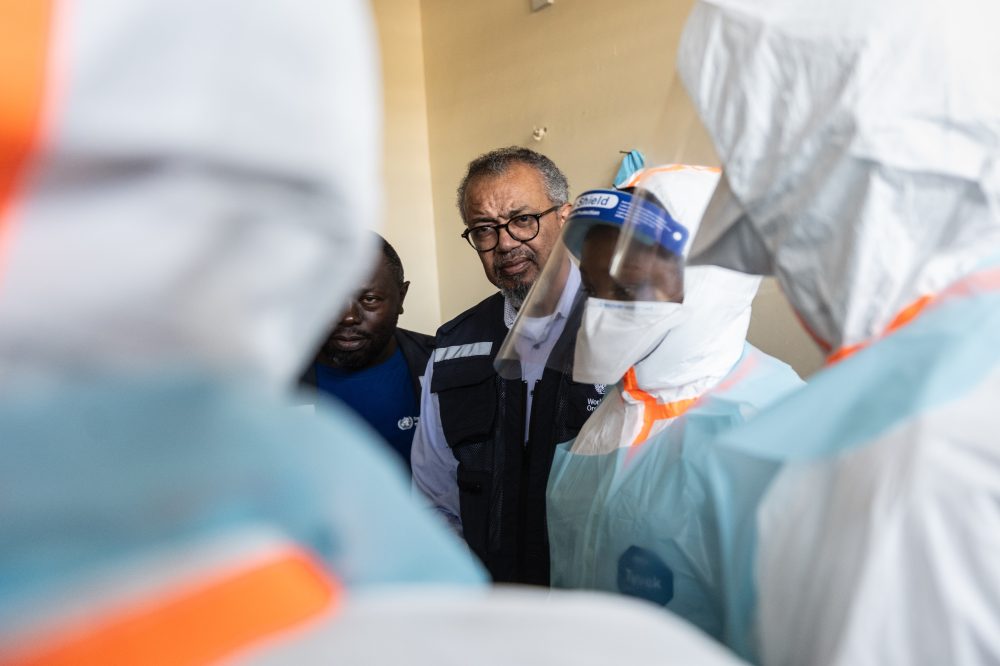

The director-general of the World Health Organization announced Sunday that five individuals have successfully beaten a rare strain of Ebola during his visit to Bunia, a city in eastern Congo that has become the center of an ongoing outbreak.
WHO Director-General Tedros Adhanom Ghebreyesus made the announcement while inaugurating a new Ebola treatment facility in Bunia, which serves as the provincial capital of Ituri.
“Four people will be discharged today and there was one that was discharged the day before yesterday,” Tedros stated during the facility’s opening ceremony.
“Of course, we’re still working on vaccines and treatments but that doesn’t mean that people cannot recover from Ebola,” he added.
According to WHO officials, one patient had previously recovered from the Bundibugyo virus strain – the specific type of Ebola currently circulating – marking the first documented recovery of a confirmed Bundibugyo patient since this outbreak began. This particular strain has no approved treatment or vaccine available.
Current official statistics reveal 906 suspected cases and 223 suspected deaths from the outbreak. In nearby Uganda, health ministry officials reported Friday that nine cases have been confirmed with one fatality.
Despite improved health infrastructure and additional aid resources, the virus is spreading more rapidly than response efforts can contain it, according to Doctors Without Borders (MSF), which issued a statement Saturday demanding immediate expansion of testing capabilities, quicker deployment of medical personnel, and reliable access for medical supplies.
Health workers are facing increased dangers due to community anger over strict medical procedures for handling deceased victims, which conflict with traditional burial customs. At least three attacks on health facilities have been carried out by local residents.
During Sunday’s treatment center opening, Tedros emphasized the critical need for community participation in outbreak response efforts.
“If you come to health facilities when you have symptoms, you can get the support and recover, so the key is to come forward as early as possible and to get the necessary support,” the WHO chief said.
“We can stop this Ebola and anyone who has it can also recover. But the rule … is this thing is everybody’s business and every citizen should be involved,” he added.
Response efforts have also been complicated by attacks from the Allied Democratic Forces, a rebel organization with ties to the Islamic State group, along with a coalition of ethnic militias operating in Ituri.
The disease has also appeared in the Congolese provinces of North Kivu and South Kivu, located south of Ituri, where the Rwanda-backed M23 rebel group maintains control over major cities including Goma and Bukavu. The rebel group has documented two cases.
“The final message we would like to share with the Ituri community is that there is hope,” Pierre Akilimali, Incident Manager at Congo’s National Institute of Public Health, said during the inauguration on Sunday.
“With the symptomatic treatment that we are currently providing, we are seeing patients recover,” Akilimali added.
“We truly have hope. The virus here is not as complicated as those we have dealt with in the past, and with the support of all our partners, we believe we will be able to bring this outbreak under control as quickly as possible,” said Davin Ambitapio, another doctor at the treatment center.