
WASHINGTON (AP) — The White House has been circulating a set of talking points to Trump supporters and Republican lawmakers declaring major wins from an initial agreement with Iran — even as the details of that deal remain secret and nuclear negotiations have yet to begin.
The document, written on White House letterhead, was obtained by The Associated Press from two people who received it. It boasts of achievements including Iran committing to never developing a nuclear weapon, the reopening of the Strait of Hormuz, and an end to fighting in Lebanon. But several of those claims conflict with what is actually happening on the ground.
The memorandum of understanding between the U.S. and Iran — expected to be signed Friday in Switzerland — has been closely held, with even Republican congressional allies and Israeli officials kept in the dark. That secrecy has fueled confusion, concern, and doubt among all but the most devoted Trump supporters.
Some Republicans admitted that keeping the deal under wraps has created an information vacuum that misinformation is rushing to fill.
“You don’t know what’s true and what’s not true — is it in there?” said Sen. Shelley Moore Capito, R-W.Va. “My speculation is that it’s probably still being written and fine-tuned, and the administration is not ready to release it until it’s all done.”
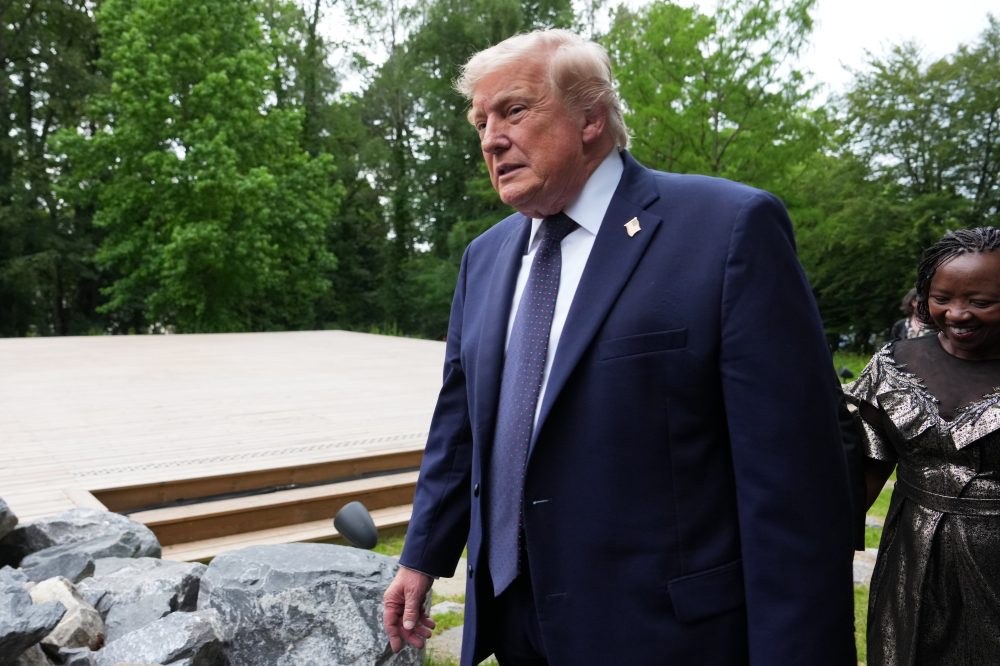
When reporters asked President Donald Trump on Tuesday at the Group of Seven summit in France why he hadn’t released the terms of the deal, he said he wanted “to get a formal setting first before we do that.”
“I’ll not only release it,” Trump added. “I’ll probably have a press conference and read it to you word by word, so that the press covers it accurately.”
Trump also said he was open to sending any final agreement to Congress for review and approval. “I like the idea, send it to Congress please,” he said. “I mean who wouldn’t approve it?”
However, submitting a nuclear deal with Iran to Congress is not a matter of choice — it is required by law. That law was passed in the wake of the 2015 Iran nuclear agreement negotiated under then-President Barack Obama, which Trump walked away from during his first term. Some congressional aides argue that even the preliminary memorandum of understanding set to be signed Friday would fall under that same congressional review requirement.
The talking points claim the Obama-era nuclear deal, known as the Joint Comprehensive Plan of Action or JCPOA, was never signed. That is only partially accurate and considered misleading. While the agreement was not treated as a formal signed treaty, the foreign ministers who negotiated it did sign a copy as an informal commemorative gesture. More significantly, the JCPOA was formally endorsed by the United Nations Security Council, giving its provisions the force of international law.
“President Trump solved a threat Washington spent forty years managing,” the talking points state. “Iran will never have a nuclear weapon.” Copies of the document were provided to the AP by a congressional aide and an outside government adviser.
Iran has long maintained it has no interest in building a nuclear weapon. However, many critics of Tehran question that stance, pointing to data from the International Atomic Energy Agency showing the country holds 440.9 kilograms — roughly 972 pounds — of uranium enriched to 60% purity, which is just a short technical step away from the 90% enrichment level needed for weapons-grade material.
The talking points also assert that “the Strait of Hormuz is open again, and energy prices American families pay every day are coming down,” and that “American families no longer have to fear a nuclear-armed Iran” and will feel relief “at the pump and at the grocery store.”
In reality, the Strait of Hormuz — through which one-fifth of the world’s oil flowed before the conflict — had been open to all shipping until February 28, when the U.S. and Israel launched attacks on Iran. That means reopening the strait would simply restore conditions to what they were on February 27, before the costly military campaign began. A return to normal shipping could take weeks or even months.
Consumer prices only rose after the war started and oil shipments through the strait were disrupted by Iran, which has insisted it will maintain control over access to the waterway regardless of any agreement.
The talking points also state that Iran will not receive U.S. taxpayer money as part of any eventual nuclear deal and will only gain financial benefits if it meets specific benchmarks. They suggest the 2015 Obama nuclear agreement cost American taxpayers billions of dollars. In fact, the financial relief provided to Iran under that deal came from frozen Iranian assets — not from the U.S. Treasury.
The document also references “the pallets of cash” the U.S. sent to Iran following the JCPOA. That cash shipment actually came from an Iranian payment made for a canceled arms sale to the government of the late Shah of Iran and had nothing to do with the nuclear agreement. It was part of a separate prisoner exchange that resulted in the release of American citizens held in Iran and several Iranians who had been imprisoned in the United States.
On Lebanon, the talking points declare that the agreement “ends military operations on every front” and includes, “for the first time,” a commitment covering Lebanon and the sovereignty of both Israel and Lebanon.
But Hezbollah, the Iranian-backed militant group active in Lebanon, has not been part of the U.S.-brokered talks between Israel and Lebanon and has rejected any outcomes from those negotiations. Israeli officials have also stated they will not consider themselves bound by the terms of the tentative U.S.-Iran agreement and say they have not been told what is in it.
“We’re less encouraged about the fact that it seems that Lebanon has been included in the agreement with Iran,” Israeli Ambassador to the U.S. Yechiel Leiter told NPR. “And we think that that’s unnecessary and unhelpful.”
A senior U.S. official, speaking anonymously on Monday to brief reporters on the broad outlines of the unreleased agreement, said that Israel withdrawing from Lebanon was not a condition of the memorandum of understanding.