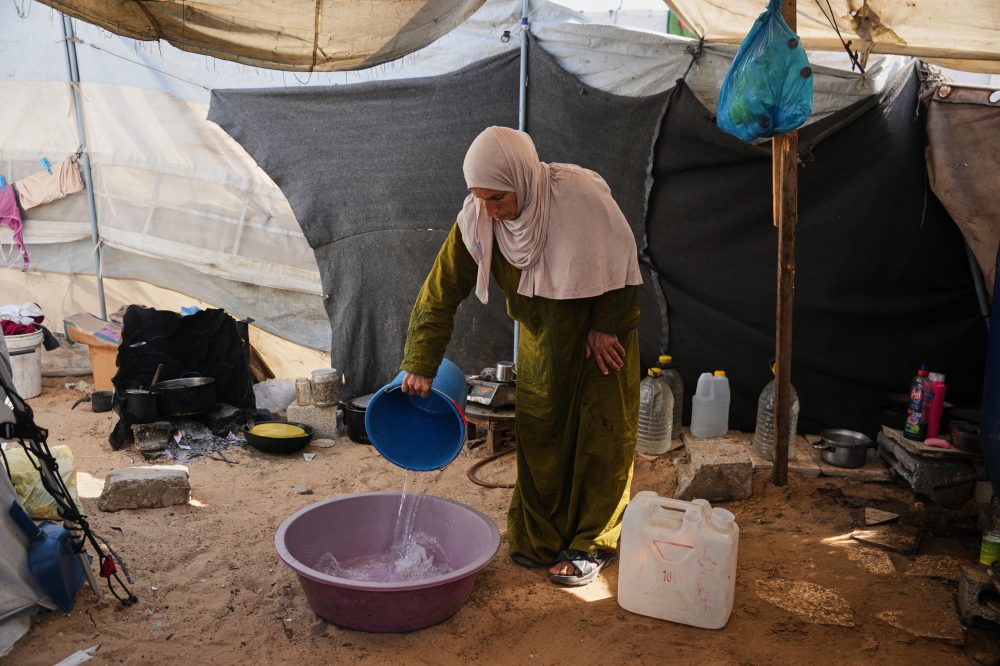

DEIR AL-BALAH, Gaza Strip — The sound of approaching water trucks sends the Abu Daqqa family into action, rushing to fill whatever battered plastic containers they can find, each marked with their family name to avoid confusion in the chaos that follows.
Yehia Abu Daqqa carefully divides the precious resource among her children, allowing just one container per child and carefully pouring small amounts into a sippy cup for her daughter outside their temporary shelter in Muwasi, a massive tent settlement now home to hundreds of thousands of displaced Palestinians.
“The water truck arrives, and some 500 to 1,000 people throw themselves at it,” Abu Daqqa said. “They start fighting. It’s real suffering.”
The ongoing water crisis has plagued Palestinians for over half a year since the ceasefire agreement between Israel and Hamas brought an end to most combat operations in Gaza. United Nations officials report that nearly 90% of the territory’s water systems were demolished during the conflict, including facilities that remove salt from seawater and plants that process sewage.
Prior to the conflict, both government agencies and private businesses supplied water through truck deliveries and underground pipeline networks. Wastewater moved through underground pipes to processing centers. Rebuilding this infrastructure remains a top priority for Gaza’s recovery efforts, though progress has stalled as Israel insists Hamas must completely give up its weapons first.
The WASH Cluster, a UN-coordinated group of humanitarian organizations working on water and sanitation issues, calculates that roughly 80% of Gaza’s population depends on truck-delivered water at central pickup locations. For resident Azmy Abu Lehya, this means walking more than 500 meters to his neighborhood’s distribution site, sometimes successfully obtaining water to carry back through Muwasi, and sometimes returning empty-handed.
“On two days, the water trucks come, and on the other two days, they don’t,” he said.
Israeli officials state they no longer impose restrictions on water imports. COGAT, the military organization handling humanitarian matters in Gaza, claims it has facilitated pipeline access to provide adequate water for sanitation, sewage treatment, drinking, and washing purposes, and has not restricted bottled water imports.
However, Palestinians report that bottled water — primarily delivered by private companies and sold in local markets — costs far more than most can afford, especially with Gaza’s economy devastated and residents unable to find employment or reliable income sources.
Muwasi resident Sharif Abu Helal avoids even looking at water bottles in his local market because he knows they’re beyond his financial reach.
“I am not ready to buy each person a bottle of water,” he said. “I have eight people. Is a gallon of water enough for them?”
Numerous materials essential for water cleaning and transportation — including pipes, fuel, cement, and chemicals like chlorine — fall under Israel’s “dual use” category and face restrictions due to concerns they might be converted into weapons or missile components.
Water access problems and shortages have been a constant challenge throughout the Gaza conflict, with pipeline systems destroyed, water delivery trucks struck by military attacks, and unexploded ordnance contaminating underground water sources that supply many wells.
In a water and sanitation assessment released this week, Doctors Without Borders (MSF), a humanitarian organization, charged Israel with weaponizing water access, “systemically depriving” residents in what they describe as a “campaign of collective punishment.” Similar charges have been made by other organizations, including Human Rights Watch.
“While Gazans are deprived of water and sanitation, Israeli authorities are using aid as a tap, closing or opening slightly to allow only drops of aid to enter the Strip,” the report said.
MSF ranks as Gaza’s second-largest water provider. Drawing from interviews conducted in late 2025 following the October ceasefire, the organization reported that Israel frequently prevented essential infrastructure components like water pumps from entering Gaza, forcing aid workers to repair old or broken parts to maintain desalination and water treatment systems. According to MSF, water shortages create widespread problems for Gaza’s 2.1 million residents, leading to sewage system failures, sanitation breakdowns, and increased rates of water-related and hygiene-related diseases.
“Israeli authorities know that without water life ends, yet they have deliberately and systematically obliterated water infrastructure in Gaza, while consistently blocking water-related supplies from entering,” said Claire San Filippo, MSF emergency manager.
While the report focused on past conditions rather than current circumstances, the organization urged Israel to permit entry of water and sanitation materials, noting that restrictions continue: “There are also not enough pipes available to create distribution networks,” the report said.
COGAT firmly rejected the MSF report’s accusations, calling them “a desperate attempt to regain legitimacy.” The organization stated that Israel permits over 70,000 cubic meters of water — approximately 33.3 liters (8.8 gallons) per person — to enter daily. Humanitarian organizations estimate individuals require at least 15 liters (4 gallons) daily for cleaning, washing, drinking, and bathing needs.