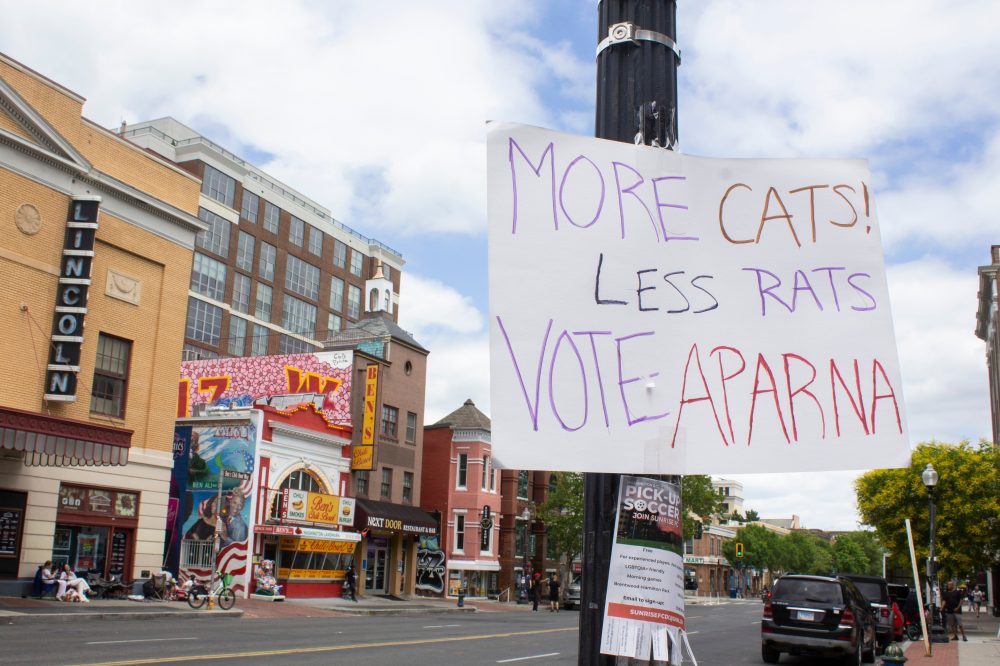

Washington, D.C., is heading to the polls Tuesday for a districtwide primary unlike anything the nation’s capital has seen before — one shaped by federal intervention, a wave of open seats, and a brand-new way of casting ballots.
Three major factors are setting this election apart. First, President Donald Trump’s ongoing and unprecedented involvement in how the district operates has become a central issue in the campaign. Second, a rare combination of top offices being open at the same time has created a domino effect of candidates shuffling for position throughout the ballot. Third, voters will be using a ranked choice voting system for the first time in D.C. history.
The Democratic primary for mayor is drawing significant attention, with Ward 4 Councilwoman Janeese Lewis George, former At-Large Councilman Kenyan McDuffie, and five additional candidates vying for the nomination. The endorsements each candidate has secured reveal a clear divide between the party’s establishment wing and its progressive base.
Lewis George has earned the support of four fellow council members, including at-large member Robert White, who is himself running for the district’s congressional seat. She has also received backing from several left-leaning organizations, including the Working Families Party, the Metro D.C. Democratic Socialists of America, and Our Revolution, a political committee connected to allies of independent Vermont Sen. Bernie Sanders, who aligns with Democrats in Congress.
McDuffie’s list of supporters reads more like a who’s who of D.C. political history. Former Mayors Sharon Pratt and Anthony Williams have endorsed him, as have outgoing At-Large Councilwoman Anita Bonds, former longtime Councilwomen Charlene Drew Jarvis and Linda Cropp, former U.S. Attorney General Eric Holder, and former Democratic National Committee Chairmen Tom Perez and Jaime Harrison.
Retiring three-term Democratic Mayor Muriel Bowser has stopped short of making a formal endorsement, but her preference has been anything but hidden. At an Economic Club event in 2025, she reportedly said, “if you like me, you’re going to love Kenyon, wink, wink,” according to NBC4 Washington. Then at a June Axios Live event, she stated, “I support Kenyon McDuffie, and I have always supported Kenyon McDuffie” — though she insisted she was not officially endorsing anyone.
Bowser has faced a difficult balancing act since Trump returned to the White House in 2025, trying to lead a heavily Democratic city while having limited power to govern independently. Progressives have criticized her for not pushing back harder against the Trump administration. On the campaign trail, Lewis George has taken indirect shots at unnamed leaders she accuses of “complying in advance” and who “shrink in the face of injustice.”
Trump himself entered the conversation Thursday, suggesting he would look at a federal takeover of the District of Columbia if Lewis George wins the mayoral race — a threat he has floated in various forms since the start of his second term.
In the race for D.C.’s non-voting seat in Congress, White, Ward 2 Councilwoman Brooke Pinto, and three others are competing to succeed retiring 18-term Democratic U.S. Del. Eleanor Holmes Norton.
Norton’s and Bowser’s retirements have created a situation not seen since 1990 — both the mayor’s office and the congressional seat are open in the same election cycle. That has triggered a chain reaction of open council seats as incumbents reach for higher office.
Washington is an overwhelmingly Democratic city. Registered Democrats outnumber Republicans by nearly 15 to one, and the district has not supported a Republican presidential candidate since it first gained the right to vote in presidential elections in 1964.
Despite those lopsided general election results, the district has significant internal divides along socioeconomic lines. Ward 3 in the wealthy upper Northwest has the highest concentration of white residents, the highest median income, and the lowest poverty rate. Ward 8 in Southeast has the largest Black majority, the lowest median income, and the highest poverty rate.
Historical voting patterns show a consistent east-west split. When Bowser first won the Democratic mayoral primary in 2014, she carried the five westernmost wards while incumbent Mayor Vincent Gray held Wards 5, 7 and 8 to the east. White’s only competitive council primary in 2016 followed a similar pattern, with him winning western wards and running nearly even in Ward 4. When he ran against Bowser for mayor in 2022, he carried only Ward 1, which covers the center of the district and includes Adams Morgan, Columbia Heights, Mount Pleasant, and the U Street Corridor. In McDuffie’s successful 2022 council race, his strongest showings came from the northwesternmost sections of Wards 3 and 4.
Tuesday’s election marks the debut of ranked choice voting in Washington, D.C. Under this system, voters list candidates in order of preference rather than choosing just one. If no candidate earns a majority of first-choice votes, the last-place candidate is eliminated, and those ballots are redistributed based on the voters’ next choices. The process continues until one candidate reaches a majority.
Here is what to know about how the results will unfold:
Polls close at 8 p.m. ET. The Associated Press will provide vote counts and declare winners in contested primaries for U.S. Delegate to Congress, mayor, attorney general, and district council. A special election is also being held to fill a vacant at-large council seat.
Only voters registered with a political party may participate in that party’s primary. Democrats cannot vote in the Republican primary and vice versa. Independent and unaffiliated voters cannot participate in either primary.
As of May 31, Washington had approximately 481,000 registered voters. Of those, about 363,000 — more than three-quarters — were registered Democrats. Roughly 25,000, or 5%, were registered Republicans, and approximately 86,000, or 18%, were not affiliated with any party.
In the 2022 mayoral primary, about 127,000 Democrats cast ballots, representing roughly 26% of registered voters. About 92,000 Democrats voted in the 2024 primary for U.S. delegate.
In the 2024 primary, about 78% of all voters cast ballots early in person or by mail — slightly above the 76% who did so in 2022. As of Wednesday, approximately 35,000 ballots had already been submitted ahead of Tuesday’s election.
Early in-person and mail ballot results will be released throughout election night alongside in-person Election Day results. However, mail ballots received on Election Day — whether by mail or drop box — and those received after Election Day with the required postmark will not be included in election night totals.
In the 2022 primary, the AP first reported results at 8:30 p.m. ET, half an hour after polls closed. The final update of that night came at 11:59 p.m. ET, with about 69% of total votes counted.
Because of the ranked choice system, only first-choice vote totals will be available on election night in races where the process is triggered. Additional rounds of counting are expected to be reported by June 21 and June 24, with complete round-by-round results expected on or after June 26. The election is scheduled to be certified on July 17.
The AP will only declare a winner when it is certain no trailing candidate can close the gap. If a race remains undeclared, the AP will continue reporting on developments such as concessions or victory claims while making clear no winner has been officially called.
Automatic recounts are triggered in D.C. elections when the margin falls below 1% of the total vote in races for federal office, mayor, attorney general, and district council, among others. Candidates may also request and pay for a recount regardless of the margin. The AP may still declare a winner in a recount-eligible race if the lead is determined to be too large to be overturned.
Tuesday’s primary comes 140 days before the 2026 midterm elections.