
BANGKOK (AP) — Stock markets across Asia showed varied performance Tuesday following a significant downturn on Wall Street, where investors heavily sold shares of companies viewed as vulnerable in the artificial intelligence competition.
Meanwhile, U.S. market futures showed upward movement and crude oil prices increased.
Japan’s Nikkei 225 jumped 0.9% to reach 57,354.14, driven by advances in semiconductor-related companies. Chip testing equipment manufacturer Advantest climbed 4.6%, while machinery producer Disco Corp. gained 2.2%.
Chinese mainland markets rose more than 1% as trading resumed after a week-long holiday break, though Hong Kong’s Hang Seng declined 1.9% to 26,564.01 as investors took profits from recent increases.
Shanghai’s Composite index advanced 1.2% to 4,129.78.
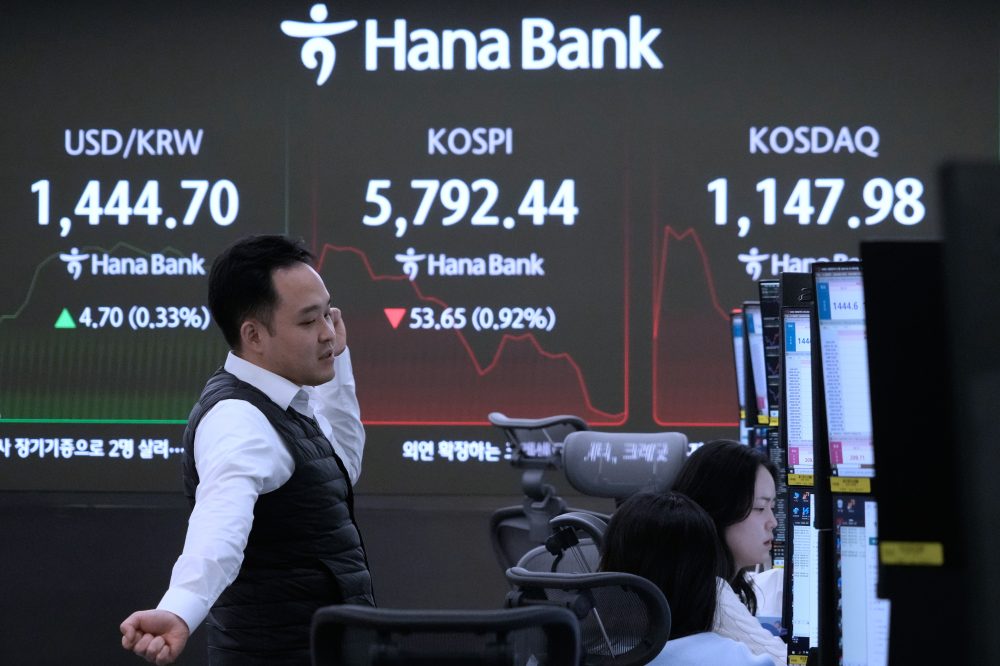
South Korea’s Kospi surged 1.8% to 5,951.90, reaching new record highs boosted by Samsung Electronics, which jumped 3.2%. Fellow chipmaker SK Hynix climbed 4.8%.
Australia’s S&P/ASX 200 dipped 0.1% to 9,014.50, while Taiwan’s Taiex rose 2.4%. India’s Sensex dropped 0.3%.
President Donald Trump’s State of the Union address is scheduled for Tuesday.
Monday saw U.S. markets decline after Trump announced his latest tariff measures.
The S&P 500 dropped 1% to 6,837.75 following Trump’s announcement of temporary 15% tariffs on other nations, coming after a Supreme Court decision rejected his comprehensive “reciprocal” import taxes from worldwide sources.
The Dow Jones Industrial Average fell 1.7% to 48,804.06. The Nasdaq composite declined 1.1% to 22,627.27.
Trump’s rapid implementation of more aggressive tariff policies demonstrates the continued uncertainty surrounding the global economy, despite the Supreme Court ruling that the president lacks legal authority for his broad “reciprocal” tariff plan.
Market analysts suggest it may require considerable time and additional legal challenges before greater clarity emerges regarding future global trade patterns.
Wall Street experienced major declines in companies suspected of facing threats from AI-powered competitors.
CrowdStrike dropped 9.8%, expanding its year-to-date losses to 25.3%. A new Anthropic tool that examines codebases for security weaknesses and recommends targeted software fixes for human evaluation has impacted cybersecurity industry stocks.
AppLovin plummeted 9.1%, bringing its yearly decline to 43.5%. The company joins other software firms affected by concerns that AI competition will capture customers and fundamentally transform their sectors.
Additional significant Wall Street movements may occur this week, especially with Nvidia’s earnings report scheduled for Wednesday.
Growing concerns suggest that companies such as Alphabet and Amazon may be investing so heavily in Nvidia’s processors that they won’t recover their investments through enhanced productivity and future earnings.
In other Wall Street activity, airline stocks declined after severe snow and strong winds led to thousands of flight cancellations throughout the busy Northeast region.
United Airlines lost 5.2%, American Airlines fell 4.9%, and Delta Air Lines dropped 3.7%.
Novo Nordisk’s U.S.-traded stock plummeted 16.4% after the Danish pharmaceutical company reported that its CagriSema drug trial showed participants lost less weight after 84 weeks compared to a comparable treatment from competitor Eli Lilly. Eli Lilly’s stock rose 4.9%.
Federal Reserve Governor Christopher Waller stated Monday that it’s a “coin flip” whether the Fed will reduce its primary interest rate at the March meeting or maintain current levels.
This represents a significant change from January, when he was among two Fed governors who opposed the central bank’s decision to keep rates unchanged after three rate reductions at year’s end.
Reduced rates would stimulate economic growth, and Trump has strongly advocated for them. However, they could also risk increasing inflation.
In early Tuesday trading, U.S. benchmark crude oil rose 57 cents to $66.88 per barrel. Brent crude, the global standard, increased 59 cents to $71.70 per barrel.
Oil prices have been rising due to concerns that President Trump might pursue military action against Iran.
The U.S. dollar strengthened to 155.16 Japanese yen from 154.66 yen. The euro weakened to $1.1775 from $1.1786.
Bitcoin’s price fell 2.4% to $63,330.