
Authorities in northeastern Congo deployed tear gas and fired warning shots during violent clashes over burial arrangements for a footballer suspected of dying from Ebola, according to witnesses.
The confrontation occurred in Rwampara, a community severely affected by the current Ebola outbreak involving the Bundibugyo strain, which has no approved vaccine or treatment available.
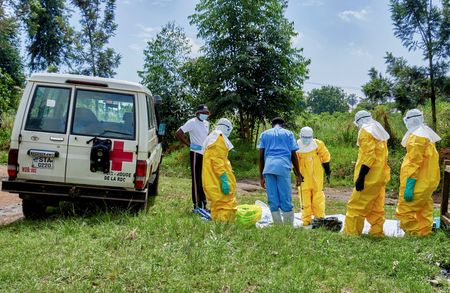
The incident underscores the challenges Congo officials face in implementing safe burial procedures for confirmed and suspected Ebola cases, which are essential for controlling the disease’s spread.
Ebola victims’ remains are extremely contagious following death, and improper burials where family members touch the body without adequate protection are a primary cause of virus transmission.
The current outbreak began when the first confirmed case died in Bunia, the provincial capital of Ituri, on April 24. The infection spread after his remains were transported to the neighboring community of Mongbwalu, where funeral attendees gathered around and touched the body.
On Thursday morning, relatives of footballer Eli Munongo Wangu rejected safe burial procedures, challenged claims that the virus caused his death, and insisted on taking possession of his remains, witnesses reported.
Munongo had competed for multiple local teams and was recognized throughout his community. He had been hospitalized several days prior to his death. A medical professional confirmed to reporters that he was considered a suspected Ebola case and that the hospital had collected samples for testing.
“I believed my son had died of typhoid fever, not Ebola,” his mother stated.
Family members, friends and community residents assembled outside the medical facility demanding to retrieve his body for their own burial ceremony, violating explicit orders requiring safe burial procedures for all deceased, according to Jean-Claude Mukendi, a senior police officer overseeing security for the outbreak response in Ituri.
Military personnel initially attempted to calm tensions before police stepped in, deploying tear gas and firing warning shots to scatter the gathering, witnesses confirmed.
The crowd subsequently ignited two treatment tents equipped with eight beds operated by medical charity ALIMA, Mukendi reported, until additional army and police units arrived to restore order.
The tents were completely destroyed by fire, along with one body scheduled for burial that day. Six patients who were receiving care in the tents are now being treated at the hospital, ALIMA confirmed in an official statement.
Batakura Zamundu Mugeni, a local traditional leader who witnessed the events, said officials are collaborating with health workers to locate any patients who may have escaped and to trace their contacts.
Mukendi attributed the violence to “young people who do not grasp the reality of the disease.”
Public suspicion and false information have previously undermined Ebola response efforts in Congo. During the 2018-2020 outbreak in North Kivu province, armed groups and civilian protesters attacked hundreds of health facilities. That outbreak became the second-deadliest on record, claiming nearly 2,300 lives.
The present outbreak, officially declared by Congo’s government on Friday, has already become the third-largest recorded, with 160 suspected deaths among 670 suspected cases, based on health ministry statistics released Thursday.
Due to the outbreak, Congo’s national soccer team has canceled World Cup preparation activities in Kinshasa and will continue training in Belgium to meet U.S. travel requirements, a team spokesperson announced.