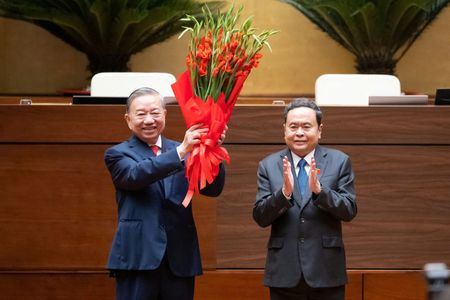

Vietnamese lawmakers made a historic decision Tuesday, unanimously selecting Communist Party Secretary General To Lam as the nation’s state president for the upcoming five-year term, establishing him as Vietnam’s most influential leader in recent decades.
This anticipated decision represents a departure from Vietnam’s long-standing tradition of shared leadership among multiple officials, concentrating power in a single individual in ways experts believe could push the single-party nation toward increased authoritarian control, while potentially allowing for quicker policy implementation similar to neighboring China.
Parliamentary records show that all 495 legislators attending Tuesday’s National Assembly gathering supported the Communist Party’s selection, with five members not present. Government officials indicated that nominations for senior state positions were completed during a late March conference.
The previous public security chief now holds dual authority to govern Vietnam for the coming five years, following his successful bid for a second term as general secretary in January.
In a separate but equally expected development Tuesday, parliament members also gave unanimous approval to Le Minh Hung as Vietnam’s incoming prime minister.
Following the election, Lam addressed legislators in a broadcast speech, expressing gratitude for holding both positions and promising “a new growth model with science, technology, innovation, and digital transformation as the primary driving forces.”
He outlined his main objectives as maintaining national stability, advancing rapid and sustainable development, and enhancing “all aspects of people’s lives.”
“Concentrating greater power in To Lam’s hands could pose risks to Vietnam’s political system, such as increased authoritarianism,” warned Le Hong Hiep, senior fellow at the ISEAS Yusof Ishak Institute in Singapore.
Nevertheless, such power concentration “could enable Vietnam to formulate and implement policies more quickly and effectively,” supporting economic expansion, he noted.
The merger of these two positions “will shift Vietnam’s domestic politics to a new normal where most of the old assumptions about Vietnam’s politics, including those about collective leadership, are no longer valid,” explained Alexander Vuving of the Asia-Pacific Center for Security Studies in the United States.
Lam previously managed both roles temporarily following the 2024 death of former party General Secretary Nguyen Phu Trong.
Even after transferring the state presidency to army general Luong Cuong, Lam continued operating as though he maintained the position, conducting extensive international travel and representing Vietnam in diplomatic meetings with foreign officials.
During his initial term as party leader, the 68-year-old Lam introduced comprehensive economic changes aimed at enhancing Vietnam’s competitiveness, generating both support and opposition.
Lam seeks to achieve double-digit economic expansion through a fresh development approach that reduces dependence on low-cost manufacturing, which has historically anchored Vietnam’s export-focused economic surge driven by international corporations.
His initiatives have occasionally created uncertainty within government circles and business communities, though he has demonstrated practical adaptability in their implementation.
He has endorsed the growth of private business empires, but prior to his reappointment, also released guidance emphasizing state-owned enterprises’ leadership role to satisfy party conservatives.
International investors frequently commend political consistency and view Lam as supportive of business interests. However, his endorsement of domestic champions and pursuit of aggressive growth have sparked concerns among some regarding preferential treatment, corruption possibilities, financial bubbles, and resource misallocation.
Regarding international relations, Lam has continued Vietnam’s “Bamboo Diplomacy” strategy and worked to maintain balanced relationships with major nations while broadening global partnerships.
“Lam’s double-hat would not signal any changes in Vietnam’s foreign policy, even if there are concerns that Vietnam is concentrating more power in a single individual,” stated Khang Vu, a visiting scholar at Boston College.
The newly chosen prime minister Hung, age 55, previously led the central bank from 2016 to 2020, becoming the youngest individual to occupy that role.
He succeeds Pham Minh Chinh, 67, who oversaw a rapidly growing economy during his five-year tenure and became one of Vietnam’s most recognizable leaders domestically and internationally through regular foreign visits and participation in global conferences.
Hung has maintained a reserved public presence in his party and central banking positions.
While lacking formal economics training, Hung’s selection is viewed by some officials as an effort to introduce economic knowledge into senior government levels, which have been primarily filled by politicians with security experience.
In his post-election remarks to lawmakers, Hung committed to pursuing sustainable growth and pledged his utmost effort to achieve the party’s ambitious target of at least 10% annual economic growth through 2030.
He lacks personal security experience, but his family maintains strong connections to the ministry Lam previously headed: Hung’s father served as public security minister, and two siblings hold general ranks in security forces.