
Vietnam’s biggest corporation by market value is pushing forward with an ambitious plan to construct what it describes as the globe’s largest stadium, despite concerns about whether sufficient demand exists to support the enormous venue.
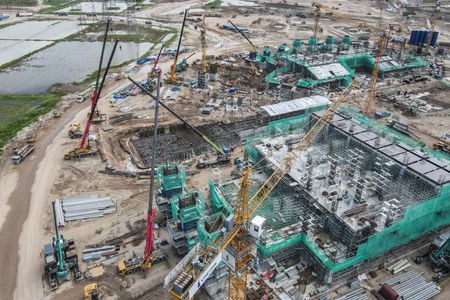
The company is speeding up work on the 135,000-seat facility located approximately 25 kilometers (15.5 miles) south of central Hanoi, with crews laboring continuously to meet a July 2027 deadline, according to a company representative who spoke with Reuters during a recent site tour. This timeline represents a one-year acceleration from the original schedule announced in December.
The venue will boast “the world’s largest seating capacity” and will include the biggest completely retractable roof ever built, according to the Vietnamese conglomerate, which is simultaneously pursuing various other major initiatives including a high-speed rail line, urban development projects, and wind energy facilities.
Currently, the International Olympic Committee recognizes the Rungrado Stadium in Pyongyang, North Korea, as the world’s largest venue, with an official capacity of 150,000, though some analysts have disputed this number and estimated the actual seating at under 120,000.
The Vietnamese company stated that the project’s massive scope reflects ambitions to accommodate major sporting competitions and cultural performances, including musical concerts.
“While football is hugely popular in Vietnam, it is unlikely that a 135,000-seat stadium could be justified on domestic football demand alone,” said James Walton, sports business group leader at Deloitte Asia Pacific. He pointed out that Vietnam’s premier V.League 1 drew an average of fewer than 6,000 spectators per game during the 2023-24 season.
The company refused to provide financial projections but expressed confidence that the facility would achieve commercial viability over time.
The corporation is dealing with significant financial pressures from its debt obligations, which totaled $36.7 billion last year, representing more than 4% of Vietnam’s entire private sector debt in 2025. This amount does not include additional borrowing by privately affiliated entities.
The Trong Dong Stadium, which takes its name from Vietnam’s traditional bronze drum, forms part of the company’s $35-billion initiative to create an “Olympic Sports City” capable of hosting premier international competitions across more than 9,000 hectares (22,200 acres) on the capital’s periphery.
“Being part of a broader urban development can improve the project’s long-term financial sustainability,” said Walton, who observed that most contemporary national stadiums typically accommodate between 60,000 and 80,000 spectators.
This initiative represents part of an extensive campaign to upgrade Vietnam’s infrastructure and maintain economic expansion of at least 10% per year through the decade’s end, which constitutes an official objective of the ruling Communist Party.
Government officials have revealed hundreds of major projects valued at an estimated $200 billion through 2030, encompassing airports, seaports, bridges and rail systems.
Quynh Nguyen, finance lecturer at Hoa Sen University in Ho Chi Minh City, said modernization was essential, but urged careful consideration of banking sector exposure and financing risks.
“In a growing country like Vietnam, infrastructure often needs to precede demand,” said Tran Thi Mong Tuyen, a researcher at the Hawaii-based Pacific Forum, while also highlighting concerns about underutilized infrastructure and postponed investment returns.