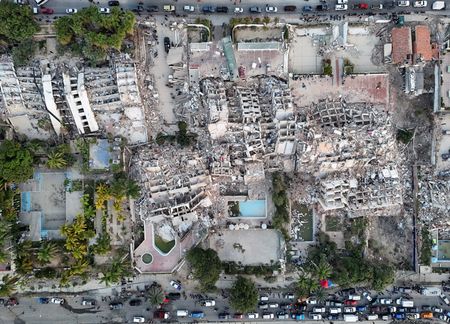

LA GUAIRA, Venezuela — A coastal housing complex built under the late Venezuelan leader Hugo Chávez once represented hope for residents displaced by deadly flooding years earlier. Today, two devastating earthquakes have reduced parts of that same development to rubble, and engineers are demanding the government immediately inspect similar public housing that remains standing.
The 1,100-unit complex, informally called ‘Los Cocos’ after a nearby beach, was partially destroyed when two back-to-back earthquakes struck on Wednesday. Resident Yelsa Rojas, who has lived on the second floor of the building since 2015, returned to find her apartment completely destroyed.
“I lost my whole apartment,” Rojas said. “We think everyone on the second floor is dead.” She survived only because she happened to be at a medical appointment when the quakes hit.
While construction specialists say it is premature to pinpoint the exact reasons individual buildings failed, they believe that years of neglect, poor enforcement of building codes, and questionable licensing practices under both Chávez and his successor, Nicolás Maduro, likely increased the human toll of the disaster. Experts also cited soil instability in La Guaira state as a major contributing factor.
As rescue teams continue searching for survivors in the debris, civil engineers fear other structures may still be at risk. So far, the government has met with the country’s main professional engineering association but has not launched any formal assessments — a delay that is drawing sharp criticism.
“It’s criminal that the government is not taking up offers from engineers and universities more quickly,” said Enrique Larrañaga, an architect and urban planner at Simon Bolivar University who has previously advised the government on national development.
Venezuela’s Communication Ministry did not respond to a request for comment. On Sunday, interim President Delcy Rodriguez announced she was forming a commission to evaluate damaged housing structures, though she gave no timeline for when those evaluations would begin.
The government has also faced criticism for being slow to deploy heavy rescue equipment and search teams in the critical first days after the disaster, leaving residents to dig through wreckage with their bare hands, shovels, and ropes. By Saturday, state television showed heavy machinery sorting through crushed concrete and brick. Residents said foreign rescue teams had helped recover bodies and called for additional support.
Larrañaga said many housing developments were rushed for political reasons and have been safety hazards for years. He also noted that Venezuela lost a significant portion of its engineering expertise during the country’s economic collapse that began in 2013. “They need to give people that have know-how access to information and resources,” he said.
Because the government has yet to begin its own inspections, volunteer engineers have stepped in to assist residents directly, according to Glennys Gonzalez, an architect and civil engineer who is coordinating dozens of professionals. Her group’s early findings suggest building codes were not followed in many instances, but further study is needed to understand why some structures survived while others completely collapsed.
La Guaira has a long history with catastrophic natural disasters. In 1999, mudslides wiped out entire coastal communities in the area, killing between 10,000 and 30,000 people. The region’s geography — steep mountains that drop sharply to a narrow strip of coastline — means floods and landslides tend to funnel directly into populated areas, said Richard Casanova, director of Venezuela’s College of Engineers.
That same geography produces soft soil, Casanova explained, making the area especially vulnerable during seismic events. He drew a comparison to the 2023 earthquakes in Turkey and Syria, where similar geological conditions contributed to the deaths of more than 50,000 people.
Four days after the 7.2-magnitude and 7.5-magnitude earthquakes, Venezuelan officials confirmed on Sunday that at least 1,450 people had died and 3,150 others were injured. Citizen-organized efforts to document the missing have gathered nearly 50,000 names.
Nicolás Labrópoulos, a civil engineer and professor at Universidad Católica Andrés Bello in Caracas, explained that the loose sand, gravel, and debris that makes up La Guaira’s ground can cause seismic waves to slow down but grow more intense, amplifying the shaking felt at the surface. Casanova added that, squeezed between mountains and sea, the soil can become almost fluid during an earthquake, making building there even more dangerous.
Many private buildings in the area also collapsed, likely due to a combination of the same soil weaknesses, years of corrosion, and inadequate quality control, Casanova said. He also noted that older structures may not have been updated to meet stronger codes put in place after a 1967 earthquake. “You can build there,” he said, “but you have to really adhere to strict codes, and given how the government has handled construction over the past two-and-a-half decades, I have my doubts in many cases.”
Following the 1999 disaster, Venezuela updated its construction laws and building codes, Casanova said. The problem, however, has never been the code itself — it has been enforcement.
Chávez’s government began constructing complexes like Los Cocos just before Venezuela’s 2012 elections as part of a broader initiative to build millions of affordable housing units across the country. Maduro continued and expanded the program. But as both leaders consolidated power, institutional oversight weakened, and so did quality controls over new construction and maintenance of existing buildings, according to architects and engineers.
The developments were built rapidly by a mix of government agencies and contractors from China, Turkey, and Belarus, working under military supervision but with little public transparency, according to Gonzalez and Casanova. The lax enforcement of codes in public buildings also sent a signal to private developers that they could cut corners, Casanova said — a stark contrast to countries like Chile, where stricter enforcement has kept earthquake death tolls relatively low.
A magnitude-8.8 earthquake in Chile in 2010 killed roughly 525 people, an outcome widely credited to rigorous building codes. In contrast, a weaker magnitude-7.0 quake in Haiti that same year killed hundreds of thousands.
Reports from multiple organizations and news outlets in recent years have documented corruption and shoddy construction tied to Venezuela’s public housing program, including buildings erected in geologically risky zones and structures showing cracks, leaks, and other serious deficiencies.
“The history of Chávez’s public housing is one of corruption and low-quality constructions built without supervision, inspection or adherence to specific codes in many cases,” Casanova said.