
VATICAN CITY – For more than four centuries, a specialized team of artisans has maintained the vibrant mosaic artwork adorning St. Peter’s Basilica, continuing an ancient craft that transforms tiny colored tiles into stunning religious displays.
The Vatican Mosaic Studio employs twelve skilled artists who not only care for the basilica’s extensive tile work but also craft smaller pieces that serve Pope Francis in what could be called “mosaic diplomacy” – presenting these handmade treasures to visiting world leaders and during papal travels abroad.
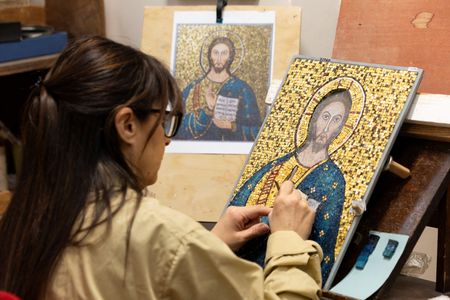
Creating each mosaic requires months of painstaking labor, as craftspeople carefully arrange minuscule colored pieces to form religious imagery of Jesus and Mary, or secular scenes like Rome’s famous Colosseum.
“It is very important today to use the mosaic technique because we are saving the ancient tradition,” studio director Paolo Di Buono explained to reporters.
The artists approach their craft with permanence in mind, knowing their creations will endure for generations. “We have the idea that we are working for something that (is) … almost eternal,” Di Buono noted.
Within the basilica itself, the workshop oversees an impressive 90,000 square feet of mosaic surfaces, including the artwork in the central dome. Church officials chose mosaics over traditional paintings specifically because the tile work better withstands smoke from candles and incense during religious ceremonies.
Among the studio’s recent accomplishments is a papal portrait now displayed at Rome’s Basilica of St. Paul Outside the Walls. Three artists collaborated for five months to complete the image, which incorporates approximately 16,000 separate tiles.
“It is meticulous work because the tiles are very small,” explained Nicoletta Marino, one of the studio’s artists. “It takes a lot of patience.”
Artist Adriano Galise proudly displayed photographs showing his mosaic creations being presented by the late Pope Benedict XVI to former U.S. Presidents George W. Bush and Barack Obama during their official Vatican visits.
“The fact that our mosaics are used as a gift by the pope is one of the most important traditions in the Vatican,” Di Buono emphasized.
Each artist in the workshop employs unique techniques when beginning new projects. Galise typically starts with black-and-white images marked with potential tile placement locations, creating something resembling a complex puzzle blueprint. Other craftspeople prefer beginning with colored photographs or sketches.
Beyond serving as an active workshop, the studio functions as a remarkable historical archive. The facility maintains a collection of 27,000 different colored tile varieties, organized within a massive 9,000-drawer filing system that spans two complete floors.
Approximately 23,000 of these tiles represent historical artifacts – color stockpiles from previous centuries that cannot be reproduced and will eventually be depleted. Some of these antique pieces were manufactured using toxic materials no longer permitted in modern production.
When creating Pope Francis’s portrait, studio artists accessed these archived materials to achieve more accurate facial shading effects.
Currently, team members are working inside St. Peter’s Basilica to restore mosaics in the Clementine Chapel dome, located in one of the church’s most sacred and ancient areas. This grotto sits near the burial site of St. Peter, Christianity’s first pope.
“We preserve the works made by our predecessors,” Di Buono reflected on the studio’s role in maintaining these artistic treasures. “We are connected in a sort of long chain, of which we are the last part.”