
Utah voters are heading to the polls Tuesday to select their party nominees for Congress, doing so for the first time under a newly redrawn district map that carved out a Salt Lake City-based district favorable to Democrats — and threw a wrench into the reelection strategies of the state’s entirely Republican congressional delegation.
The revised congressional boundaries have the potential to produce an additional Democratic seat in the U.S. House, where Republicans currently hold a narrow majority. That majority is already at risk in the 2026 midterm elections, when the party holding the White House historically tends to lose congressional seats.
Utah adopted the new map despite opposition from the Republican-controlled state Legislature. A state court had struck down the lawmakers’ 2021 redistricting plan, which had split Salt Lake City — a Democratic stronghold — among four Republican-leaning congressional districts. The court found that the GOP-drawn map violated a 2018 voter-approved measure aimed at limiting partisan influence in the redistricting process. The Utah Supreme Court upheld that ruling in February, and a Republican-backed effort supported by President Donald Trump to repeal the 2018 anti-gerrymandering law fell short of making the November ballot. The Utah shake-up comes even as Republicans are positioned to gain seats through mid-decade redistricting efforts in other states, also at Trump’s urging.
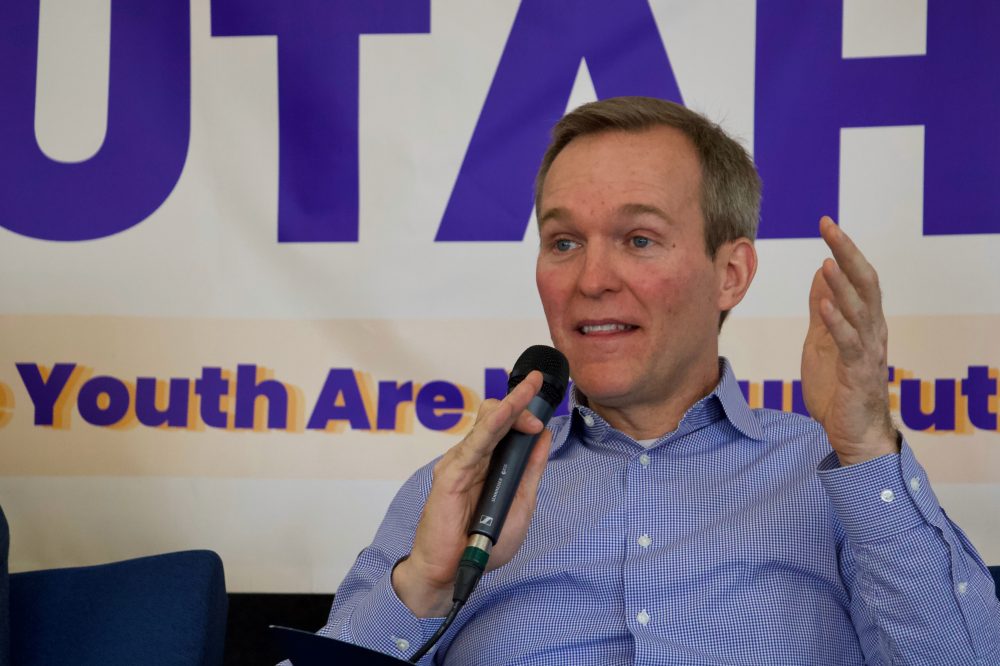
In the newly created Salt Lake City-based 1st Congressional District, former Salt Lake City mayor and former Democratic U.S. Rep. Ben McAdams is attempting a political comeback in a district far more favorable to Democrats than the one he held for a single term at the end of the last decade. McAdams faces state Sen. Nate Blouin, tax attorney Michael Farrell, and former American Heart Association lobbyist and former TikTok and Meta policy analyst Liban Mohamed in the Democratic primary. As of early June, McAdams had raised nearly three times as much as Blouin overall and far outpaced the rest of the field in cash on hand. On the Republican side, Riley Owen is running without opposition. Had this district existed during the 2024 presidential election, former Vice President Kamala Harris would have won it with 60% of the vote.
The new 2nd Congressional District in northwest Utah is the least altered of the four districts, closely mirroring the current 1st Congressional District. Republican U.S. Rep. Blake Moore, who currently represents the 1st District, is seeking a fourth term but faces a strong primary challenge from state Rep. Karianne Lisonbee. At the April state party convention, Lisonbee beat Moore by nearly a two-to-one margin among delegates, though Moore secured a place on the primary ballot through a signature petition drive. Lisonbee has taken aim at Moore for co-chairing the “Better Boundaries” committee that helped pass the 2018 redistricting law, which many Utah Republicans blame for costing their party a congressional seat.
In the sprawling new 3rd Congressional District, which covers southern and eastern Utah, Republican U.S. Rep. Celeste Maloy is fighting off a primary challenge from former state Rep. Phil Lyman as she seeks her second full term. Maloy currently represents the 2nd Congressional District, which overlaps with the new 3rd District in southwestern Utah, but much of the new district along the Colorado border is unfamiliar political territory for her. Maloy narrowly edged out Lyman at the April state convention after two rounds of voting, but the margin wasn’t wide enough to keep him off the primary ballot.
In the new 4th Congressional District, Republican U.S. Rep. Mike Kennedy faces no opposition for renomination. The district largely overlaps with the western portion of Maloy’s current 2nd District — not the eastern half he has represented since 2025. Republican U.S. Rep. Burgess Owens, who currently represents the 4th District in central Utah, chose not to run for reelection. President Trump has endorsed all three Republican incumbents seeking to return to Congress.
Roughly half of Utah’s 29 state Senate seats and all 75 state House seats are also on the ballot in 2026. Republicans hold commanding supermajorities in both chambers.
Polls close at 8 p.m. Mountain Time, or 10 p.m. Eastern Time. The Associated Press will provide results and declare winners in contested primaries for U.S. House, state Senate, state House, and state Board of Education races.
Any registered voter in Utah may participate in the Democratic primary regardless of party affiliation. Only registered Republicans may vote in the Republican primary. Eligible voters may register in person at the polls during early voting or on Election Day. Voters with no party affiliation may register as Republicans at the polls on Election Day to participate in the Republican primary.
As of June 16, Utah had approximately 2.1 million registered voters, including roughly 1 million registered Republicans, about 297,000 registered Democrats, and around 622,000 voters with no party affiliation. In the 2024 Republican state primary, about 427,000 votes were cast. Democratic primary turnout has ranged from roughly 68,000 in the 2024 presidential primary to about 221,000 in the 2020 presidential primary.
Elections in Utah are conducted primarily by mail. As of last Thursday, approximately 163,000 ballots had already been returned, including about 127,000 from Republicans, 32,000 from Democrats, and roughly 2,900 from unaffiliated voters.
Most counties are expected to release a substantial portion of early and mail-in results in the first vote update of the evening. However, in about two-thirds of counties, advance voting results are released alongside Election Day in-person results. In the 2024 state primary, the AP reported its first results at 10:03 p.m. ET — three minutes after polls closed. The final update that night came at 2:07 a.m. ET, with about 74% of votes tallied. The count surpassed 90% two days after Election Day.
The AP will declare a winner only when it determines there is no remaining path for a trailing candidate to overcome the gap. Recounts in Utah are automatic only in the case of a tied vote. A losing candidate may request a recount if the margin is 0.25% of the total vote or less. Tuesday marks 133 days until the 2026 midterm elections.