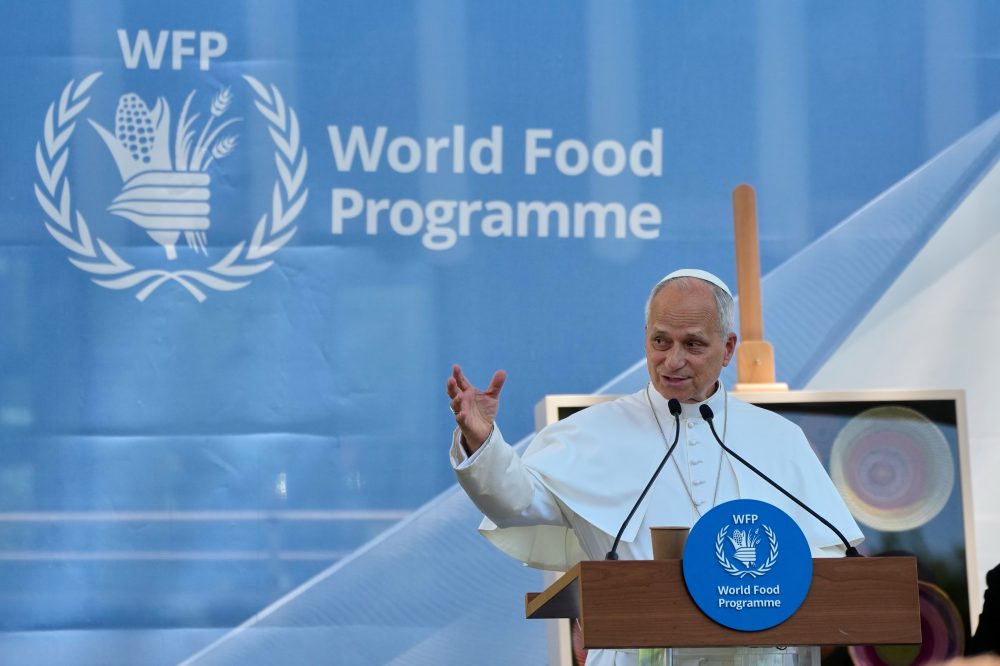

ROME (AP) — Pope Leo XIV delivered a stark message Monday, telling world governments that it has become far easier to sustain wars than to feed the people caught in them. The pope urged nations to free up resources and cut through the red tape blocking food aid from reaching those who desperately need it.
Speaking before the governing council of the U.N. World Food Program in Rome, Leo pushed for the elimination of political and administrative hurdles that slow the delivery of humanitarian assistance while military operations continue without such obstacles.
His message echoed a similar warning delivered by the late Pope Francis during a WFP visit roughly ten years ago. Leo took direct aim at the bureaucratic and ideological forces that he said stand between hungry people and the help meant for them.
“Whereas forms of aid and development projects are obstructed by involved and incomprehensible political decisions, skewed ideological visions and impenetrable customs barriers, weaponry is not,” he said. “In effect, conflicts are ‘fed’ more readily than people are nourished.”
The timing of his appeal is significant. According to a recent WFP report, funding for food assistance has plummeted by roughly 59% since 2022, even as the number of people in need has climbed dramatically.
There was some encouraging news on the funding front last week. The United States announced a pledge of $800 million to the WFP — a contribution the agency says will provide assistance to more than 38 million people across at least 37 countries during a period of unprecedented global need.
Despite that pledge, the WFP’s funding appeal for 2026, which exceeds $10 billion, remains far from fully covered.
For many years, the U.S. Agency for International Development served as the primary engine of humanitarian aid around the world. However, the Trump administration dismantled the agency last year, eliminating $60 billion in overall assistance. Following a policy reset in December, the U.S. has since restored some WFP funding and announced $218 million in support for UNICEF.
Leo described today’s global crises — spanning armed conflict, climate pressures, and economic hardship — as “persistent realities” that have become embedded in the world’s systems. He argued that the international order is not merely failing to address hunger, but is actually perpetuating the conditions that cause it.
The pope painted a picture of a fractured global community where nations increasingly put their own interests ahead of international cooperation, even as hunger continues to drive instability, displacement, and conflict.
He closed with a call for human dignity to be placed at the heart of every major decision made by world leaders.
“Every human person possesses an inherent and inalienable dignity that remains intact regardless of circumstance, condition or social status,” he said.