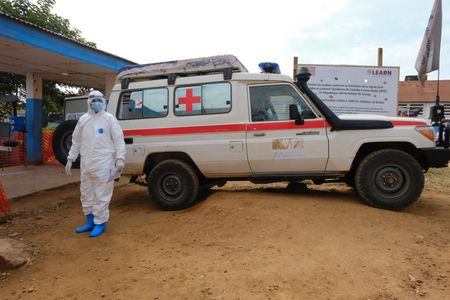

U.S. health officials announced Friday that the country is sending doses of an experimental Ebola treatment to Africa, along with 2,500 diagnostic tests, as an ongoing Bundibugyo ebolavirus outbreak continues to worsen.
The response effort is being led by the Administration for Strategic Preparedness and Response through its Biomedical Advanced Research and Development Authority, known as BARDA. The agencies are coordinating support for the Democratic Republic of the Congo and Uganda, where the outbreak is active.
Unlike some other Ebola strains, the Bundibugyo strain currently has no approved vaccines or treatments available, making experimental options a critical part of the response.
At the center of the treatment effort is MBP134, an experimental monoclonal antibody therapy developed in partnership with Mapp Biopharmaceutical. Doses are being transferred to the affected countries for compassionate use — meaning it can be given to patients outside of a formal clinical trial setting due to the severity of the situation.
Additional doses are also being provided for a randomized clinical trial being conducted by the University of Oxford to formally evaluate how well the drug works.
Officials noted that MBP134 has demonstrated activity against multiple Ebola species in early laboratory studies and has already completed an initial safety trial. Data gathered from its use during the current outbreak could play a role in future regulatory decisions about the therapy.
On the testing front, BARDA has pre-positioned 2,500 rapid diagnostic tests for potential deployment to Africa to help identify infections and guide public health decision-making.
At the same time, BARDA is moving forward with efforts to develop a vaccine specifically targeting the Bundibugyo strain. The agency has issued a request for proposals seeking vaccine candidates built on the same platform used to create Merck’s Ervebo — the first Ebola vaccine approved in the United States, which targets a different strain known as Zaire.