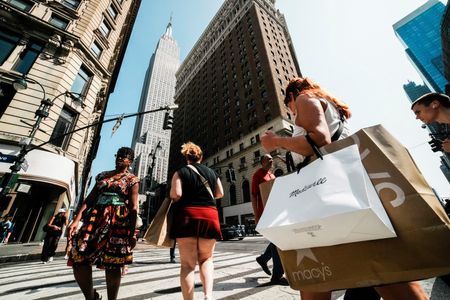

WASHINGTON — American consumers spent more than expected at retail stores in May, though economists are cautioning that the momentum may not last as the financial cushion from tax refunds begins to fade.
The Commerce Department’s Census Bureau announced Wednesday that retail sales rose 0.9% in May, following a downwardly revised 0.4% gain in April. Analysts surveyed by Reuters had projected a more modest 0.5% increase for the month. It’s worth noting that these figures are not adjusted for inflation and primarily reflect spending on goods.
Part of the jump in sales was driven by higher prices at the gas pump, which pushed up receipts at service stations. Gasoline prices had surged to four-year highs during the U.S.-Israeli conflict with Iran, though prices have since pulled back. The national average at the pump dipped below $4 per gallon this week for the first time since April.
On Sunday, the U.S. and Iran announced they had reached an agreement to end the war and reopen the Strait of Hormuz. In addition to easing energy costs, tax refunds and a rising stock market have helped support consumer spending — though that spending has come at the cost of personal savings. The national saving rate fell to a four-year low in April.
Economists at PNC Financial say their internal data analysis found that “households are spending down refunds more quickly than in prior years, with higher gas outlays accounting for much of the difference.” They added that the trend was “especially pronounced for households in the bottom quartile by refund size, which have drawn down more than 60% of their refunds in 2026 versus 43% at the same point last year.”
With the tax filing season now behind us and much of those refunds already spent, analysts expect consumer spending to slow in the months ahead.
A key measure of core retail sales — which strips out automobiles, gasoline, building materials, and food services — rose 0.7% in May after a 0.5% gain in April. This figure is closely watched because it aligns most directly with the consumer spending portion of the nation’s gross domestic product.
Consumer spending makes up more than two-thirds of the overall U.S. economy. It grew at a 1.4% annualized rate in the first quarter, a period when the broader economy expanded at a 1.6% pace. The Atlanta Fed’s GDP tracking tool now shows the economy growing at a 2.8% rate in the current quarter.
As for interest rates, the retail sales report is not expected to shift the Federal Reserve’s approach. The central bank was anticipated Wednesday to hold its benchmark overnight interest rate steady in the 3.50% to 3.75% range. While the chances of a rate hike have grown somewhat as prices rise, most economists do not foresee any policy tightening this year, pointing to declining oil prices as a stabilizing factor.