
Military forces from the United States and Philippines conducted a demonstration of advanced anti-ship missile technology during their yearly joint training exercises on Saturday, positioning the weapons system in a strategically important location near Taiwan.
The demonstration took place in Batanes province, the Philippines’ northernmost region home to approximately 20,000 people. This area sits roughly 100 miles south of Taiwan along the Luzon Strait, a crucial waterway that has become a focal point in the ongoing strategic rivalry between Washington and Beijing for influence across the Asia-Pacific.
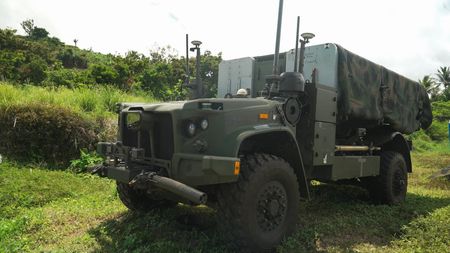
The military exercise featured the NMESIS anti-ship missile system, which was transported to the area aboard a US C-130 cargo plane and set up in Basco, the provincial capital.
“Training out here in Batanes allows us a different environment than what we’re normally allowed to operate in,” said U.S. Staff Sergeant Darren Gibbs. “So it gives us unique opportunities to actually utilize the system and train within our capabilities, and it offers experiences we don’t normally get offered in our day-to-day training.”
According to Gibbs, the NMESIS system operates with significant autonomy. “The purpose of this system is for it to be fully autonomous, for us not to require a driver or passenger inside the vehicle itself,” he explained. “We will tell it where to go and then we program what it needs to do.”
The mobile coastal defense system can engage surface ships from land positions at distances reaching approximately 115 miles, making it a formidable defensive tool for island nations.
Francisco Lorenzo, who serves as the Philippine exercise director, explained to reporters that bringing American weapons like the NMESIS to Batanes serves to evaluate how well such systems can operate in isolated areas. This marks the second consecutive year the missile system has been deployed to Batanes for the exercises.
“It is part of training so as to test the feasibility or rehearse their deployment there when need arises,” Lorenzo stated. He noted that one key goal of the Balikatan exercises – the Filipino term meaning “shoulder-to-shoulder” – involves practicing “defence of our territory with our allies.”
Lorenzo clarified that the missile system would not fire live rounds during the exercises and was brought solely for deployment practice and simulation purposes. The equipment will be removed from Batanes when the training concludes. The US previously brought its Typhon missile system to the Philippines in 2024 for similar joint exercises.
The exercises also included maritime attack training in Itbayat, a Batanes municipality located about 155 kilometers from Taiwan at the country’s northernmost point.
This year’s war games involve more than 17,000 military personnel, with roughly 10,000 coming from US forces, even as America maintains significant military commitments in the Middle East.
Beijing consistently condemns the presence of American military equipment in the Philippines, arguing such deployments increase regional instability.
Chester Cabalza, who leads the Manila-based International Development and Security Cooperation think tank, told reporters that “the NMESIS can spark a powder keg for Beijing and asymmetric deterrence for Manila and Taipei in the Bashi Channel along the Luzon Strait.”
Cabalza noted that the system’s ability to be airlifted and positioned along any Philippine coastline within hours makes it particularly concerning to Beijing, which likely views its Batanes placement as part of a “U.S.-led encirclement” strategy.
Recent months have seen China expand its military activities in both the South China Sea and Taiwan Strait, boosting its naval presence around Taiwan and moving an aircraft carrier through the strait. Satellite imagery analyzed by Reuters also shows China erected a barrier this month at the entrance to Scarborough Shoal.
Philippine President Ferdinand Marcos Jr has acknowledged that any military conflict over Taiwan would force his country to evacuate Filipino workers and residents from the island, potentially pulling the Philippines “kicking and screaming into the conflict.”
Defense Secretary Gilberto Teodoro confirmed in an April 28 interview that Manila has developed contingency plans for evacuating Filipinos from Taiwan should fighting break out, though he declined to provide specifics about those preparations.