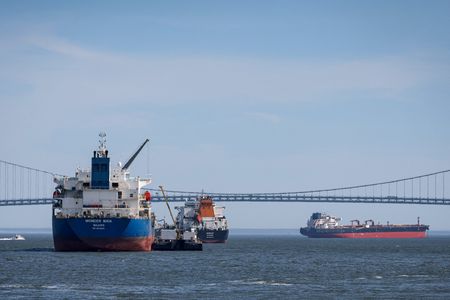

The United States reached a historic milestone last week, coming closer than ever to becoming a net oil exporter since the World War Two era, as international demand for American crude oil reached extraordinary levels.
The surge comes as the ongoing conflict involving Iran and Israel has created massive disruptions in global energy markets. Iranian threats to maritime traffic have effectively blocked approximately 20% of the world’s oil and gas shipments from moving through the crucial Strait of Hormuz passage.
This disruption has forced refineries across Asia and Europe to seek alternative oil sources wherever available, dramatically increasing demand for American crude from the world’s top oil-producing nation.
According to federal data released Wednesday, the gap between oil imports and exports shrank to just 66,000 barrels daily last week – the smallest margin recorded since tracking began in 2001. Meanwhile, American oil exports jumped to 5.2 million barrels per day, marking the highest level in seven months.
Historical records show the last time America was a net oil exporter on an annual basis was 1943.
Janiv Shah, vice president of oil markets at Rystad, explained that the surge in American crude exports demonstrates how buyers from the Atlantic Basin and Asia are casting wider nets for available supplies, with regional price differences justifying transportation costs.
Some countries, including Greece, have purchased American crude for the first time ever in recent months.
Shipping data from Kpler reveals that roughly 2.4 million barrels daily, representing 47% of American exports last week, were destined for Europe. About 1.49 million barrels per day, or 37%, headed toward Asia – an increase from 30% the previous year.
Major purchasing countries included the Netherlands, Japan, France, Germany, and South Korea. Additionally, a tanker carrying 500,000 barrels signaled its destination as Turkey, which would represent the first American oil shipment to that country in at least twelve months.
While exports soared, American oil imports fell by more than 1 million barrels daily to 5.3 million barrels per day last week. The country continues importing substantial amounts of crude because domestic refineries are configured to process heavier, more sulfur-rich grades rather than the lighter, sweeter crude America produces.
The Middle Eastern supply crisis drove the price difference between Brent crude futures and West Texas Intermediate crude futures to as high as $20.69 per barrel last month. This gap reduced American buyers’ interest in imports while making domestic crude more appealing to European and Asian refineries.
Physical crude oil prices for immediate European delivery reached record highs near $150 per barrel Monday, with African crude also hitting new peaks.
Industry experts warn that American exports are approaching maximum capacity limits. Kpler analyst Matt Smith projects exports will reach approximately 5.2 million barrels daily for April, noting that monthly export levels are testing capacity constraints.
Traders and analysts estimate America can export up to 6 million barrels daily, though limitations include pipeline capacity and vessel availability. The country’s export record stands at 5.6 million barrels per day, achieved in 2023.
“The market is already testing the export ceiling with 5.2 million bpd exported last week. Every incremental barrel from here costs more in freight and logistics than the last one,” said Bekzod Zukhritdinov, a Dubai-based oil trader.
Shah noted that releasing medium sour crude from the Strategic Petroleum Reserve could push more light, low-sulfur American crude grades toward export markets. However, he cautioned that tanker shortages and elevated freight costs could limit export demand.
Rohit Rathod, a senior analyst at Vortexa, reported that approximately 80 empty supertankers were traveling toward the Gulf of Mexico as of Wednesday, likely planning to collect crude shipments during April and May.