
SEATTLE (AP) — Despite enormous growth in American soccer over the past 25 years, the U.S. men’s national team has failed to move the needle on the world stage.
Stars like Christian Pulisic, Tyler Adams, and Weston McKennie delivered results at the 2022 and 2026 World Cups that look remarkably similar to what Tim Howard, Michael Bradley, and Jozy Altidore produced back in 2010 and 2014.
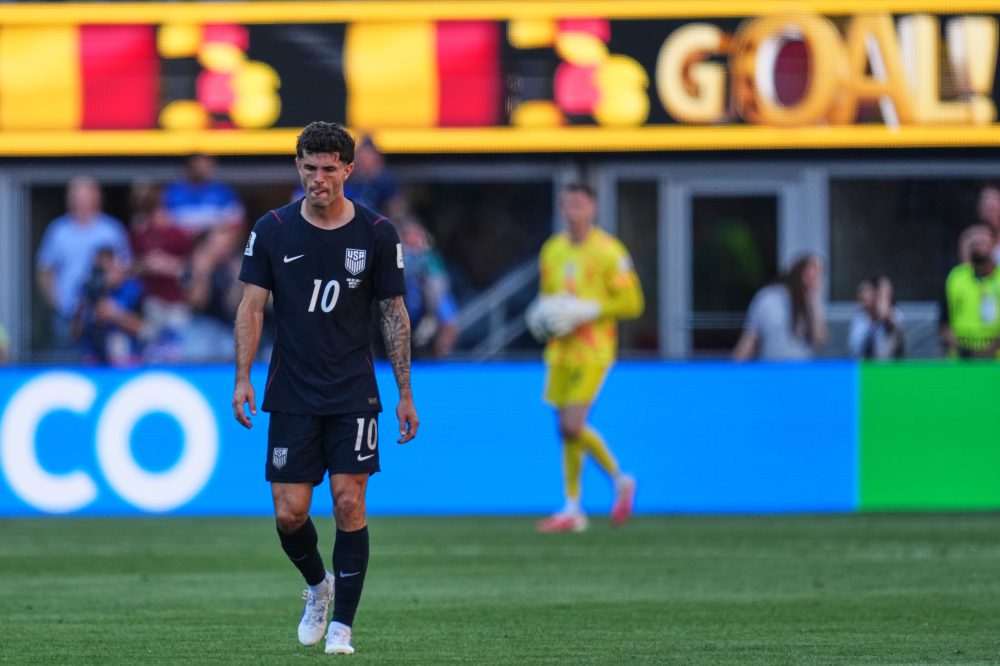
“We want to be able to go and compete with some of the best in the world and we just still have that next step to come,” Pulisic said following Monday night’s error-filled 4-1 defeat to Belgium in the round of 16.
Billions of dollars have been poured into the program with the hope of lifting the Americans into soccer’s elite tier — yet the results tell a different story. After reaching the semifinals of the very first World Cup in 1930, the U.S. failed to even qualify from 1950 through 1990. Since returning to the tournament, the Americans have been eliminated in the round of 16 in 1994, 2010, 2014, 2022, and now 2026. They failed to advance from their group in 1990, 1998, and 2006, and missed qualifying altogether for 2018.
U.S. coach Mauricio Pochettino offered some perspective on the team’s slow progress. “It’s not like you are in a rocket and you improve and you grow. … It’s not linear,” he said.
On a positive note, the U.S. did win three World Cup games for the first time ever, defeating Paraguay, Australia, and Bosnia-Herzegovina, before losing to Turkey and Belgium. As a host nation, the Americans were seeded and avoided facing a top-10 ranked opponent until they ran into Belgium.
Looking ahead to the next World Cup — held in Spain, Portugal, and Morocco with three additional games in South America — Pulisic, McKennie, and Adams will all be 31 years old.
Folarin Balogun was the team’s top scorer with three goals, establishing himself as a legitimate striker on the world stage. The 25-year-old, a former Arsenal youth player now in the fourth year of a five-year deal with French club Monaco, also made international headlines when a red card suspension — issued after he awkwardly landed on an opponent’s ankle — was lifted following a phone call from U.S. President Donald Trump. A move to a bigger club could be on the horizon for him.
Midfielder Malik Tillman made history at this tournament, becoming the first player since France’s Bernard Genghini in 1982 to score two free kick goals in a single World Cup. The 24-year-old is heading into his second year of a five-year contract with German club Bayer Leverkusen, though he struggled for consistent playing time during the 2025-26 season, losing his starting spot between late March and the final match of the season.
Pochettino indicated he plans to sit down with the U.S. Soccer Federation after a rest period to determine whether the federation wants him to continue past his contract expiration this summer — and whether he’s willing to commit to a full four-year cycle.
The Argentine coach took over from Gregg Berhalter in late 2024, following the team’s first-round elimination at the Copa America. His debut year also included disappointing finishes in the CONCACAF Gold Cup and Nations League.
“We were in a mess,” Pochettino said. “I’ve seen this team show that we can play football. We can play soccer. We can compete. That we need keep improving — a lot of young players with a lot potential and future.”
The goalkeeper position, once considered the team’s greatest asset from 1990 through 2014, has become a glaring weakness over the past decade and may be at its lowest point since the 1980s. The era of reliable shot-stoppers like Tony Meola, Kasey Keller, Brad Friedel, Tim Howard, and Brad Guzan feels like a distant memory.
Both Zack Steffen and Matt Turner struggled to cement themselves at top European clubs. Matt Freese, who took over as the starting goalkeeper from Turner last year, handed Belgium a gift goal in Monday’s loss — a moment that will likely live on in blooper reels for years to come.
The next wave of goalkeepers — Gabriel Slonina, Chris Brady, Patrick Schulte, and Roman Celentano — will have the next four-year cycle to prove they can step into the No. 1 role.
With the World Cup field now expanded to 48 nations and North and Central America and the Caribbean receiving six spots, qualifying should remain manageable for the region’s powerhouses: Mexico, the U.S., and Canada. All three were bounced in the round of 16, while Curaçao, Haiti, and Panama each finished last in their respective groups.
If the Americans don’t show significant improvement before the 2030 World Cup, they are unlikely to be seeded — meaning they could face a top-tier nation right out of the gate in the first round.