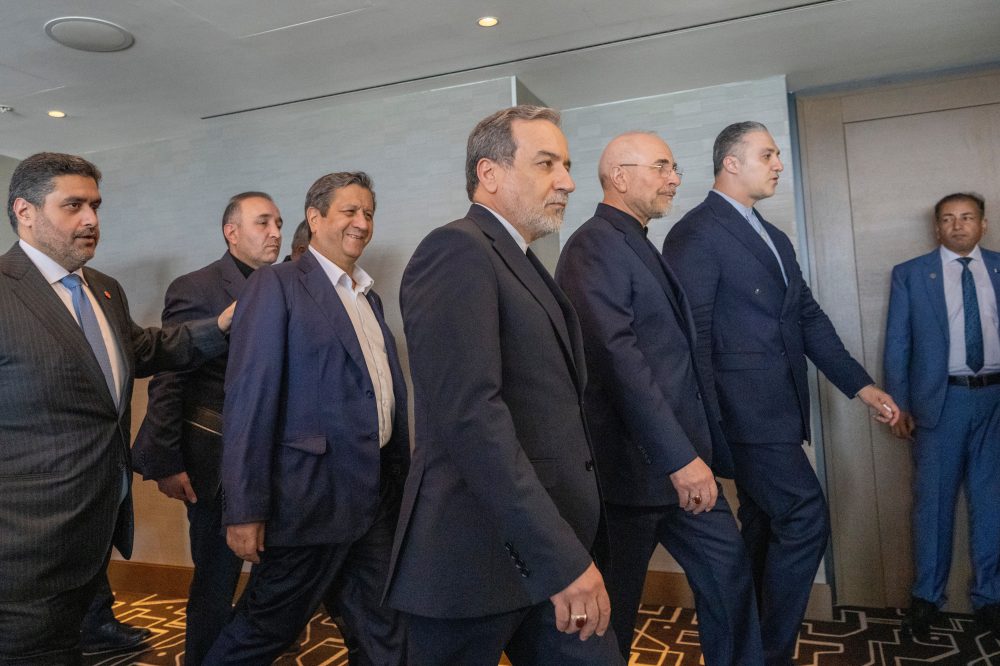

Negotiators from the United States and Iran gathered Monday in Obbuergen, Switzerland for a second day of diplomatic talks, working toward a permanent resolution to the conflict between the two nations following a turbulent opening day.
The mediating countries, Qatar and Pakistan, described the initial round of discussions as showing “encouraging progress.” A senior U.S. diplomat, speaking anonymously due to the sensitive nature of the ongoing negotiations, said headway had been made on several issues — notably the creation of “mechanisms” to keep the Strait of Hormuz open to global energy shipping and to maintain a ceasefire in southern Lebanon.
However, the first full day of negotiations was thrown into turmoil by sharp remarks from President Donald Trump, who was thousands of miles away from the Swiss talks but whose comments drew strong objections from the Iranian side.
Iranian state media reported that the talks were temporarily halted following the “publication of an insulting message by the U.S. President.” The Iranian delegation then met separately with Qatari mediators before leaving the negotiating site, according to state media. The senior U.S. diplomat later said the Iranians had remained on the premises and that talks were continuing.
Iranian President Masoud Pezeshkian had declared he would “never back down from the right to enrich uranium,” state media reported. Trump then told Fox News in a phone interview that Pezeshkian should be careful about his words, and also threatened to take over Iran, according to one of the network’s correspondents.
Trump continued posting warnings to Iran on social media even as negotiators were at the table, writing: “Iran must immediately stop their highly paid PROXIES in Lebanon from causing trouble. If they don’t, we’ll hit Iran very hard again, just like we did last week, only harder!!!”
The American negotiating team includes Vice President JD Vance, special envoy Steve Witkoff, and Jared Kushner, the president’s son-in-law. Iran’s delegation is led by Mohammad Bagher Qalibaf, the country’s parliamentary speaker, and Foreign Minister Abbas Araghchi. Vance told Fox News on Saturday that he expected to remain in Switzerland only a “day or two,” with Kushner and Witkoff managing the bulk of the technical discussions.
In a joint statement, Qatar and Pakistan announced that the high-level portion of the talks had concluded and that technical negotiations would continue in Switzerland for the remainder of the week. The two countries said both sides had agreed to establish a “communication line” to ensure safe passage of vessels through the Strait of Hormuz, as well as a framework for ending the conflict between Israel and the Iranian-backed militant group Hezbollah in Lebanon.
The United States did not immediately respond to the joint statement, while Iran expressed appreciation for the mediators’ efforts. Foreign Minister Araghchi wrote on X that the first “real test” of the negotiations would be whether the new mechanism could actually halt the fighting between Israel and Hezbollah.
Among the topics discussed was Iran’s posture regarding the Strait of Hormuz. Iran’s military claimed it had closed the strait on Saturday in response to ongoing fighting in Lebanon, though U.S. Central Command disputed that claim.
An interim agreement signed last week by the leaders of both countries calls for a 60-day window in which negotiators will work out the future of Iran’s nuclear program. The international community has raised concerns that Iran may be seeking to develop nuclear weapons — something Iran denies. Additional issues, including the status of frozen Iranian financial assets, are also part of the agenda.
While the talks cover a wide range of complex subjects, Iran has made clear its priority is resolving the conflict in Lebanon. A renewed ceasefire there that took effect Saturday appeared to be holding, and Israel’s military announced it would lift movement restrictions for residents near the Israel-Lebanon border on Monday morning. Neither Israel nor Hezbollah is a party to the U.S.-Iran agreement.