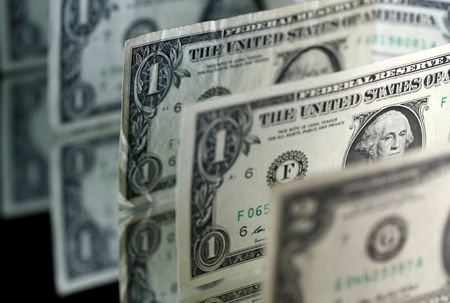

The US dollar experienced significant declines against major world currencies Tuesday following President Donald Trump’s decision to postpone planned military strikes on Iran’s electrical infrastructure, easing concerns about extended conflict in the Middle East region.
In a post on his Truth Social platform, Trump stated that the United States and Iran have had “very good and productive” discussions regarding a “complete and total resolution of hostilities in the Middle East.” Iranian officials, however, have disputed these claims, denying any direct diplomatic engagement.
These conflicting statements have left financial markets uncertain, despite an initial surge following Trump’s announcement of a five-day delay in the planned bombing. Market participants remain concerned about ongoing disruptions to approximately 20% of global oil and liquefied natural gas shipments passing through the Strait of Hormuz due to regional tensions.
The British pound retreated 0.5% to $1.33925 after Monday’s nearly 1% gain, while the euro declined 0.2% to $1.1593 following a 0.4% increase in the prior session.
The dollar index, tracking the US currency against multiple trading partners, climbed nearly 0.2% to 99.35 after reaching close to a two-week low Monday.
“The news overnight is giving a breather to volatility at least, but it’s difficult to see that this is going to trigger a risk-on trend,” said Rodrigo Catril, a currency strategist at National Australia Bank.
Catril noted that Trump’s previous policy decisions have made traders cautious, with uncertainty about whether this represents genuine diplomatic progress or merely stepping back from market-disrupting threats.
The Australian dollar dropped 0.2% to $0.6993 during early trading, retreating from a six-week peak. New Zealand’s currency fell 0.23% to $0.5845.
Crude oil prices moved higher after Monday’s dramatic 10% plunge, with Brent crude futures climbing back above $100.94 per barrel as supply concerns continue affecting market sentiment.
“The key question is whether participants see this as a genuine extension that brings a deal closer, or simply a delay that prolongs uncertainty,” said Chris Weston, head of research at Pepperstone.
“The U.S. dollar has seen selling on the back of the move lower in crude and the broader repositioning in risk. However, there is little conviction in the move, and conditions remain ripe for sharp reversals.”
The Japanese yen held steady at 158.61 against the dollar after Japan reported core consumer inflation of 1.6% in February. This figure fell short of the Bank of Japan’s 2% inflation target for the first time in nearly four years, creating challenges for the central bank’s interest rate policy decisions.