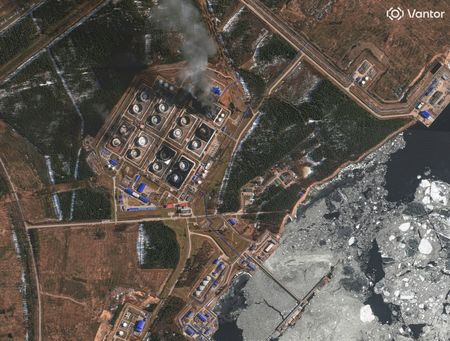

Newly released satellite imagery shows Ukrainian drone strikes have destroyed nearly half of the storage infrastructure at Primorsk, a critical Russian oil export facility on the Baltic Sea, according to data analyzed Thursday.
The attacks represent an escalation in Ukraine’s campaign targeting Russian energy infrastructure, with the heaviest bombardments hitting Baltic Sea ports since the conflict began over four years ago.
Commercial satellite data from U.S. intelligence firm Vantor revealed extensive damage to Primorsk’s storage capabilities by late March. At least eight massive storage tanks, each holding 50,000 cubic meters, sustained significant damage in the strikes.
Industry analysts indicate the destruction represents roughly 40% of the facility’s total storage capacity, potentially forcing major reductions in export operations. The damaged infrastructure plays a crucial role in the port’s logistics operations and directly affects oil shipment capabilities.
Primorsk normally processes approximately 1 million barrels daily, representing nearly 1% of worldwide oil supply. Russian pipeline operator Transneft data shows the main depot houses 14 crude oil storage tanks and four diesel storage facilities.
Industry sources report that two of the eight severely damaged tanks were specifically used for diesel fuel operations. Transneft, which oversees port operations, has not responded to requests for comment.
The nearby Ust-Luga port also faced repeated bombardments throughout March, forcing multiple suspensions of loading operations. Russian regional officials confirmed strikes occurred on March 22, 25, 27, 29, and 31.
Satellite analysis indicates eight petroleum storage tanks at Ust-Luga Oil terminal, each with 30,000 cubic meter capacity, were damaged by fires. This represents approximately 25% of that facility’s total storage infrastructure.
The imagery also revealed damage to several dock facilities at the ports.
Kremlin spokesperson Dmitry Peskov has denounced the bombardments as “terrorist attacks,” stating Russia is implementing measures to safeguard critical infrastructure facilities.
At one point during March, approximately 40% of Russia’s oil export operations were offline due to the attacks, pipeline closures in Ukraine, and seizure of Russian-affiliated tanker vessels.